
Cool Air Again on a Shaded Bayside Lot
Tree cover keeps a Point Washington house shady, and it also drops pine straw and leaves into the outdoor unit while insects move into its wiring. We put gauges and a meter on the system first, then repair the part those readings actually point to.
What moves into the electrical compartment
Every outdoor condenser has a small metal compartment on its side where the wiring lands. Inside sit the run capacitor, which gives the compressor and fan motor their push at startup, and the contactor, the switch that closes when the thermostat calls for cooling. Summer heat is hard on both. A capacitor that has cooked through enough seasons swells, loses strength, and finally leaves the motor humming without turning.
On a wooded Point Washington lot there is a second problem. That compartment is warm and sheltered, and insects love it. Open the side panel on a unit under the pines and this is a normal find: dead roaches across the top of a capacitor and a dried-out frog on the panel next to it. Bodies lying across terminals can short a circuit, and debris packed into a contactor can keep it from closing cleanly, so the unit clicks and does nothing.
None of that is the owner’s fault, and none of it means the system is finished. Usually it comes down to a part, a cleanout of the compartment, and a service panel that seals properly again.
Keeping the critters out for good means finding the way in. Service panels get left loose after a visit, screws go missing, and the gaps where refrigerant lines and wiring enter the cabinet are rarely sealed well. We close those up before we leave, because a fresh capacitor sitting in the same open compartment is only waiting for the next frog.
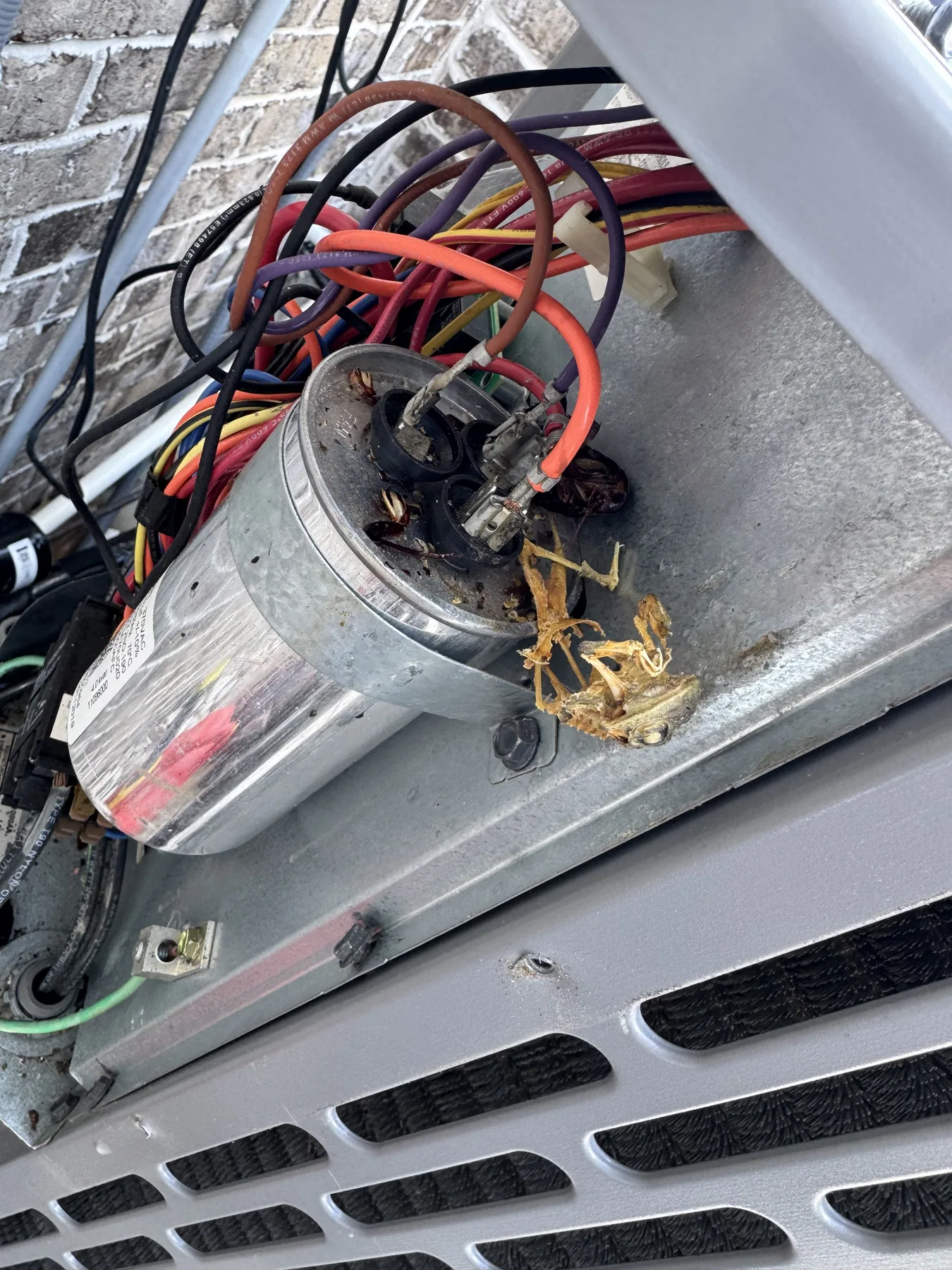
Roaches on a run capacitor and a dried frog on the panel beside it, inside a condenser’s electrical compartment.
A humming unit usually needs a part. It rarely needs a new system.
What the pines drop on the outdoor unit
Shade helps a condenser. A unit sitting out of the afternoon sun sheds heat more easily than one baking on a bare pad. The trees giving that shade also shed, though, and a unit under pines collects needles on its top grille and packs leaves and pollen against its fins. Heat leaves the system as air passes through those fins. Block enough of them and the unit runs longer, pressures climb, and the compressor works harder for less cooling.
Keep a clear space around the sides and pull straw off the top before it mats down. Shrubs planted tight against the cabinet choke it the same way, only slower. After a storm brings branches down, walk out and look.
Being on the bay side does not put a house out of reach of salt. It still rides inland on the breeze and settles on the coil along with the pollen. A gentle rinse from a garden hose, with the system off, washes both out of the fins. Leave the pressure washer in the shed, because it folds fins flat.
Signs worth a phone call
- A low hum from the outdoor unit with no fan turning
- A click at the condenser when cooling is called for, then nothing
- Vent air that feels cool but never properly cold
- Pine straw or leaves matted flat against the coil fins
- A burnt or electrical smell near the outdoor unit
- Drips from the air handler closet, or a stain on the ceiling
- The condenser breaker tripping more than once
Tell us what the unit sounds like
Humming, clicking or blowing warm? Call 850-318-5777 and describe it. We test before we recommend anything, and you hear a straight number before a single part comes off the truck.
- Phones picked up around the clock
- Plumbing CFC1429646 and mechanical CMC1250426
- We repair before we replace
Condensate with nowhere to go
Air conditioning pulls moisture out of the house as it cools, and in this humidity it pulls a lot. That water drips off the indoor coil into a pan and leaves through a small drain line that runs outside or ties into the plumbing. From spring through fall the system barely rests, so the inside of that line stays wet all season. Slime grows in it, and given enough time it closes the line off.
What happens next depends on the equipment. A system with a float switch shuts itself down when the pan fills, which feels like a breakdown and is really a safety doing its job. A system without one lets the pan overflow into the closet or the ceiling below. We clear the line, flush it, and check how it is pitched, since a line that sags holds standing water and clogs again sooner.
On a wooded lot, also look at where the line ends outside, because leaf litter and straw can bury that outlet. Our post on an outdoor AC unit on a wooded lot covers the rest of that yard work.
One call when it crosses into plumbing
Plenty of condensate lines empty into a drain inside the house, and a backup there can look like either trade’s problem. Noah carries the Florida plumbing certification and the mechanical one himself, so the drain, the pan and the air handler all stay with one company and nobody argues over whose side the clog is on. A maintenance plan keeps that line flushed on a schedule, and its price is posted before you ever pick up the phone.
Not sure whether the water in the closet is coming from the AC or from a supply pipe? Switch the system off at the thermostat and give it an hour. Water that slows and stops points to condensate. Water that keeps coming is a plumbing leak, and our leak detection page for Point Washington covers that side of the house.
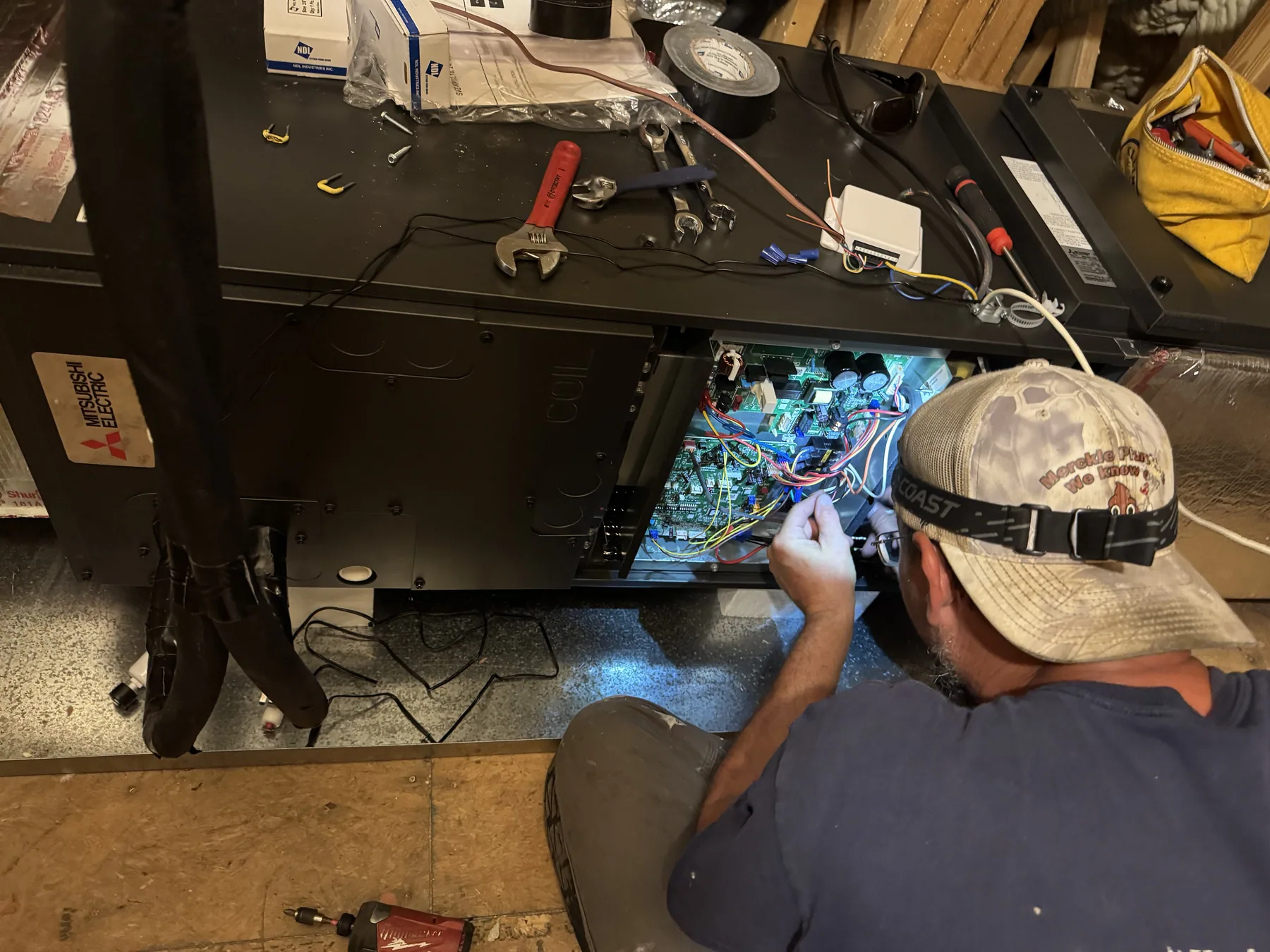
What happens once we’re at the unit
- Open the compartment
Power off, service panel off, and a look for nests, debris, burnt wiring and swollen capacitors before any meter comes out.
- Test the capacitor
A meter reading against the rating printed on its label shows whether it is weak. Plenty of weak ones look perfectly normal.
- Check the contactor
We watch whether it pulls in when the thermostat calls, and whether its contacts are pitted or fouled.
- Temperature split and duct pressure
Air in versus air out at the indoor coil, plus static pressure in the ducts, show whether heat is leaving the house and air is moving.
- Refrigerant pressures
Gauges confirm the charge. A low reading means we look for the leak before anyone adds refrigerant to it.
- Repair or replace, in plain words
If the unit will hold a repair, you get a straight number for it. If it will not, we show you the readings that say so.
Point Washington AC questions we hear
Can bugs really stop an air conditioner?
They can. Insects and small animals crawl into the electrical compartment for shelter, and their bodies end up across terminals or inside the contactor. That can short a circuit or keep the contacts from closing, so the unit hums or never starts. Clearing them out and replacing the damaged part usually fixes it.
How often should I clear pine straw off the condenser?
Whenever you see it collecting, and after any storm that brings needles and leaves down. The goal is a clear path for air through the fins on every side. Brush debris off the top grille with the system switched off, then rinse the coil gently with a garden hose to wash out what is left.
Does a house on the bay side need its coil rinsed?
Yes. Salt carries inland on the wind, so a unit set back from the Gulf still collects some on its fins, along with pollen and fine grit. A soft rinse with fresh water every so often costs nothing and slows the corrosion that eventually turns into a refrigerant leak.
My system shut off and the pan is full of water. What happened?
The condensate drain line has most likely clogged, and a float switch cut the system off before the pan could spill over. It is a common call in this humidity and usually a quick repair. Leave the system off and call, rather than emptying the pan and restarting it over and over.
How do I know if it is the capacitor?
You usually cannot tell by looking, which is why we test it. The common signs are a hum from the outdoor unit, a fan that will not spin on its own, or a compressor that tries to start and gives up. Capacitors hold a charge, so leave the panel closed.
Will you tell me if the system is worth repairing?
Yes, and we would rather repair it. A part, a clogged line or debris in the compartment is a repair. When the readings show the compressor or coil cannot hold one, we walk you through those numbers first, so any decision about replacement stays yours to make.
Other help for a Point Washington house
Point Washington is a normal part of our week, working out of Freeport. If the outdoor unit is humming, clicking or blowing warm, call 850-318-5777 and describe what you hear. You can also send a note with what you have noticed, or look through the gallery for jobs we have finished. The Point Washington page lists everything else we handle nearby.