A Thermostat That Suits Your Actual System
A smart thermostat is only as good as the wiring behind it and the equipment settings inside it. Both take a few minutes to get right and cause months of trouble when they are not.
Installing a smart thermostat looks like a weekend job, and on a straightforward single stage system with a common wire already run, it nearly is. The trouble starts when the wiring at the wall does not match what the new thermostat expects. Older Florida houses often have a four or five wire bundle with no dedicated common conductor, and smart thermostats need continuous power to run a display, a radio and a processor.
The workaround many people reach for is a power stealing setup or an add on adapter at the air handler. Those can work, but done casually they cause the symptoms nobody connects back to the thermostat: a system that cycles oddly, a blower that runs when it should not, a screen that reboots at random, a heat pump that gets stuck in the wrong mode. Running a proper common wire or wiring the adapter correctly avoids the whole category.
Then there is configuration, which matters more than the brand you buy. The thermostat has to be told what it is controlling: single or multi stage cooling, heat pump versus straight AC, whether there is auxiliary or emergency heat, how the reversing valve is energized, minimum run times, and how staging is handled. Get that wrong and the equipment runs inefficiently or short cycles, which in our climate means a house that never dehumidifies properly.
Reasons People Call Us for This
- The thermostat you bought will not power up, or the screen keeps restarting
- There is no C terminal, or the wire bundle at the wall has fewer conductors than the new unit needs
- You have a heat pump and want the auxiliary heat configured so it stops running when it should not
- The house is a rental or a second home and you want to manage temperature remotely
- Multiple zones or multiple systems and you want them all set up consistently
- The current thermostat holds a temperature poorly, or the room it sits in is not representative of the house
Most smart thermostat complaints are wiring or configuration problems, not defective thermostats.
Where These Installs Go Sideways
The missing common wire is the first hurdle. Older thermostat wiring in this area frequently has enough conductors for the basic calls and nothing left over for continuous power. The correct fixes are running new thermostat wire, repurposing an unused conductor in the existing bundle when one genuinely exists, or installing the manufacturer’s adapter at the air handler. What we avoid is leaving a marginal power stealing arrangement that works in mild weather and misbehaves in August.
Heat pump configuration is the second. A lot of homes here run heat pumps, and the reversing valve can be energized in either heating or cooling depending on the manufacturer. Set that backwards and the system blows cold when you call for heat. Auxiliary heat settings are just as consequential, since electric strip heat that engages too eagerly is expensive to run and easy to misconfigure.
Humidity control is the piece most installs skip entirely. Many smart thermostats can extend run time slightly to pull more moisture out of the air, and in a climate with our dew points that setting is worth having on. It costs nothing and makes the house feel better at a higher setpoint, which is exactly the trade you want here.
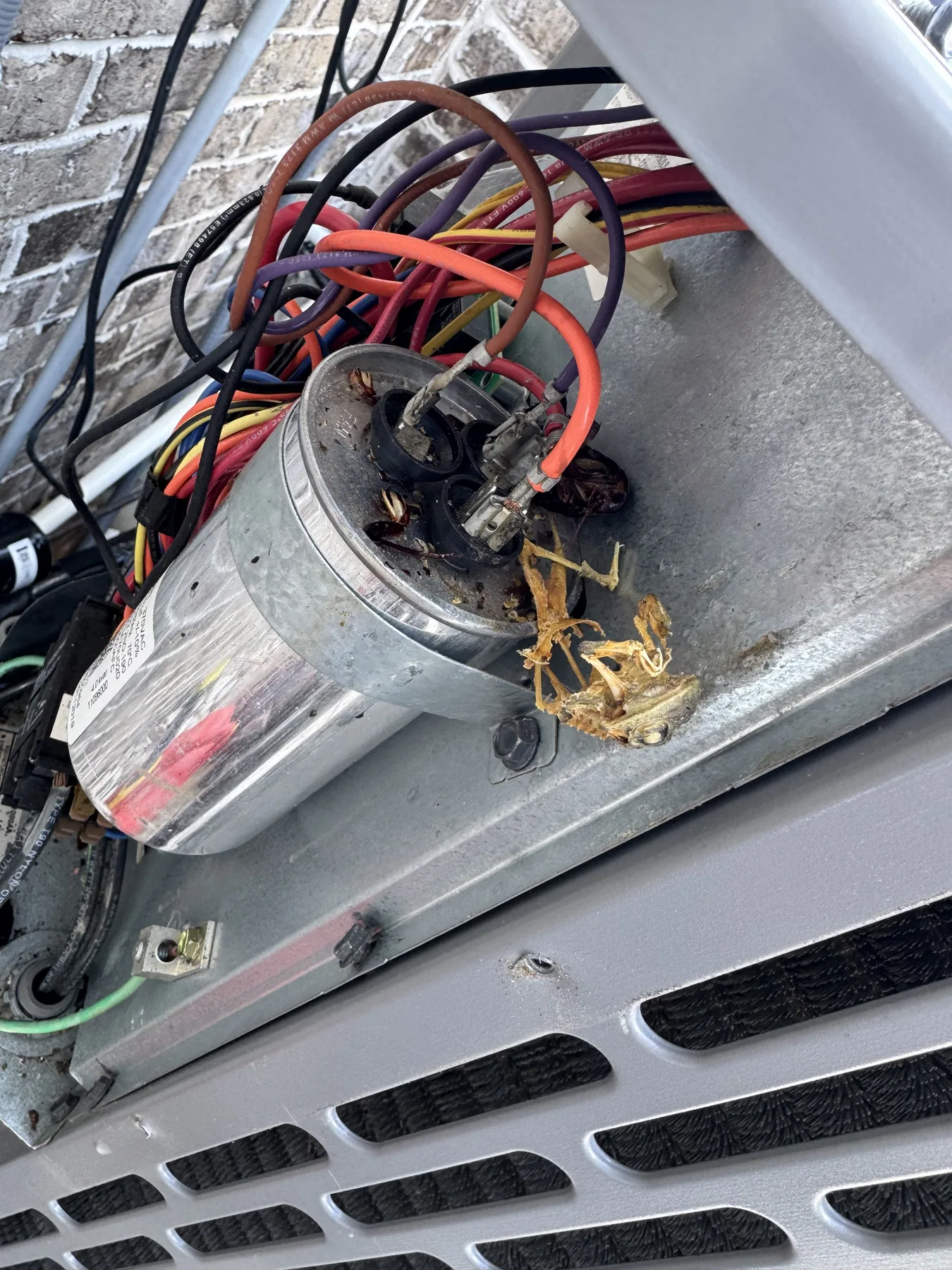
Landing thermostat conductors at the air handler board after running a dedicated common wire.
Get it looked at
Bring your own thermostat or ask us what suits your equipment. Either way it gets wired and configured properly. Call 850-318-5777.
- Answered 24 hours, 7 days
- Licensed CFC1429646 and CMC1250426
- Repair first, always
Think of a maintenance plan like an oil change for your home.
How the Install Goes
- Identify the equipment
We check what you actually have, single stage, multi stage, heat pump, auxiliary heat, zoning, before touching a wire.
- Check the wiring at both ends
The wall and the air handler board both get inspected. If a common wire is missing, we sort out the correct way to supply it.
- Mount and wire the new thermostat
Wires land on the right terminals and get labeled, and the old plate holes get covered properly.
- Configure for your system
Stage counts, heat pump and reversing valve orientation, auxiliary heat lockouts, minimum cycle times, humidity settings.
- Run every mode
Cooling, heating, fan, auxiliary if present, watching the equipment respond at each call before we say it works.
- Set it up with you
Wifi, app, schedules and remote access, plus a plain explanation of the settings we chose and why.
Thermostat Work Across Our Coverage Area
Remote access is a common request in Santa Rosa Beach, Seaside, WaterColor, Grayton Beach, Seagrove Beach, Inlet Beach, Miramar Beach and Destin, where a lot of properties are rentals or second homes. Being able to see indoor humidity from somewhere else is genuinely useful when a house sits empty for weeks in a humid summer.
We do the same work for full time residents in Freeport, Point Washington, Choctaw Beach, Niceville, Valparaiso, Eglin Air Force Base, DeFuniak Springs, Paxton, Ponce de Leon, Westville, Vernon, Ebro, Caryville and Panama City Beach. Call 850-318-5777 and we will book a visit.
Not sure we reach you? Regular stops include Valparaiso, Ebro, Santa Rosa Beach, Destin, Vernon, Point Washington, Niceville, Caryville, Miramar Beach, Eglin Air Force Base and our hometown of Freeport. If your town isn’t named, the full service area list will settle it.
Questions we get about this
Can I supply my own thermostat?
Yes, plenty of customers do. Tell us the model when you book so we can confirm it suits your equipment, particularly if you have a heat pump, multiple stages or zoning. We would rather flag a mismatch before you have opened the box.
What is a C wire and why does it matter?
The common wire completes a circuit that gives the thermostat continuous low voltage power. Old mechanical thermostats did not need it. A smart thermostat with a screen and a wifi radio does, and without one it has to steal power through the equipment, which causes odd cycling and reboots.
Will a smart thermostat lower my power bill?
It can, mostly through scheduling and not conditioning an empty house. We are not going to put a percentage on it because your savings depend on your habits, your equipment and your house. The bigger comfort gain here is usually the humidity setting.
Do smart thermostats work with heat pumps?
Most do, but the configuration has to be right, especially the reversing valve orientation and the auxiliary heat lockout. This is the setting we most often find wrong on thermostats somebody else installed.
Can you install thermostats for a zoned system?
Yes. Zoned systems have a control panel between the thermostats and the equipment, and the thermostats need to be compatible with that panel. We check the panel first, because not every smart thermostat plays nicely with every zone board.
My old thermostat left holes and marks on the wall. Can you handle that?
Smart thermostats are usually smaller than what they replace. We use a trim plate to cover the old footprint, or we patch where a plate would look wrong. It is a small thing, but it is part of doing the job properly.
Related HVAC work
- Air Duct Cleaning
- Air Balancing Analysis
- Duct Leakage Testing
- Duct Sealing
- Mini-Split Installation
- Ductless Mini Splits
- HVAC Maintenance
- HVAC System Diagnostics
- Indoor Air Quality
Not seeing it? The full list is on the HVAC page, or just call 850-318-5777 and describe it. You can also see the work or send a note.