
Fix the Leak, Protect What’s Underneath It
Once the leak’s located, the question is how to repair it with the least disruption to the units and the business around it. Sometimes that’s not the obvious answer.

Repairing a commercial leak is a choice, not a single procedure. A failed section of copper in an accessible ceiling gets cut out and replaced in an hour. The same failure under a slab in an occupied ground-floor unit means either breaking concrete in someone’s space or rerouting the line overhead and abandoning the old run. Both are legitimate, and they cost very different things.
What tips the decision is history. If this is the first failure on an otherwise healthy line, spot repair is almost always right. If the same run has leaked before, or the material is at the end of its life, repairing one spot means coming back for the next one, plus another round of damage to whatever sits below. That’s when rerouting stops being the expensive option.
The other half of the job is containment. In a commercial building, the leak damages the space around it while we work, so drying, protecting finishes, and keeping the affected area sealed off from tenants and customers is part of doing this properly rather than something somebody else handles later.
What you’re likely seeing
- A stain spreading on a ceiling tile or drywall below an occupied unit
- Warm or damp flooring in a specific area of a ground-floor space
- Water surfacing at a wall base or expansion joint
- Baseboard, trim or flooring lifting or separating in one spot
- Persistent musty smell in a room that’s otherwise dry
- A previously located leak that was patched and is wet again
The second repair on the same run usually costs more than the reroute you skipped.
Why the failure happened where it did
Most commercial leaks start at a specific weakness rather than randomly. Joints and fittings take stress from thermal movement every time hot water runs. Sections where a line rubs against a strap, a stud or a slab penetration wear a thin spot over years. Undersized lines carrying high velocity water erode from the inside at every elbow, which is why copper failures cluster at direction changes.
Under slab, the mechanism is different. Copper in direct contact with concrete or damp soil corrodes from the outside, and any small manufacturing flaw becomes a pinhole under decades of pressure. There’s no warning because there’s nothing to see, which is why an under-slab failure usually announces itself as a water bill or a warm floor rather than a drip.
In stacked coastal buildings, one more factor matters: what’s below. A riser leak in a condo, hotel or apartment building doesn’t stay in the unit where it started. Water finds the floor penetration, follows it, and shows up two or three levels down. That’s why a small leak in one unit turns into a claim involving several, and why speed on repair matters more in these buildings than the size of the failure suggests.
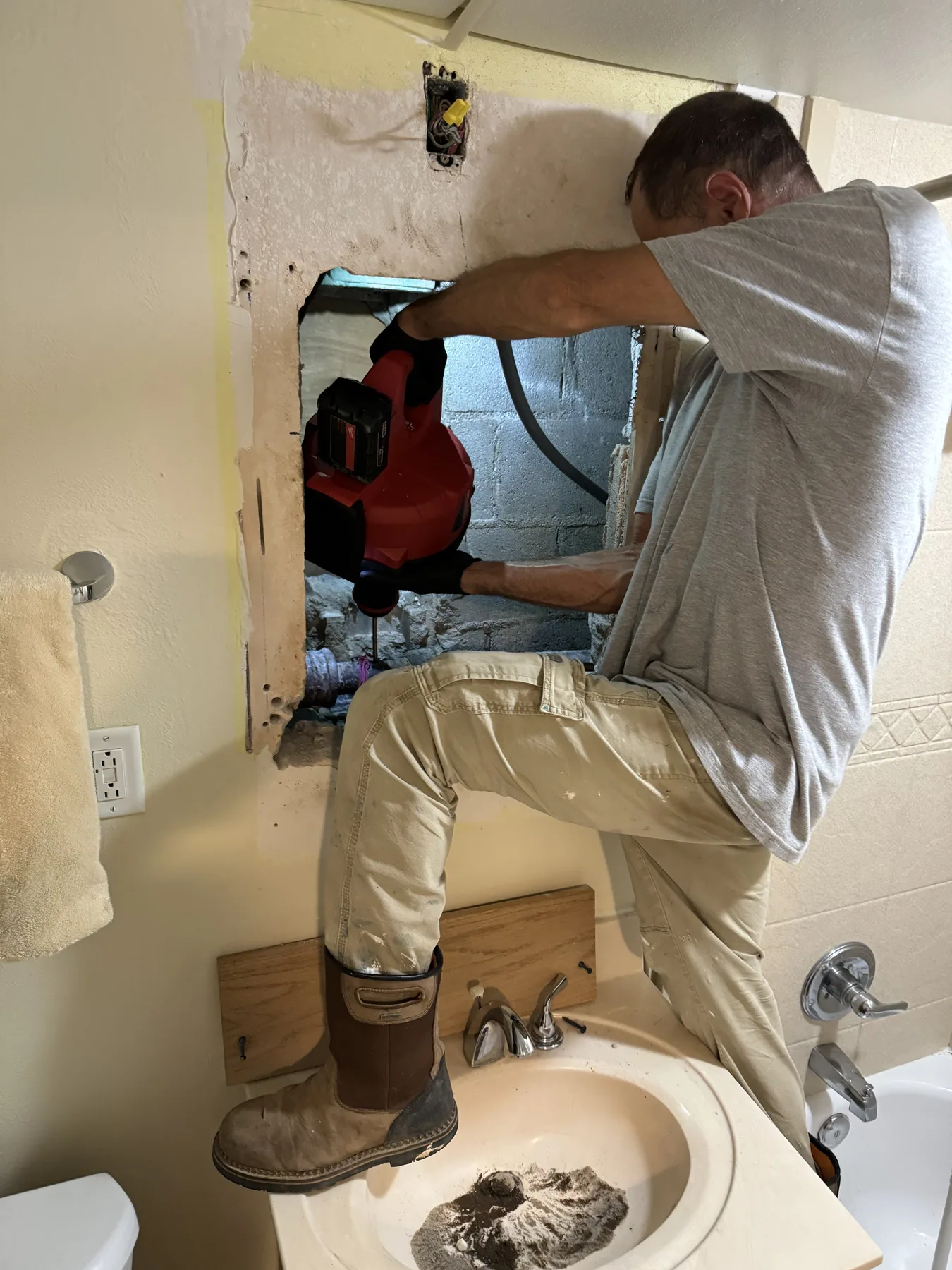
Replacing a failed section of supply line in a ceiling cavity above an occupied commercial space.
Commercial work
Water showing up in a unit below? Call 850-318-5777. Stopping it today is cheaper than the drywall tomorrow.
- Answered 24 hours, 7 days
- Licensed CFC1429646 and CMC1250426
- Repair first, always
A maintenance plan puts a licensed contractor’s eyes on this before it fails.
Getting it repaired and buttoned back up
- Confirm the location
We verify what was found before opening anything, because opening the wrong spot in an occupied building is expensive twice.
- Isolate the smallest zone
Shutting one riser or one branch instead of the building keeps the rest of your tenants in water while we work.
- Choose the repair honestly
Spot repair or reroute, with the reasoning laid out. If your line’s failed before, you’ll hear that reroute is likely cheaper over five years.
- Repair and pressure test
New material in to code, tested under pressure before anything gets closed, so we’re not finding out later.
- Dry and restore
The affected area gets dried out properly and finishes go back. Wet cavity space in this climate does not resolve itself.
- Document for the file
Photos, the cause, the repair method and the affected units, which is what owners, boards and carriers will need.
Leak repair in occupied coastal buildings
We repair commercial leaks throughout Walton and Okaloosa counties, including Freeport, Santa Rosa Beach, Point Washington, Miramar Beach, Destin, Niceville and Valparaiso, plus the 30A towns of Grayton Beach, Seaside, WaterColor, Seagrove Beach and Inlet Beach. Most of that work happens in buildings that stay open and occupied while we do it.
We also cover DeFuniak Springs, Paxton, Ponce de Leon, Westville, Ebro, Vernon and Panama City Beach. Slab construction is standard across the region, so the reroute versus spot-repair conversation comes up on almost every job, and we’d rather you understand the tradeoff than just be handed a number.
Towns we get to most: Freeport, Santa Rosa Beach, Point Washington, Miramar Beach, Niceville, Destin, Eglin Air Force Base, Valparaiso, Ebro, Vernon, Caryville. See the full service area.
Questions we get about this
Can you repair it without shutting the whole building down?
Usually. Most commercial buildings can be isolated by riser, branch or wing, and we always look for the smallest shut-off that lets us work.
If a full shut-off is unavoidable, we’ll tell you before we close the valve and give you a realistic window so you can notify tenants ahead of time.
Should we spot repair or reroute the line?
First failure on a healthy line, spot repair. Second failure on the same run, or aged material, and rerouting overhead usually costs less over a few years once you count the damage each future leak causes.
We’ll show you what the line looks like and give you both numbers. It’s your building and your call, but you should be making it with the full picture.
Who handles the drywall and flooring?
We restore what we open to get to the pipe, and we dry the affected area properly before closing it. For large-scale water damage restoration across multiple units, that’s specialist work and we’ll tell you straight when you need that instead of stretching beyond what we do well.
How fast can you get to us?
We answer 24 hours a day, and an active leak in a commercial building is treated as an emergency because the damage compounds by the hour. Call and we’ll tell you honestly when we can be there.
If you can isolate the water yourself in the meantime, do it. That single step does more to limit the cost than anything we do after we arrive.
Will we get documentation for the insurance claim?
Yes, and this is a category where it matters. You get photos before and after, the cause, the repair method, and which units were affected. Carriers ask for exactly that, and reconstructing it after the fact is much harder than recording it as we go.
Related plumbing work
- Commercial Emergency Plumbing
- Commercial Drain Cleaning
- Commercial Sewer Repair
- Commercial Hydro Jetting
- Backflow Installation
- Commercial Water Heaters
- Commercial Repiping
- Commercial Leak Detection
- Commercial Water Line Repair
This page covers one job. The rest of what we do is on the plumbing page, and real job photos are in the gallery. For anything else, call 850-318-5777 or send us a message.