
Hot Water Your Building Can’t Operate Without
A restaurant can’t run without hot water and a hotel can’t rent a room without it. We repair what’s repairable and size replacements to real demand.
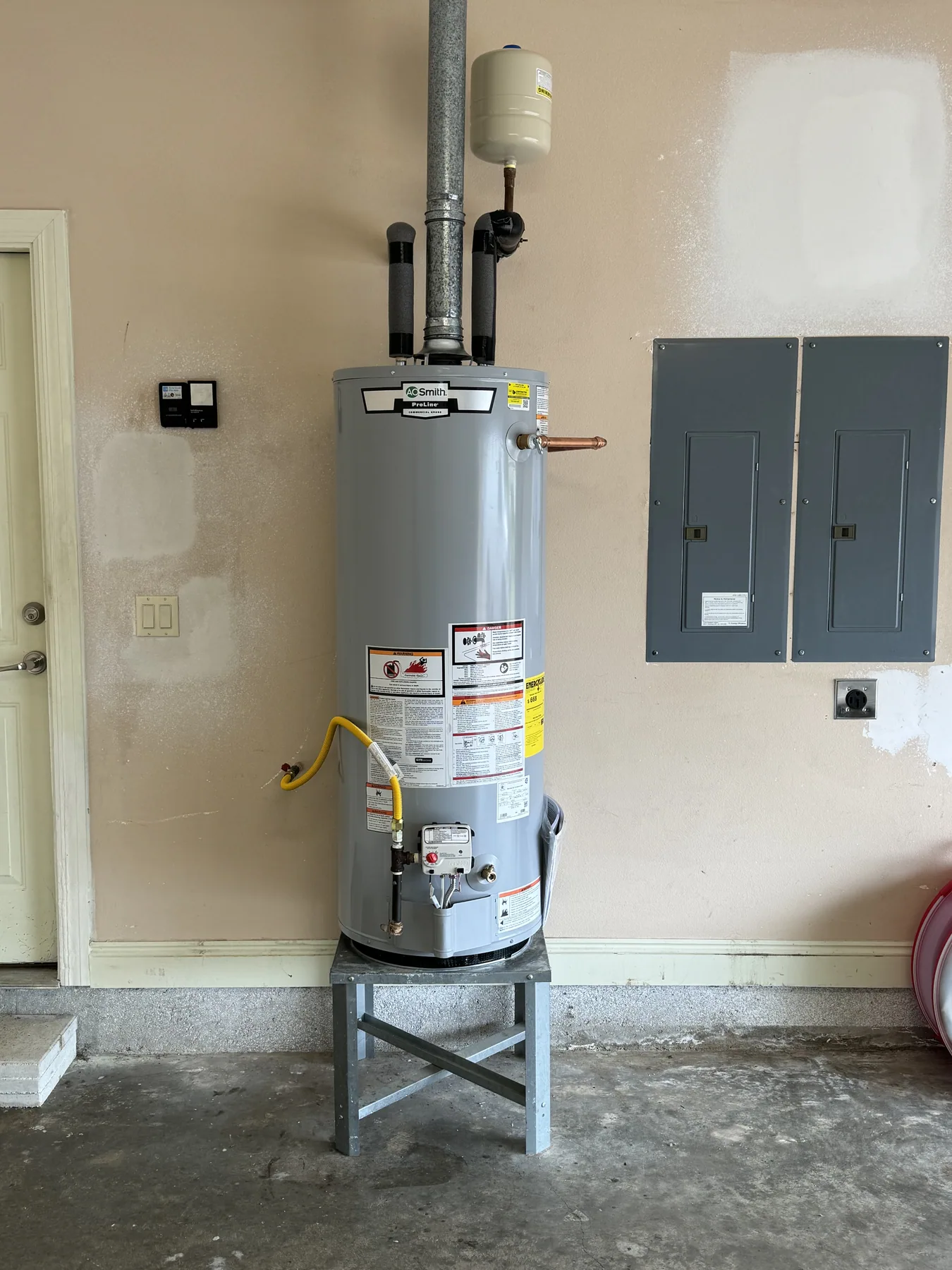
Commercial hot water is a demand problem before it’s an equipment problem. What matters isn’t the tank’s gallon rating on its own, it’s how much hot water the building needs at its worst hour and how fast the unit can recover afterward. Get that wrong and you have a system that tests fine on a slow Tuesday and runs cold every checkout morning.
So we start by asking what the building actually does. A hotel’s peak is a compressed window when everybody showers at once. A restaurant’s is a sanitizing load at a specific temperature during and after service. An office building has modest total demand with occasional spikes. Same equipment category, completely different sizing math.
Repair comes before replacement whenever it honestly can. A failed thermostat, a burned element, a bad gas valve, a stuck thermal expansion tank or a sediment-loaded tank are all fixable, and a lot of commercial units get replaced for problems that a service call would have solved. When the tank itself is done, we’ll show you why rather than just telling you.
Signs the system isn’t keeping up
- Hot water runs out during your peak window and recovers fine afterward
- Temperature swings at the fixture even though the setpoint hasn’t changed
- Rumbling, popping or kettling noises from the tank when it fires
- Rusty or cloudy hot water that clears when you switch to cold
- Water around the base of the unit or a relief valve discharging regularly
- A dish machine failing to reach sanitizing temperature
- Pilot or burner problems that keep coming back after a reset
Size to the worst hour of your week, not the average day. The average day was never the problem.
What actually wears these units out
Sediment is the most common one. Minerals in the supply settle to the bottom of a tank and bake into a layer over the burner or around the lower element. That layer insulates the water from the heat source, so the unit runs longer for the same output, the steel below it overheats, and you get the rumbling sound of water flashing to steam under the crust. Regular flushing genuinely delays this.
The anode rod is the part almost nobody thinks about. It’s a sacrificial metal rod that corrodes on purpose so the tank lining doesn’t. Once it’s consumed, the corrosion moves to the tank itself, and a tank that leaks from the body is finished. Replacing an anode on schedule is cheap. Replacing a tank because nobody checked it is not.
Locally, mineral content in the well-sourced supply around Freeport and Walton County is a familiar concern, and commercial units cycling constantly through a full season accumulate sediment much faster than a residential heater does. Buildings that go from near-empty in shoulder season to full occupancy also stress the recovery side hard, which is where undersized systems finally show themselves.
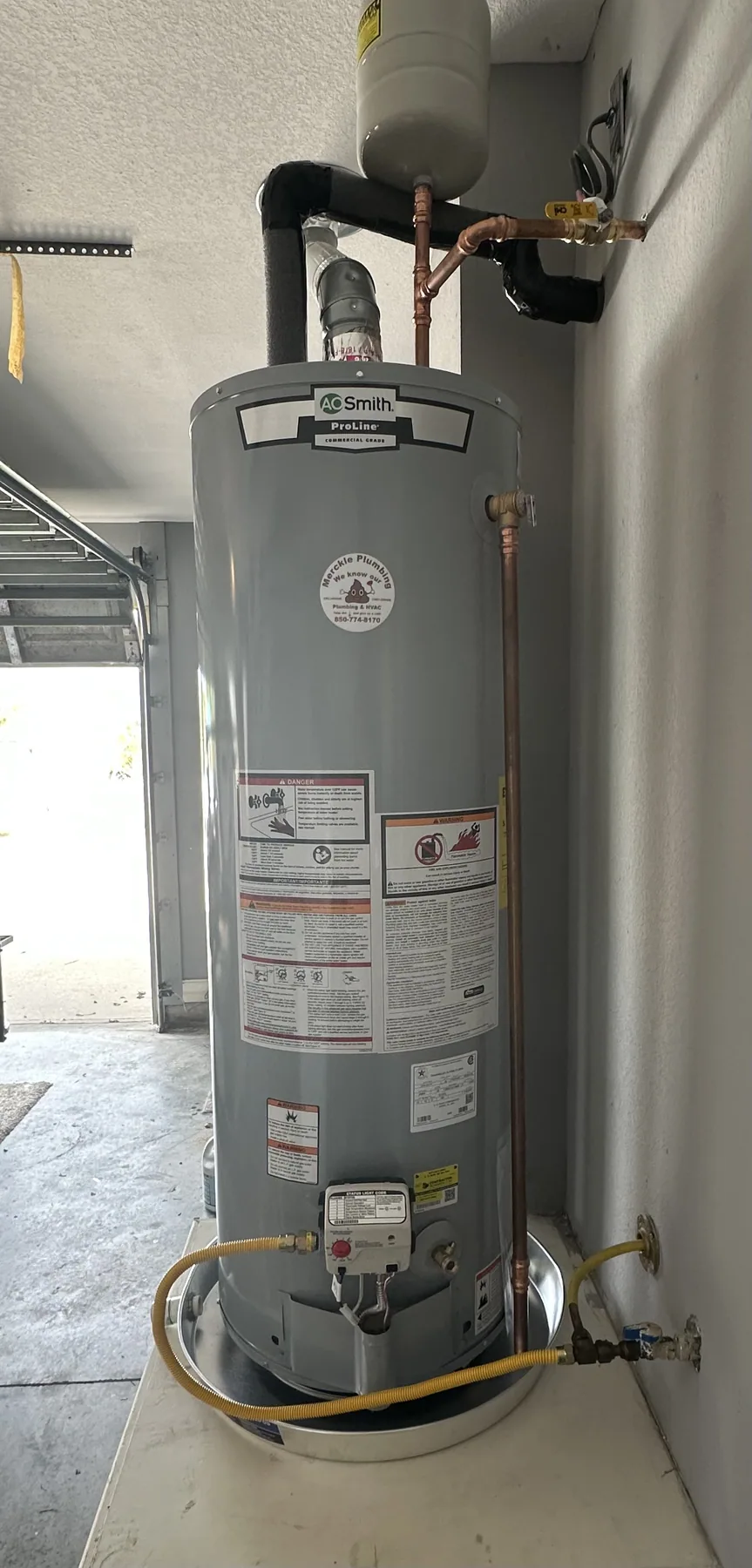
Checking recovery and delivery temperature on a commercial water heater during a peak-demand test.
Commercial work
Running out of hot water at the worst hour? Call 850-318-5777 and we’ll get it looked at before it fails completely.
- Answered 24 hours, 7 days
- Licensed CFC1429646 and CMC1250426
- Repair first, always
Prices for every maintenance plan are posted, so you know the cost before booking.
How we approach a commercial unit
- Diagnose before quoting
We find out what’s actually failed. A lot of units on the replacement list have a repairable fault, and you deserve to know which one you have.
- Measure real demand
Fixture count, peak hour, and required temperatures. That’s what determines the right unit, not the label on the one that’s currently there.
- Lay out the options
Repair, like-for-like replacement, or a different configuration. You hear what each one costs and what it means for your operation before anything gets ordered.
- Schedule the outage
Replacement means a hot water interruption. We put that window where it hurts least and tell your staff exactly how long it’ll be.
- Install to code
Correct venting, gas or electrical, expansion control, relief piping and seismic or structural support as required. Permitted where the job calls for it.
- Verify under load
We check recovery and delivery temperature at the fixtures under real demand, not just at the tank.
Hot water for coastal businesses and properties
We service commercial water heating for restaurants, hotels, rentals and offices in Freeport, Santa Rosa Beach, Miramar Beach and along 30A through Point Washington, Grayton Beach, Seaside, WaterColor, Seagrove Beach and Inlet Beach. Vacation-rental buildings there see a demand pattern most equipment isn’t sized for: near-zero draw, then everybody at once on turnover day.
We also cover Destin, Niceville, Valparaiso and Eglin AFB, plus DeFuniak Springs, Paxton, Ponce de Leon and Panama City Beach. Because we hold both plumbing and mechanical licenses, gas-fired units, venting and combustion air get handled by the same contractor instead of splitting the job between two trades.
Home base is Freeport, and from there we’re regularly in Miramar Beach, Destin, Santa Rosa Beach, Niceville, Point Washington, Valparaiso, Eglin Air Force Base, Caryville, Vernon and Ebro. The rest of our range is listed on the service area page.
Questions we get about this
Can you repair it, or does it have to be replaced?
Plenty of what gets called a dead water heater is a thermostat, an element, a gas valve, a thermocouple or a sediment problem, and all of those are repairs. We diagnose first and tell you honestly which side of the line you’re on.
A tank leaking from the body is genuinely finished, because the steel has corroded through and there’s nothing to repair. We’ll show you where it’s coming from rather than asking you to take our word.
How long will we be without hot water during a replacement?
For a straightforward like-for-like swap, usually a matter of hours. If the venting, gas line or electrical needs work to suit the new unit, it takes longer, and we’ll tell you that before we start rather than discovering it with your building dry.
We schedule the interruption around your operation. For hotels that usually means mid-afternoon, for restaurants it usually means before service.
Should we go tankless for a commercial application?
Sometimes. Tankless suits steady continuous draw and saves standby energy, but it needs adequate gas supply and proper venting, and it doesn’t behave like a tank during a short, enormous simultaneous peak.
A hotel checkout window and a restaurant sanitizing load are very different problems. We’ll tell you which one your building actually has instead of pushing one technology at every property.
What maintenance keeps these alive?
Flushing sediment out of the tank on a real schedule, checking the anode rod before it’s fully consumed, testing the relief valve, and verifying combustion on gas units. That’s most of it.
It’s the same idea as an oil change. Small regular attention costs far less than the failure it prevents, and it’s exactly the kind of thing that gets skipped until a Saturday morning with no hot water.
Can you handle a whole building’s worth of units?
Yes. Multi-unit properties often have a mix of ages and conditions, so we’ll survey what’s actually in the building, flag the units at real risk, and help you plan replacements over time instead of all at once in an emergency.
Related plumbing work
- Office Building Plumbing
- Apartment Complex Plumbing
- Hotel Plumbing
- Commercial Emergency Plumbing
- Commercial Drain Cleaning
- Commercial Sewer Repair
- Commercial Hydro Jetting
- Backflow Installation
- Commercial Repiping
Not seeing it? The full list is on the plumbing page, or just call 850-318-5777 and describe it. You can also see the work or send a note.