
New Water Service Sized for What You’re Building
Running new service to a building or upgrading an undersized one. Sizing is the decision that matters most, and it’s the one you can’t easily revisit later.
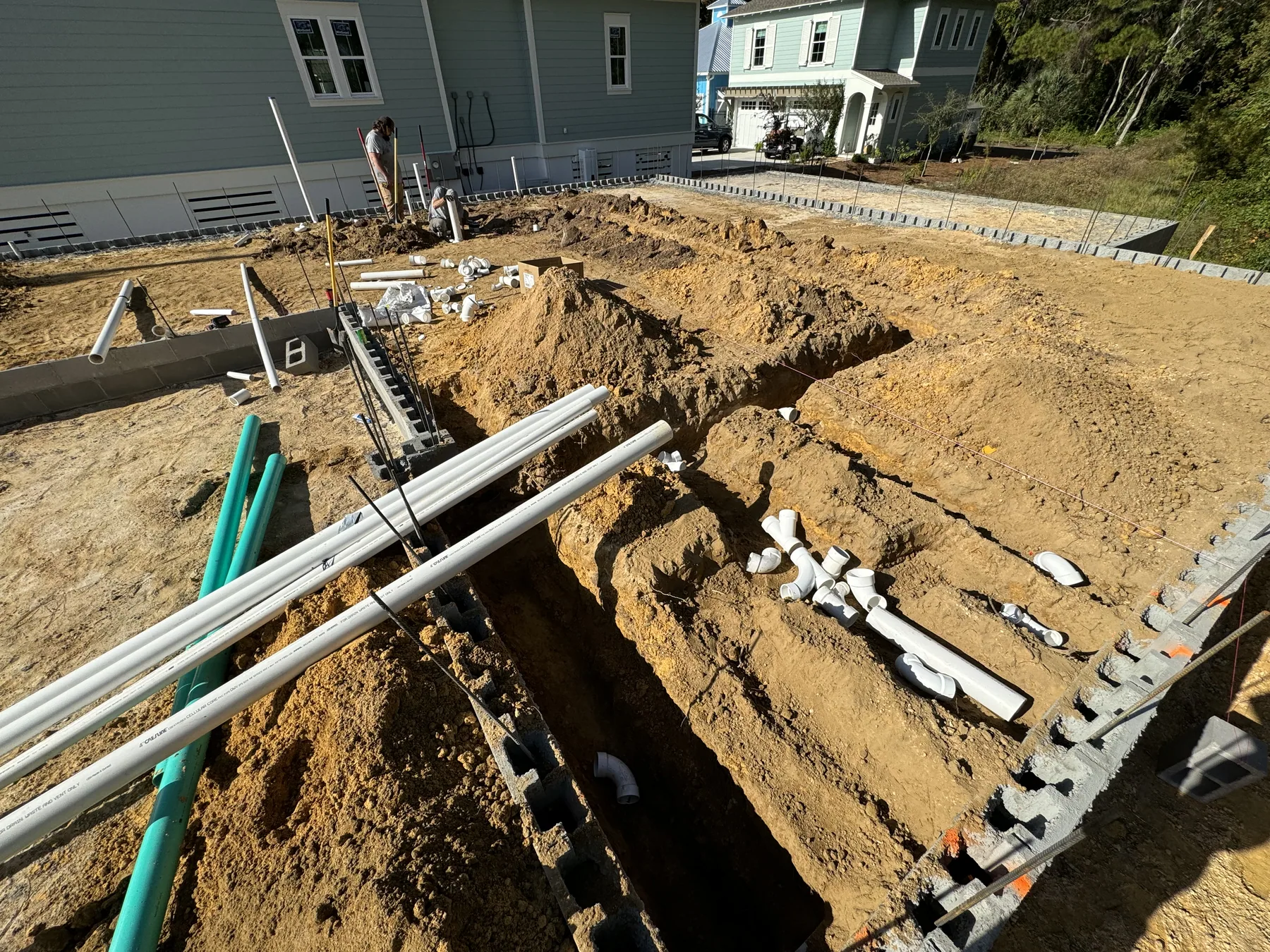
Installing a new commercial water service means running pipe from the utility’s connection to your building and sizing it for what the property will actually demand. This comes up on new construction, on expansions where the existing service can’t carry the added load, and on older buildings whose original service was sized for a very different use than the current one.
Sizing is the heart of it. Undersize the service and every fixture in the building suffers at peak demand, which is a problem you can’t solve with interior plumbing afterward. Oversize it badly and you’ve spent money on pipe and possibly a larger meter you’ll pay for monthly. The calculation runs off fixture units, simultaneous demand, available pressure at the connection, elevation, and the friction loss over the run’s length.
The rest is planning and coordination. Route, depth, sleeving under paving, separation from other utilities, tie-in scheduling with the water authority, and where the backflow assembly and interior shut-off will live. Working that out before the trench opens is what keeps this from becoming an expensive improvisation.
When a property needs new service
- New construction or a building pad with no existing service
- An addition, second building, or expanded tenant space added to the site
- Pressure that drops badly whenever multiple fixtures run at once
- A change of use, like an office space becoming a restaurant
- Fire suppression requirements the existing service can’t support
- A service line so old that repairing it again isn’t sensible
- Irrigation added to a property already at its service capacity
You can fix a lot of things later. An undersized service line isn’t one of them.
Getting the sizing and the route right
Demand sizing starts with counting what the building will run and how much of it runs simultaneously. A restaurant with a dish machine, prep sinks and public restrooms behaves nothing like an office of the same square footage. A hotel’s simultaneous demand at checkout dwarfs its average. We size to the realistic peak, because the peak is the only hour the sizing gets tested.
Available pressure at the connection sets the ceiling. Every foot of pipe, every fitting, every elevation gain and the backflow assembly all consume pressure between the main and your farthest fixture. On a long run to a building set back from the road, that friction loss is significant and it’s precisely why services get upsized. Doing the math beforehand costs nothing. Discovering it afterward costs a second trench.
Route matters as much locally. The high water table in the low ground around Freeport and the 30A corridor affects trench work and bedding. Sandy soil needs proper compaction so the line doesn’t settle under a drive lane. Crossings under parking and roadway want sleeving so the line stays serviceable without tearing up pavement the next time anybody touches it.
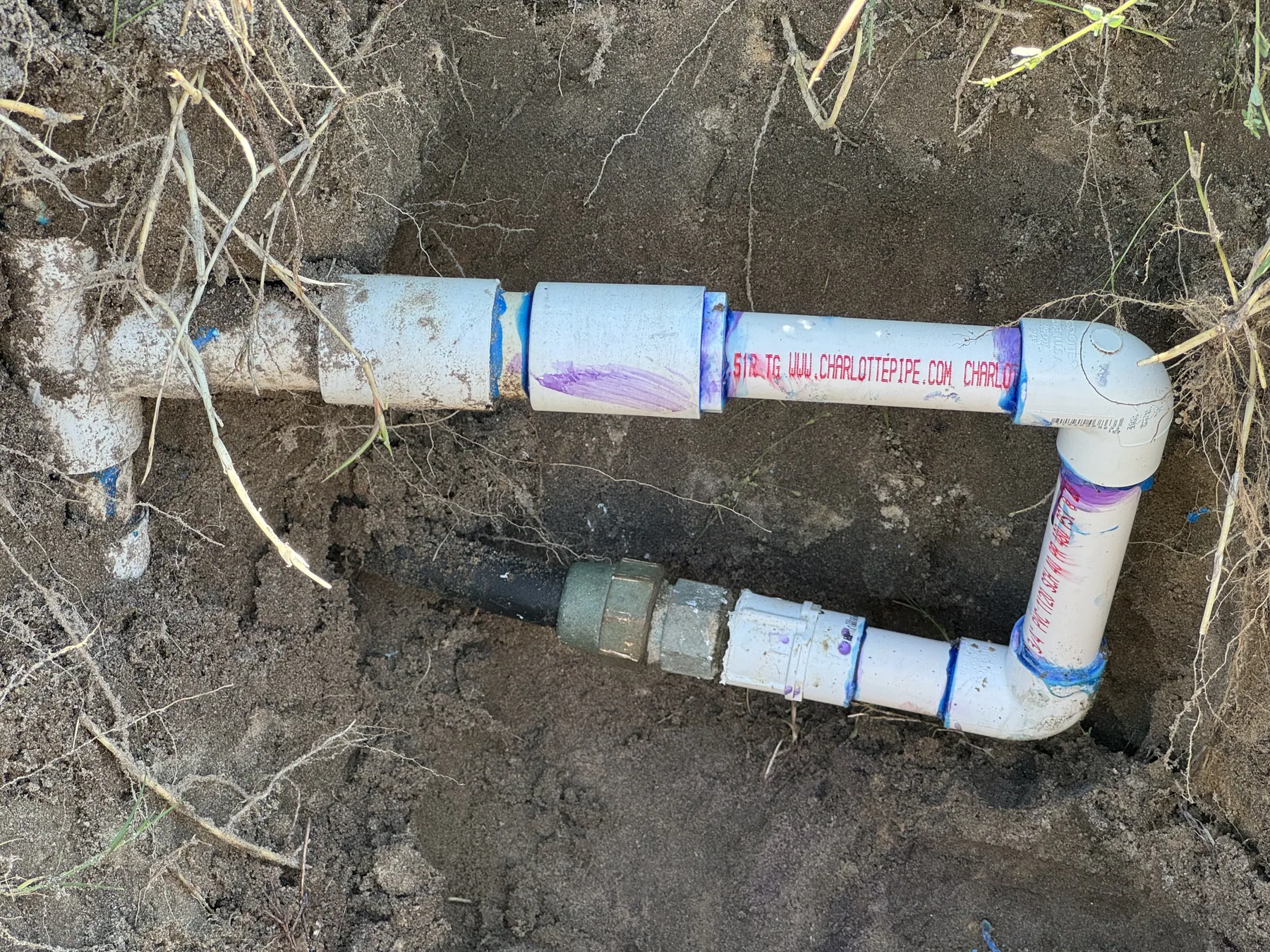
New commercial water service line bedded and pressure tested before backfill on a Walton County site.
Commercial work
Planning a build or an expansion? Call 850-318-5777 early and we’ll tell you what the service needs to be.
- Answered 24 hours, 7 days
- Licensed CFC1429646 and CMC1250426
- Repair first, always
A maintenance plan puts a licensed contractor’s eyes on this before it fails.
From plan to a live service
- Calculate the demand
Fixture units, simultaneous use, and the building’s real peak, so the size is based on the operation rather than on what’s already in the ground.
- Check pressure and the connection
Available pressure at the tap and the friction loss over the planned run. This is where undersizing gets caught, before anything is buried.
- Design the route
Depth, separation from other utilities, sleeving under paving, and where the backflow assembly and main shut-off will sit for future access.
- Permit and coordinate
Permits pulled, utility locates called, and the tap and meter set coordinated with the water authority and the other trades on site.
- Install, test, inspect
Pipe installed with proper bedding and compaction, pressure tested, disinfected where required, and inspected before backfill closes it.
- Document as-built
Where the line actually runs and how deep, which is what saves the next contractor from putting a machine through it.
New service installations along the Emerald Coast
We install commercial water services in Freeport, Santa Rosa Beach, Point Washington, Miramar Beach and throughout the 30A corridor including Grayton Beach, Seaside, WaterColor, Seagrove Beach and Inlet Beach. Most of that is Regional Utilities territory, and their connection and inspection requirements get confirmed before the design is finalized rather than after the trench is open.
The same work runs into Destin, Niceville, Valparaiso and Eglin AFB, north to DeFuniak Springs, Paxton, Ponce de Leon and Westville, and east through Ebro, Vernon and Panama City Beach. Requirements vary between water authorities across those counties, so we verify what your specific utility wants on each project.
Home base is Freeport, and from there we’re regularly in Miramar Beach, Destin, Santa Rosa Beach, Niceville, Point Washington, Valparaiso, Eglin Air Force Base, Caryville, Vernon and Ebro. The rest of our range is listed on the service area page.
Questions we get about this
How do you decide what size service we need?
We count the fixtures the building will actually run, work out realistic simultaneous demand, then check that against available pressure at the connection and the friction loss over the length of the run.
It’s arithmetic, not a guess, and we’ll walk you through it. If your plans change during design, the number changes with them, which is much cheaper than finding out after the pipe is buried.
Can we upsize an existing service instead of running new?
Sometimes, if the existing route is sound and the constraint is only diameter. Often the honest answer is that a new run costs about the same and gives you a line with a known age and known material.
We’ll price both if both are genuinely viable rather than steering you to the bigger job.
Do you coordinate with the utility for the tap and meter?
Yes. The connection and meter set are the utility’s, and their schedule usually drives the project timeline more than our work does. We coordinate it and tell you what their lead time realistically looks like.
Will this hold up construction on the rest of the site?
It shouldn’t if it’s sequenced right, which is why we’d rather be involved early. Water service is a trench-and-inspection item that other trades depend on, and it’s a common source of delay when it gets scheduled late.
We work alongside the GC and other subs on the site and plan the trench around what else is going in the ground.
What about the backflow preventer?
Commercial services generally require one, and where it sits should be decided as part of the service design rather than added on afterward. It needs clearance for the annual test, protection, and drainage for a relief discharge.
We handle the assembly selection, install and initial certification along with the service so it’s one job with one contractor rather than a coordination problem.
Related plumbing work
- Commercial Sewer Repair
- Commercial Hydro Jetting
- Backflow Installation
- Commercial Water Heaters
- Commercial Repiping
- Commercial Leak Detection
- Commercial Leak Repair
- Commercial Water Line Repair
- Commercial New Construction
Can’t find your exact problem above? Describe it on the contact form or over the phone at 850-318-5777. You can browse the full plumbing list first, or look through photos of our work.