
Hot Water Again, Without Guessing at the Tank
Most water heater trouble comes down to a short list of parts: the pilot and burner, the flue, the gas control, the relief valve, and whatever has settled in the bottom of the tank. We check them in that order and tell you whether a repair makes sense before anybody mentions a new heater.
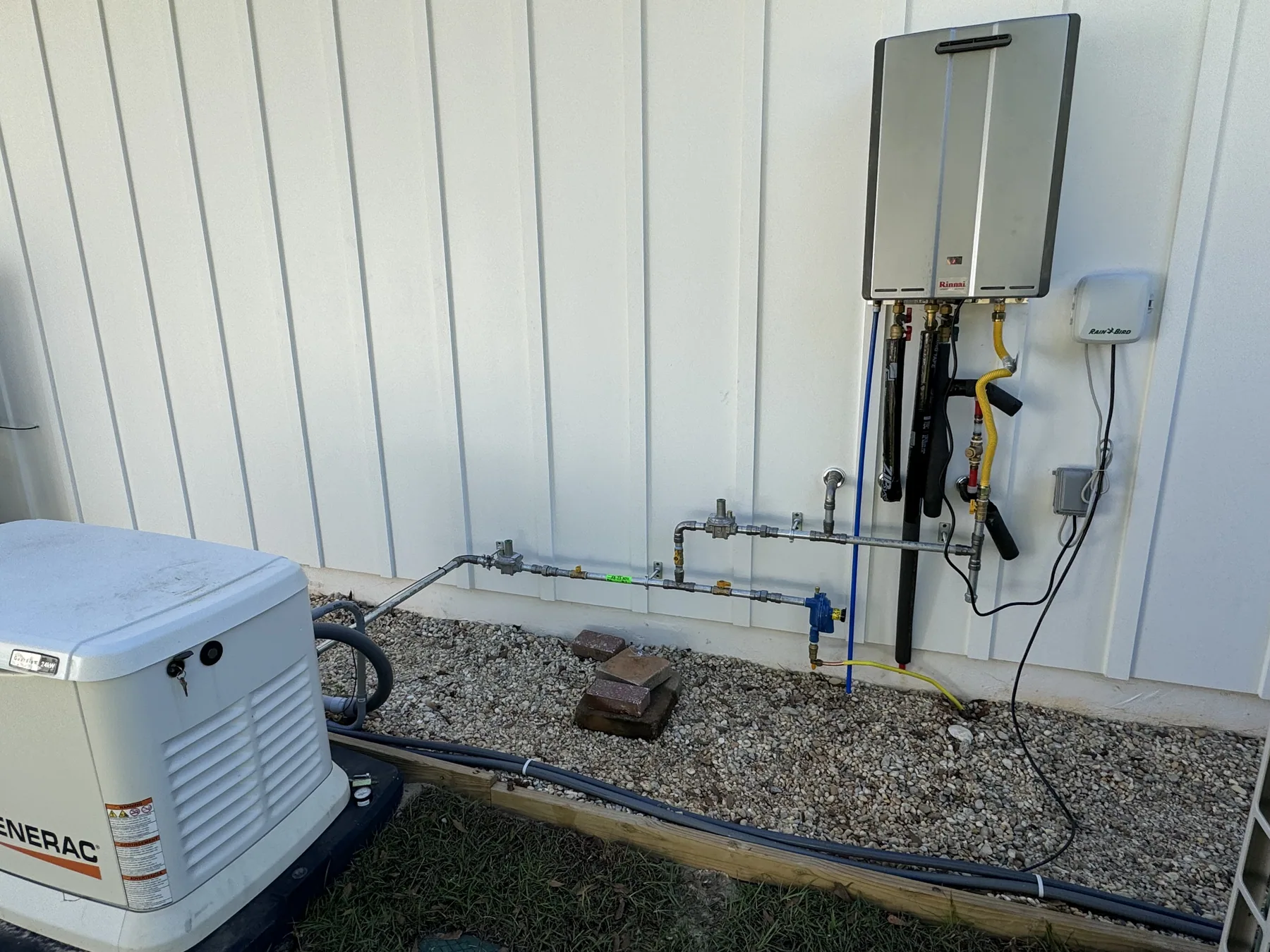
A gas tank in the garage, checked part by part
A gas tank water heater in a garage is a familiar setup around here: the tank on a stand, a metal flue rising out of the top, often an expansion tank above it, and a flexible gas line feeding the control. Any one of those pieces can be the reason your showers have gone lukewarm. A tankless unit hung on an outside wall gets the same part-by-part look, just with the gas supply, the venting and the scale inside the heat exchanger at the top of the list.
On a gas unit we start at the bottom. A pilot that will not stay lit often traces back to a thermocouple or a dirty pilot assembly. A burner that lights but burns weak and yellow may be short of combustion air or simply dirty. A gas control valve on its way out can leave you with hot water that runs short far sooner than it used to.
Then the flue. Exhaust has to draft up and out of the garage, and a vent pipe that has come apart, rusted through, or spills back at the draft hood is a safety problem, and it gets dealt with first.
What owners tend to notice before they call:
- Hot water giving out partway through a shower
- A pilot light that keeps going out
- Popping or rumbling while the burner runs
- Rusty or brown water from the hot tap only
- An exhaust smell near the top of the heater
- Water collecting on the stand or the floor
- The relief valve pipe dripping outside
Popping from inside the tank is usually sediment, and it rarely gets quieter on its own.
The expansion tank and the valve that drips
The small tank plumbed in above many heaters is an expansion tank. Water grows in volume as it heats, and on a system with a check valve or backflow device, that extra volume has nowhere to go. The expansion tank gives it room. Once its internal air charge is gone, pressure climbs every time the burner fires.
The temperature and pressure relief valve is the part that reacts to that. It is built to open and dump water when pressure or temperature gets too high, so a relief line that drips after each heating cycle is often reporting a dead expansion tank or high house pressure. The valve itself may be perfectly fine.
So we test house pressure, check the charge in the expansion tank, and then look at the valve. Swapping the valve alone when the tank is the cause only buys you a new valve that drips too. And a relief line should never be capped or plugged to stop the drip, because that takes away the one part protecting the tank from bursting.
Sediment, age, and whether a repair is worth it
Minerals in the water settle to the bottom of the tank over time. On a gas heater that layer sits between the burner flame and the water, so the heater works harder, rumbles as trapped water boils underneath, and can overheat the steel at the bottom. Flushing the tank on a sensible schedule keeps that layer thin, much like an oil change keeps an engine running.
There is also a metal rod hanging inside most tanks, called the anode, that corrodes on purpose so the steel shell does not. Once that rod is used up, the tank starts rusting from the inside, and rusty hot water or a rotten egg smell is often how it announces itself. Checking and replacing the anode on a younger heater is one of the simplest ways to keep it going.
Whether to repair or replace has a lot to do with the tank’s age and condition. A younger heater with a failed thermocouple, gas control or expansion tank is a straightforward repair and worth doing. An older tank leaking from the body itself, or rusting through at the base, cannot be patched, because the tank is the part that failed.
The in-between cases are where a clear explanation matters most. We tell you what we found, how much life the tank realistically has left, and give you a straight number for the repair and for a replacement, so you make the call with the facts in front of you.
Lukewarm showers or a dripping valve?
Call 850-318-5777 and tell us what the heater is doing. Have the brand handy, and whether it runs on gas or electric.
- Repair looked at before replacement
- Plumbing and mechanical certifications held by Noah
- Phone answered around the clock
What happens on a water heater call
- Hear the symptoms
Lukewarm water, noise, a smell or a puddle each point at different parts, so your description decides where we begin.
- Gas and flue before anything else
We confirm the gas supply, the burner flame and the draft up the vent, because a venting fault is a safety call.
- Test pressure and the relief side
A gauge on a hose bib reads house pressure, and the expansion tank and relief valve get checked as a pair.
- Drain a sample
Water drawn from the drain valve shows how much sediment and rust is sitting at the bottom of the tank.
- Explain, then let you decide
You hear what failed and why, what the repair involves, and whether the tank is worth fixing. The choice stays yours.
Water heater questions worth asking first
Why does my hot water run out faster than it used to?
Sediment taking up room in the bottom of the tank, a burner that is not firing fully, or a failing gas control can all cut into the hot water you get. On an electric heater, a burned out lower element is a common cause. Each one has a different fix, which is why we test before replacing parts.
Is it normal for the relief valve pipe to drip?
A rare drip can happen, but regular dripping means something is pushing that valve open. Most often the expansion tank has lost its charge or the house pressure is too high. Never cap the line to stop it. Call, and we will find the cause before swapping any parts.
What is the small tank above my water heater for?
That is usually an expansion tank. Heated water takes up more room, and the tank absorbs that extra volume so pressure does not spike each time the heater runs. When it fails, the relief valve often starts dripping, and that drip is usually the first clue anyone gets.
How often should a water heater be flushed?
It depends on your water and how hard the heater works. A rental with a steady run of guests goes through far more hot water than a house that sits empty for weeks. We can look at what drains out of yours and suggest a schedule that fits how the house is used.
Can a leaking water heater be repaired?
That depends on where the water is coming from. A leaking drain valve, relief valve or fitting can be replaced on the spot. Water coming out of the tank body means the inside has corroded through, and at that point replacing the heater is the only honest option we can offer you.
Is a gas smell near the water heater an emergency?
Yes. Leave the garage, do not flip switches or light anything, and call the gas utility from outside. Once the gas side has been made safe, call us and we will track down the source, whether that turns out to be a fitting, the flex line or the gas control.
Heaters on the bay side, and the air handler nearby
We work out of Freeport, and Point Washington is part of an ordinary week for us, so a water heater call out here is routine work. Keeping the common thermocouples, valves and fittings on the truck means a lot of repairs can wrap up in a single trip.
In plenty of houses the water heater is not far from the air handler, and that is where having both trades under one roof pays off. Noah holds the Florida plumbing certification CFC1429646 and the mechanical certification CMC1250426, so while we are there for the tank we can glance at the condensate line as well. With humidity keeping that line wet nearly all year, a clogged one is among the backups we clear most often.
For second homes and rentals, tell us when the next guests arrive. A heater that is only slow can usually be scheduled around a stay. One that is leaking or smells of gas should not wait for anybody’s calendar.
Read more on the Point Washington page, see what we cover across Walton County, or visit our main water heater repair page for the full picture.
More Point Washington pages
Call 850-318-5777 and tell us what the heater is doing, send us a message with the brand and the symptoms, or browse the gallery first.