A New System Sized For Your House, Not a Catalog
Equipment brand matters far less than sizing and installation quality. The same unit can run beautifully in one house and struggle in the one next door.
An HVAC system is sized to a specific building. Square footage, ceiling height, window area and orientation, insulation, and how leaky the house is all feed into how much capacity it actually needs. Getting that wrong in either direction causes problems. Too small and it runs forever without catching up on the hottest afternoons. Too large is worse in Florida, because an oversized system satisfies the thermostat quickly, shuts off, and never runs long enough to pull humidity out of the air.
That humidity point is the one most people have not heard. Removing moisture is a function of runtime across a cold coil. A system that blasts the house to temperature in short bursts leaves you at 72 degrees and clammy, with condensation on registers and that damp smell in closets. Right sized equipment running longer, steadier cycles is what actually makes a Gulf Coast house feel comfortable.
We install the equipment, and we look hard at what it is connecting to. New efficient equipment attached to leaking undersized ductwork will not deliver what the label promises. If the duct system needs work to make the new install perform, we will say so before you buy, not after.
When Replacement Makes Sense
- Repair costs are stacking up across multiple visits in the same season
- The system cannot hold the setpoint on the hottest afternoons even when everything is working
- The house is cool but feels damp, with condensation showing on vents or windows
- The equipment uses R-22 refrigerant, which is no longer produced and costly to source
- Power bills have climbed steadily while your usage habits have not changed
- The compressor or the coil has failed on equipment already well into its service life
An oversized system cools fast, shuts off early, and leaves your house cold and clammy.
What We Look At Before Quoting
Load first. We look at the building itself rather than assuming the tonnage of whatever came out is correct, because plenty of existing systems were oversized from the start and simply got replaced with the same mistake for two decades running. Window area and how the house faces the afternoon sun matter a great deal here, and a 30A house with a wall of west facing glass has a genuinely different load than an identical floor plan in DeFuniak Springs.
Then the duct system. Static pressure tells us whether the existing ductwork can move the airflow the new equipment requires. Undersized returns are extremely common in older Panhandle homes, and a strangled return makes even excellent equipment run hot, loud, and inefficient. It is far cheaper to correct that during the install than to chase comfort complaints afterward.
Then the equipment itself. Florida sits in the federal Southeast efficiency region, so split system air conditioners under 45,000 Btu per hour have to meet 14.3 SEER2 and larger ones 13.8 SEER2, while heat pumps meet 14.3 SEER2 and 7.5 HSPF2 nationally. Higher efficiency tiers exist and sometimes pay for themselves given how many hours these systems run here. We will show you the honest math for your house and let you pick, including the option of staying at the baseline.
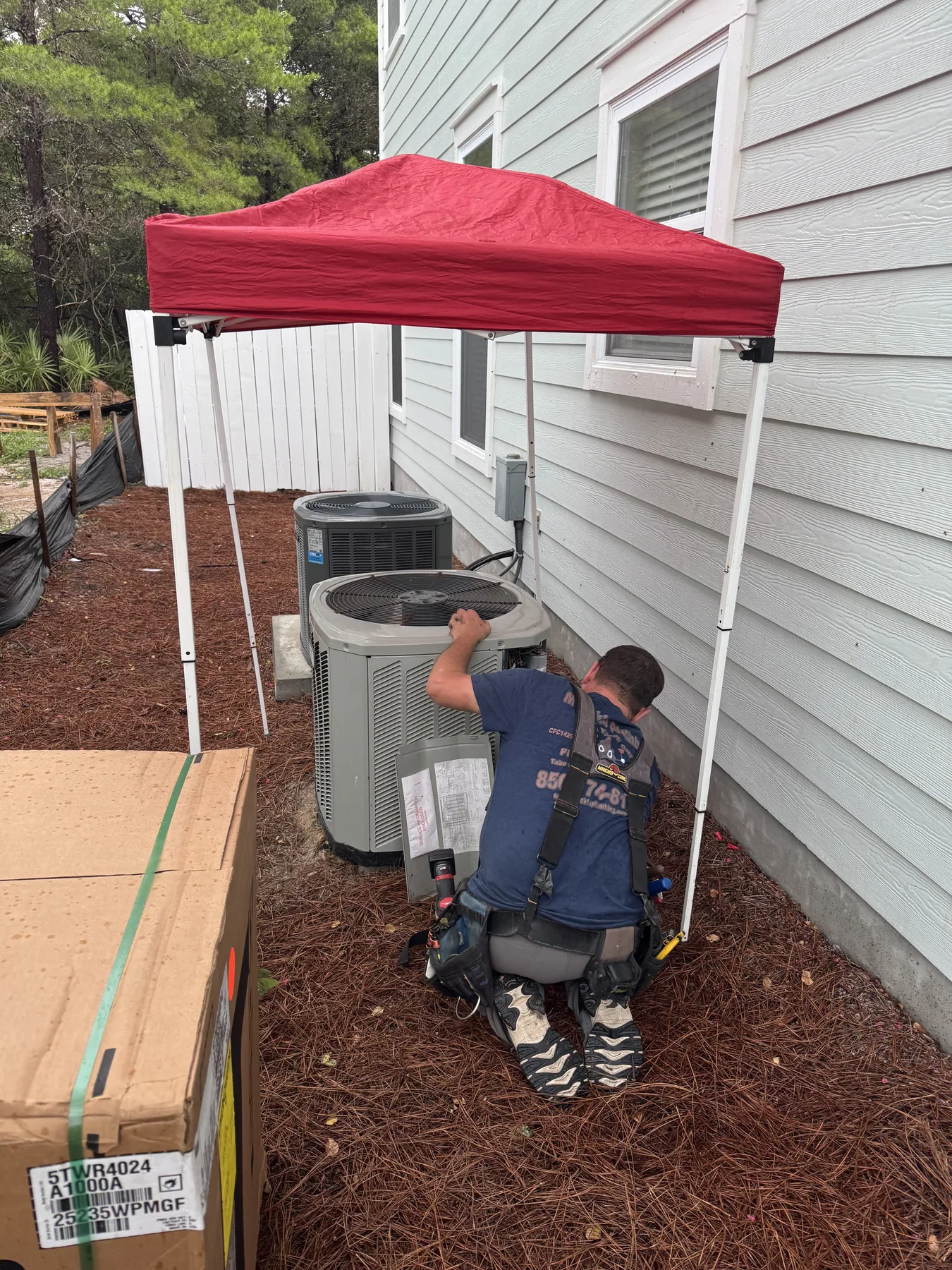
New outdoor unit set on a pad and line set connected during a system replacement near Miramar Beach.
Get it looked at
Thinking about replacing a system? Call 850-318-5777 and we will walk the house and give you a straight number with real options.
- Answered 24 hours, 7 days
- Licensed CFC1429646 and CMC1250426
- Repair first, always
A maintenance plan keeps this kind of thing from becoming an emergency.
From Quote to Startup
- Walk the house
We look at the existing equipment, the duct layout, returns, the electrical, and the drain, then talk through what has bothered you about how the house has been running.
- Size it properly
Capacity comes from the building, not from what was there before. If the old system was the wrong size, this is where that gets corrected.
- Lay out real options
You get a straight number for each option and a clear explanation of what the difference actually buys you. No pressure, no expiring discount.
- Do the install right
Old equipment out, new set and secured, line set brazed under nitrogen, proper vacuum pulled, charge weighed in, condensate routed with a real trap and a safety switch.
- Correct the air side
Duct connections, returns, and any sections that need attention get handled while everything is open and accessible.
- Commission and hand over
We verify airflow, temperature split, and operating pressures, set up the thermostat with you, and go over registration and maintenance before we leave.
Installing Along the Emerald Coast
We install across Walton County out of Freeport, from the beach communities of Seaside, WaterColor, Grayton Beach, Seagrove Beach and Inlet Beach through Santa Rosa Beach, Miramar Beach and Point Washington, and inland to DeFuniak Springs, Paxton and Choctaw Beach. Coastal installs get extra attention on the outdoor unit, because salt air is relentless on condenser coils and where a unit sits relative to prevailing wind genuinely affects how long it lasts.
Okaloosa County work covers Niceville, Valparaiso, Destin and Eglin Air Force Base, and we reach Ebro, Vernon, Caryville, Westville, Ponce de Leon and Panama City Beach. Rental properties on 30A get sized with heavy occupancy swings in mind, since a house sleeping fourteen in July has a very different load than the same house sitting empty in February.
Closest to home: Freeport, Point Washington, Santa Rosa Beach and Miramar Beach. A little farther west: Destin, Niceville, Valparaiso and Eglin Air Force Base. Inland to the north: Ebro, Vernon and Caryville. The service area page covers everything else.
Questions we get about this
How long does an installation take?
A straightforward changeout of like for like equipment is usually one day. Jobs that involve duct modifications, a new pad and electrical, or relocating an air handler can run into a second day. We tell you which one you are looking at before we start.
Which brand should I buy?
Installation quality and correct sizing affect how a system performs far more than the badge on the cabinet. We install solid, widely supported equipment so parts stay easy to get for years. We will talk through the actual differences between tiers instead of steering you to whatever carries the biggest margin.
Is a higher efficiency unit worth it here?
Sometimes genuinely yes, because Florida systems run an enormous number of hours and efficiency gains compound with runtime. But it depends on your equipment size, your usage, and how long you plan to stay. We will show you the numbers for your house rather than pushing the top of the line by default.
Do I need new ductwork with a new system?
Not always. We measure static pressure and inspect the duct system to find out. Some homes need nothing, some need a return corrected, and some have flex runs that are genuinely finished. You will hear which before you commit to anything.
Should I get a heat pump or an air conditioner with strip heat?
In this climate a heat pump is usually the better fit, because our winters are mild enough that a heat pump handles nearly all of the heating season efficiently. We can walk you through how that decision looks for your specific house.
Will you handle permits and registration?
Yes. We pull what the jurisdiction requires and register the equipment with the manufacturer so your warranty is actually active, which is a step that quietly gets skipped more often than it should.
Related HVAC work
- AC Repair
- Furnace Repair
- Furnace Installation
- Furnace Tune-Up
- Heat Pump Service
- Air Balancing
- Evaporative Coolers
- Smart Thermostat Installation
- Air Duct Cleaning
Not seeing it? The full list is on the HVAC page, or just call 850-318-5777 and describe it. You can also see the work or send a note.