
Better Water Starts With Testing Yours First
Filtration only works when the equipment matches what is actually in your water. So we test yours before recommending anything.
Water treatment is the corner of plumbing with the most sales pressure attached to it, and the reason is that most people cannot verify the claims. Someone shows up, talks about what is in the water generally, and sells a system. Whether that system addresses anything present in your particular supply is a separate question that often goes unanswered.
We start with a test. Regional Utilities draws from wells, including the Rock Hill wellfield north of Freeport, and distributes municipally after treatment. Properties outside the franchise area, and there are plenty out toward Paxton and Westville, are on private wells with no treatment at all and water chemistry that changes from one parcel to the next. Mineral content is a familiar concern locally. What is in your specific line is what determines the equipment.
Then the equipment follows the findings. A sediment filter handles particulate. A carbon filter addresses taste, odor, and chlorine. A softener handles mineral hardness through ion exchange. A whole-house system treats everything entering the house, a point-of-use unit treats one tap. These are different tools and the right one depends entirely on the test result, not on what happens to be in the truck.
Things people notice about their water
- White crust building on faucet aerators, showerheads, and glass shower doors
- Soap that will not lather well and laundry that comes out stiff
- A chlorine taste or smell at the tap
- Spotting on dishes that no rinse aid seems to fix
- Sediment or fine grit collecting in the bottom of a toilet tank
- A sulfur or metallic taste, which shows up more on private wells
- A water heater that needs flushing far more often than it should
Anyone selling you filtration without testing your water first is guessing.
Where the minerals and the taste come from
Groundwater picks up whatever it passes through. Water moving through the limestone and sand formations under this part of Florida dissolves minerals on the way to the well, and those minerals arrive at your tap in solution. When water heats or evaporates, they come out of solution and deposit, which is the white scale on a showerhead and the film on a glass door. It is the same process building a layer inside your water heater where you cannot see it.
Municipal treatment adds a different variable. Chlorine or chloramine is used to keep the distribution system safe, which is a good thing and also the reason some people do not like the taste. A carbon filter takes it out at the point where the water enters your house or at a single tap, without changing anything about the safety of the supply on the way there.
Private wells are their own case. No treatment, no monitoring, and chemistry that depends on the specific geology under the property and the depth of the well. Iron, sulfur, and sediment are the usual complaints out on rural parcels, and neighbors a mile apart can have genuinely different water. This is where testing is not optional, because there is no utility report to read.
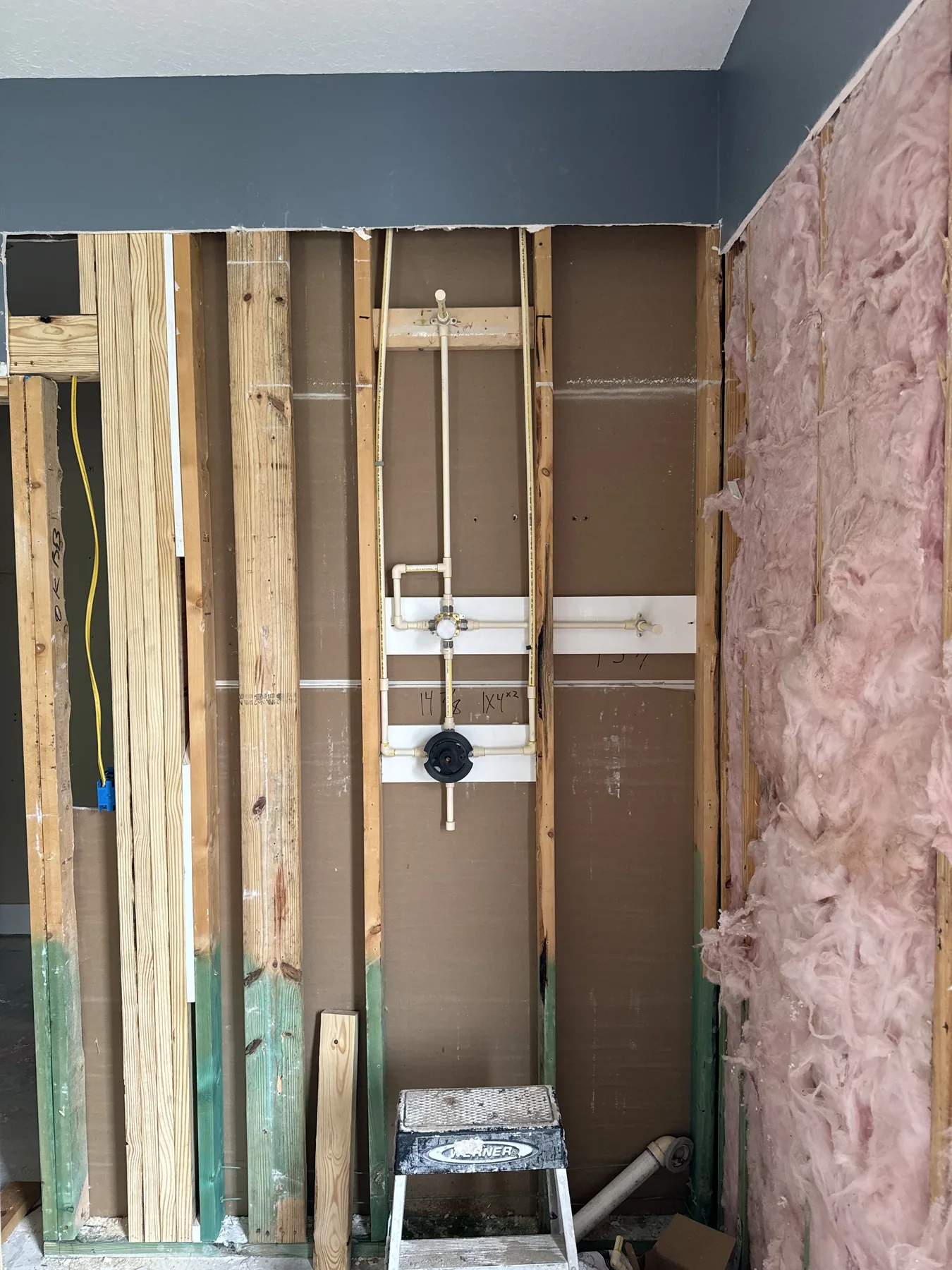
Setting a whole-house filtration system with bypass valves on the main supply line.
Get it looked at
Wondering what is actually in your water? Call 850-318-5777. We test first and recommend second, or tell you that you do not need anything.
- Answered 24 hours, 7 days
- Licensed CFC1429646 and CMC1250426
- Repair first, always
A maintenance plan puts a licensed contractor’s eyes on this before it fails.
How we approach it
- Test the water
Sample from your line and find out what is present. Everything after this depends on it.
- Explain the results plainly
What is in the water, what it is doing to your fixtures, and what actually matters versus what is merely detectable.
- Match equipment to findings
Sediment, carbon, softening, or a combination, sized to the household. If the test does not justify a system, we will say so.
- Install it properly
Correct placement in the line, bypass valves so the house has water during service, and drainage handled to code.
- Show you the upkeep
Cartridge intervals, salt if there is a softener, what to watch. Equipment nobody maintains stops working within a year.
Water treatment around Freeport and the coast
Households on Regional Utilities across Freeport, Santa Rosa Beach, Point Washington, and the 30A towns get treated municipal water drawn from wells, so the usual conversation there is about mineral scale and taste rather than safety. We install filtration in Seagrove Beach, Grayton Beach, Seaside, WaterColor, Inlet Beach, Miramar Beach, and Destin, often for owners tired of scale on glass shower enclosures in rental properties.
Out past the franchise boundaries, toward Paxton, Westville, Ponce de Leon, Vernon, Caryville, and Ebro, more properties run on private wells and the water is whatever the aquifer under that parcel provides. Those jobs always start with a test, because iron, sulfur, and sediment show up in wildly different combinations from one property to the next. We also serve DeFuniak Springs, Niceville, Valparaiso, Eglin Air Force Base, Choctaw Beach, and Panama City Beach.
Home base is Freeport, and from there we’re regularly in Miramar Beach, Destin, Santa Rosa Beach, Niceville, Point Washington, Valparaiso, Eglin Air Force Base, Caryville, Vernon and Ebro. The rest of our range is listed on the service area page.
Questions we get about this
Do I need a whole-house system or just a filter at the sink?
It depends on what is bothering you. If the complaint is drinking water taste, a point-of-use filter at one tap solves it for far less. If the complaint is scale on fixtures, buildup in the water heater, and stiff laundry, that is happening throughout the house and needs treatment at the main.
Is the water here bad?
No. Regional Utilities treats and monitors the municipal supply and it meets the standards it is required to meet. Most filtration around here is about taste, scale, and protecting fixtures rather than about safety. Private wells are a different situation, since nobody is testing those but you.
How hard is our water?
We are not going to quote you a number we have not measured. Mineral content is a familiar concern locally and hardness varies with the source and your location in the system, so we test your line and give you your actual figure rather than a neighborhood average.
Will a softener make my water taste salty?
A properly sized and set softener should not. Salt is used to regenerate the resin bed, not to add salt to your drinking water. If softened water tastes salty, something is set wrong or the unit is regenerating improperly, and that is worth looking at.
What maintenance do these systems need?
Cartridge filters get changed on a schedule based on your water and your usage. Softeners need salt kept up and periodic checks on the settings. We show you exactly what yours needs before we leave, because a neglected system quietly stops doing anything.
Related plumbing work
- Gas Line Installation
- Gas Line Repair
- Repiping
- Bathroom Plumbing
- Kitchen Plumbing
- New Construction Plumbing
- Plumbing Inspection
- Hydro Jetting
- Emergency Plumbing
This page covers one job. The rest of what we do is on the plumbing page, and real job photos are in the gallery. For anything else, call 850-318-5777 or send us a message.