
Fixing the Leak Once You Know Where It Is
Once a leak is located, the real question is how to fix it with the least damage to your house. That answer changes with where the pipe runs.

Repair starts where detection ends. You know the spot, so now it is a decision about access and method. A leak at an exposed fitting under a sink is a twenty-minute job. The same size hole in a copper line six inches under a living room slab is a different conversation, and pretending otherwise is how people get talked into work they did not need.
For a line under concrete there are basically two roads. Open the slab at the marked point, cut out the bad section, and put in new pipe. Or abandon that run and reroute a new line overhead through the attic and down a wall. Spot repair is less disruptive and cheaper if the pipe is otherwise sound. A reroute makes sense when the line has already failed once before, because a pipe that pinholes in one place is usually thinning everywhere.
We lead with repair. That is the whole reason Noah started the company, he was tired of watching people get sold a repipe when a section swap would have carried them for years. If your system genuinely needs more than a patch we will tell you plainly and show you why. We just will not open with it.
Leaks we get called out to fix
- A located slab leak that a detection visit already marked
- Green or white crust building on a copper joint, which means it has been weeping
- A supply line to a toilet or faucet that drips at the connection
- A pinhole spraying a fine mist inside a wall cavity or attic
- Water heater fittings leaking at the top connections
- A hose bibb that runs down the exterior wall after a freeze
A pipe that pinholed once is telling you something about the whole run.
What we are actually repairing
Most repairs come down to metal that got thin or a seal that got old. Copper corrodes from water chemistry and from the constant flex of hot lines expanding and contracting. Threaded steel connections rust at the thread, where the metal is thinnest by design. Rubber and fiber washers harden and stop conforming. None of it is dramatic, it is just materials aging at different rates in the same wall.
Our climate adds pressure from outside. Salt air near the Gulf works on exposed metal at hose bibbs, outdoor showers, and anything on the beach side of a house, so coastal properties in Inlet Beach, Grayton Beach, and Miramar Beach chew through exterior fittings faster than an inland house in DeFuniak Springs does. Choosing the right material for that exposure is part of the repair, not an upsell.
Then there is the repair that was done badly the first time. Mixed metals joined without a dielectric fitting corrode at the junction. Overtightened plastic nuts crack months later. We see a fair amount of work where the original fix caused the second failure, and part of doing this right is not repeating it.
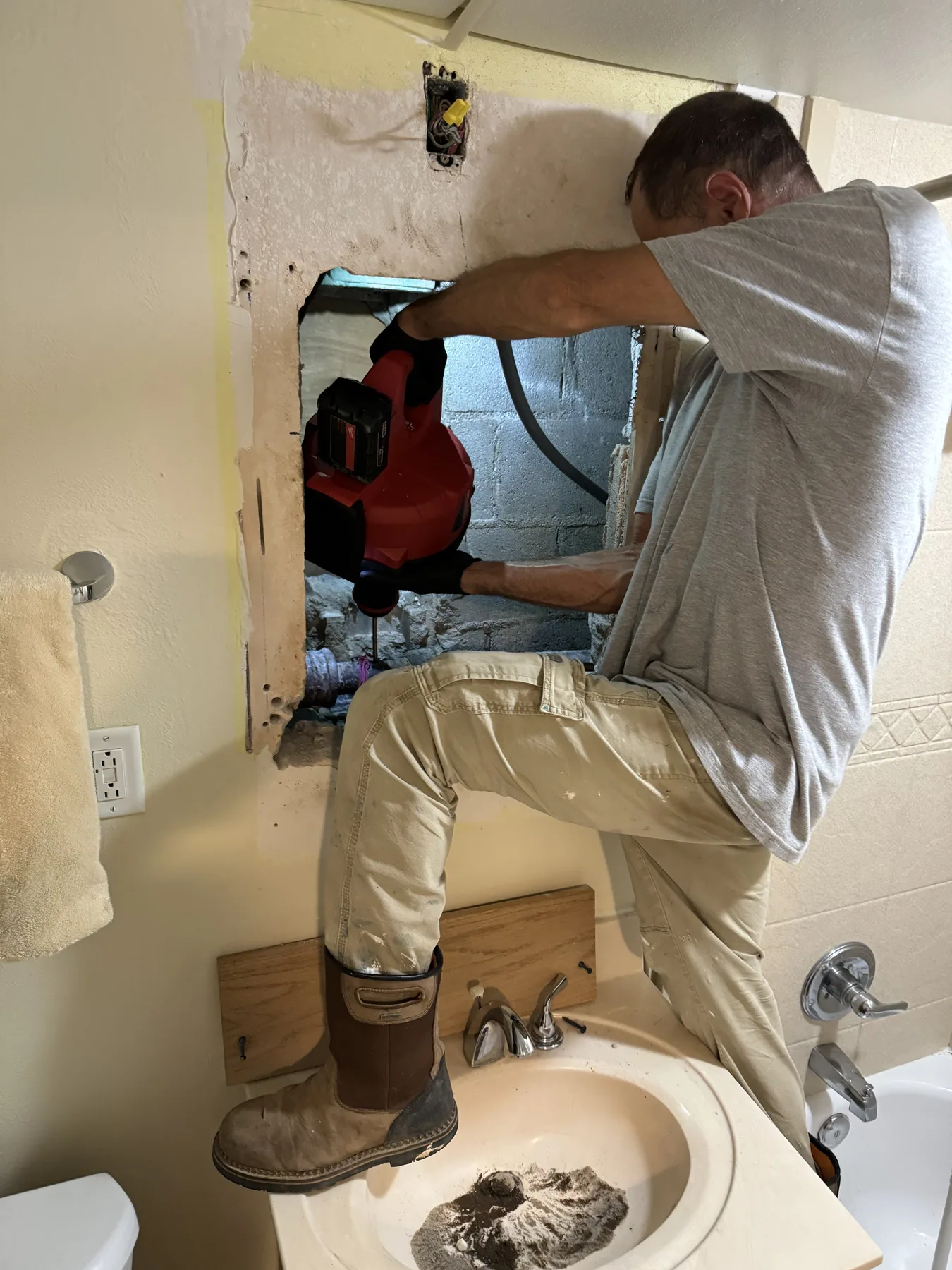
Cutting out a corroded section of copper and joining in new line on a repair in Santa Rosa Beach.
Get it looked at
Know where the leak is and want it handled? Call 850-318-5777 and we will tell you what it takes to fix it properly.
- Answered 24 hours, 7 days
- Licensed CFC1429646 and CMC1250426
- Repair first, always
Maintenance plan visits come with a written condition report and photos.
The repair, start to finish
- Confirm the location
We verify the leak is where it was marked before anything gets opened. Cutting the wrong spot helps nobody.
- Pick the access route
Through the slab, through a wall, or overhead reroute, whichever gets to the pipe with the least tearing out.
- Cut out the failed section
The damaged run comes out entirely. We do not wrap a clamp around a rotting pipe and call it repaired.
- Join it properly
New pipe, correct fittings, correct materials for the exposure, pressure tested before anything closes back up.
- Put the area back
The opening gets closed and cleaned up, and you get told plainly what shape the rest of that line is in.
Repair work across the Emerald Coast
Freeport and Santa Rosa Beach are our home ground and where most repair calls come from. Along 30A we work in Seaside, WaterColor, Seagrove Beach, Grayton Beach, Inlet Beach, and Point Washington, where a lot of the housing is newer construction on slab with the whole supply system the same age. When those hit their first failures, they tend to hit several in a stretch.
Inland the housing stock is older and more mixed, so repairs in DeFuniak Springs, Paxton, Ponce de Leon, Vernon, Caryville, and Westville often involve older galvanized or a patchwork of materials from different decades. We also cover Destin, Miramar Beach, Niceville, Valparaiso, Eglin Air Force Base, Choctaw Beach, Ebro, and Panama City Beach.
Home base is Freeport, and from there we’re regularly in Miramar Beach, Destin, Santa Rosa Beach, Niceville, Point Washington, Valparaiso, Eglin Air Force Base, Caryville, Vernon and Ebro. The rest of our range is listed on the service area page.
Questions we get about this
Should I do a spot repair or reroute the line?
If the pipe is otherwise in good shape and this is a first failure, a spot repair is usually the sensible move. It costs less and disturbs less of the house.
If that same run has already leaked before, a reroute overhead is often the better value, because the rest of the pipe is the same age and the same thickness as the part that just failed.
Do you have to break the floor for a slab leak?
For a spot repair, yes, a small opening at the located point. An overhead reroute avoids opening the slab entirely by abandoning the buried run and going through the attic instead. Which one is right depends on the pipe, not on a policy.
Will you push me toward a whole repipe?
No. Repair-first is why this company exists. If a repipe is genuinely the better call we will explain the reasoning and show you the pipe, but we start with the smallest fix that actually solves it.
Can you repair a leak you did not find?
Yes, though we will confirm the location ourselves before opening anything. If a previous locate was off, cutting where it says wastes your money and leaves the leak running.
How long does a typical repair take?
An accessible fitting or supply line is usually the same visit. A slab spot repair takes longer because of the opening and the concrete work, and a full reroute is typically a day or more depending on the layout of the house.
What about the drywall and flooring after?
We close the opening we made and clean up behind ourselves. Finish work like matching tile or texturing and painting drywall is normally handled separately, and we will tell you up front what is and is not included so there is no surprise.
Related plumbing work
- Drain Cleaning
- Sewer Line Repair
- Sewer Line Replacement
- Water Heater Repair
- Water Heater Installation
- Tankless Water Heater Repair
- Tankless Water Heater Replacement
- Tankless Water Heater Installation
- Water Filtration
This page covers one job. The rest of what we do is on the plumbing page, and real job photos are in the gallery. For anything else, call 850-318-5777 or send us a message.