
Cold showers usually mean one broken part
A tank heater that quits is usually one failed component, not a dead tank. We find out which before anybody talks about replacing anything.
A storage water heater is a simple machine. Cold water drops to the bottom of the tank through a dip tube, a burner or an electric element heats it, a thermostat decides when to stop, and a temperature and pressure valve protects the whole thing from going too hot or too high. When you lose hot water, one of those five parts is almost always the reason.
That matters because the parts are cheap and the tank is not. A gas heater that will not stay lit often has a failed thermocouple, a little sensor that tells the gas valve the pilot is actually burning. An electric heater that gives you two lukewarm showers has usually lost its upper or lower element. Neither one is a reason to buy a new heater.
We check the parts first. If the tank itself is rusted through and leaking from the shell, we will tell you that plainly, because welding a rusted tank is not a thing. But we are not going to quote you a whole replacement on a unit that needs one small sensor.
What you notice before it quits entirely
- Hot water runs out much faster than it used to, then comes back an hour later
- Water is warm but never actually hot, no matter where the dial is set
- Rumbling, popping or kettle sounds from the tank while it heats
- The pilot light will not stay lit after you relight it
- Rusty or brown hot water while the cold tap runs clear
- Water dripping from the discharge pipe at the side or top of the tank
- A slow puddle under the heater that keeps coming back after you mop it
A thermocouple failure and a dead tank feel identical in the shower. They are not the same repair.
Why tanks fail the way they do here
Sediment is the big one. Every gallon of water that enters the tank carries dissolved minerals, and when that water gets heated the minerals drop out and settle on the bottom. Our supply is drawn from wells and distributed municipally, so mineral content is a familiar thing around Freeport. On a gas heater that layer sits directly between the burner flame and the water, so the burner runs longer and hotter, the steel gets stressed, and you hear that popping sound as water flashes to steam underneath the crust.
The other quiet killer is the anode rod. It is a sacrificial metal rod hanging inside the tank whose whole job is to corrode instead of the tank lining. Once it is used up, the tank is next. Most people have never heard of it, which is why so many heaters die of rust at an age where they should still have years left.
Then there is the T and P valve, the safety valve on top. If it is weeping, sometimes that means thermal expansion pressure has nowhere to go, and sometimes it means the thermostat is running the tank far hotter than it should. Those are two different repairs, so we test rather than guess.
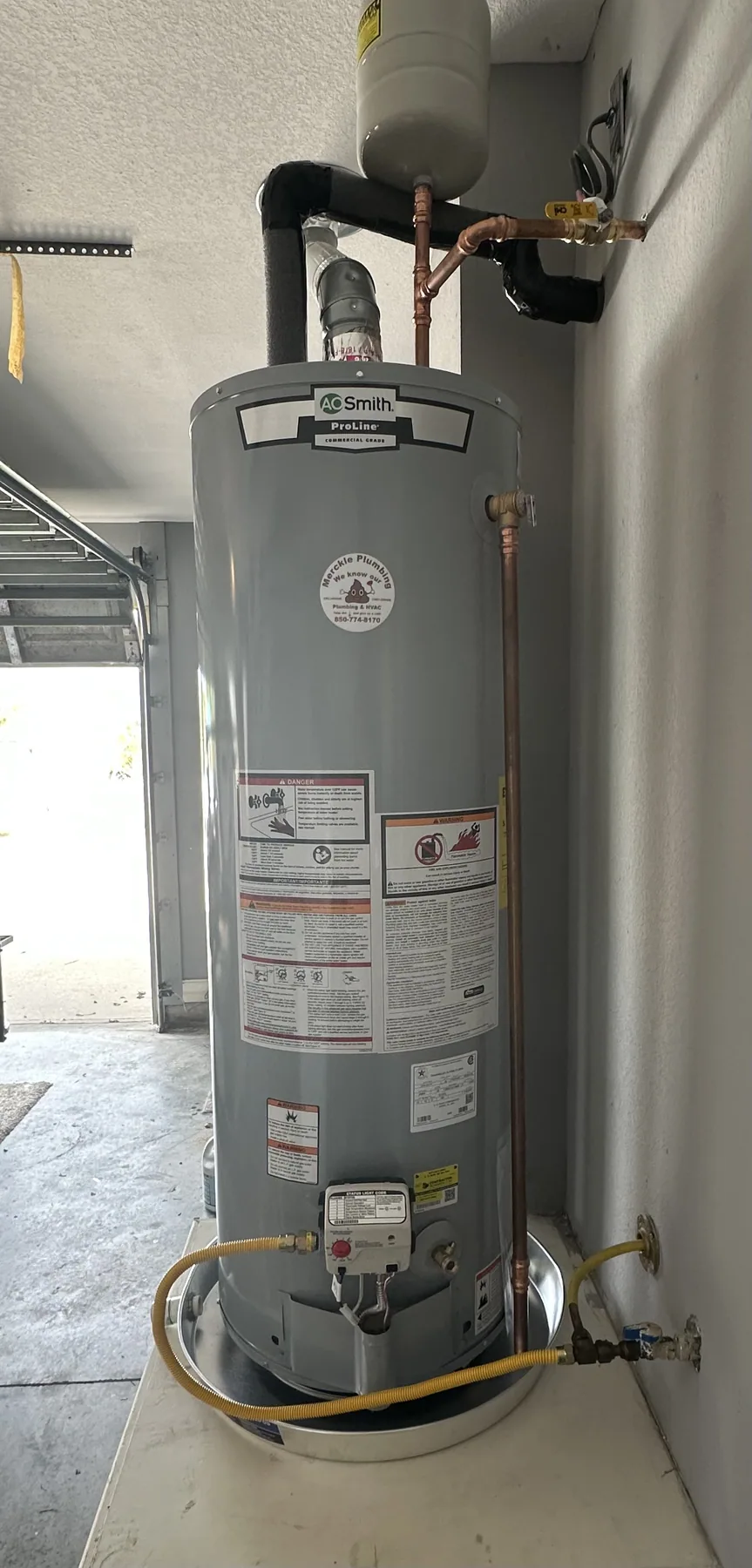
Testing a lower heating element before writing off the tank on a Santa Rosa Beach service call.
Get it looked at
Tell us what the heater is doing and roughly how old it is. We will tell you on the phone whether it sounds like a part or a tank, and what a visit takes.
- Answered 24 hours, 7 days
- Licensed CFC1429646 and CMC1250426
- Repair first, always
Maintenance plan visits come with a written condition report and photos.
How a repair call actually runs
- You tell us what it is doing
Lukewarm, no hot at all, noisy, leaking. Each of those points at a different part, so it shapes what we bring on the truck.
- Power, gas and supply get checked first
A tripped breaker, a closed gas valve or a stuck shutoff explains more no-hot-water calls than you would think. Free to rule out, embarrassing to skip.
- We test the components
Elements and thermostats get checked with a meter. On gas, we look at the thermocouple, the gas valve and the burner assembly. We are looking for the failed part, not a reason to sell a tank.
- You get a straight number before we touch anything
You hear what failed, what it takes to fix, and what it costs. If the tank is genuinely finished, you hear that too, with the reasoning.
- Repair and verification
We fix it, run it back up to temperature, confirm the recovery and check the T and P valve and connections before we leave.
Tank heaters we keep running along the coast
We repair storage heaters all through Walton County, from garages in Freeport and DeFuniak Springs to closets and attic platforms in Santa Rosa Beach and the 30A towns. Coastal rentals get worked hard: a four bedroom in Seagrove Beach or Inlet Beach can run four showers back to back on a Saturday changeover, and a heater with a failed lower element simply cannot keep up with that even though it seems fine on a quiet weekday.
West into Okaloosa we cover Niceville, Valparaiso, Destin and Eglin Air Force Base, and north and east we run out to Ponce de Leon, Vernon and Ebro. Older homes inland tend to have heaters in laundry rooms or garages where a slow leak goes unnoticed for weeks. Newer coastal construction often puts the unit in a conditioned closet, where the same leak reaches drywall and flooring fast. Where the heater sits changes how urgent the call is, and we will tell you honestly which one you have.
Beach-side calls take us to Santa Rosa Beach, Miramar Beach and Destin. Away from the beaches we’re in Freeport, Point Washington, Niceville, Valparaiso and Eglin Air Force Base, and farther up in Ebro, Vernon and Caryville. See the whole service area for more.
Questions we get about this
My heater is old. Is repairing it just throwing money away?
Not automatically. Age matters less than what actually failed. A ten year old tank with a bad thermostat and a clean shell has plenty of life in it. A six year old tank leaking from the seam does not, no matter how new it feels.
We will tell you which one you have and let you decide. That is the whole reason this company exists.
What is the popping noise?
Sediment on the tank floor. Water gets trapped underneath the mineral layer, flashes to steam, and forces its way up through the crust. It is a symptom, not an emergency, but it means the burner is working harder than it should and the tank bottom is taking heat it was not meant to take.
Water is dripping from a pipe near the top of the heater. Is that bad?
That is usually the temperature and pressure relief valve doing its job, which means something upstream is wrong. Either the thermostat is letting the tank overheat, or pressure has built up with nowhere to expand. Both are worth a call rather than a wait.
Can you work on the heater without replacing it?
Yes, and that is our default. Thermocouples, elements, thermostats, dip tubes, gas valves, T and P valves and anode rods are all serviceable parts. We replace a tank when the tank is the problem.
Do you come out after hours?
The phone is answered 24 hours a day, seven days, by a person. No hot water on a Tuesday morning can usually wait until we can get there properly. Water actively running across a floor cannot, and we treat those differently.
Do you handle tankless units too?
We do, but they fail for completely different reasons, mostly scale and ignition faults rather than elements and sediment. That work is on our tankless water heater repair page.
Related plumbing work
- Water Heater Installation
- Tankless Water Heater Repair
- Tankless Water Heater Replacement
- Tankless Water Heater Installation
- Water Filtration
- Gas Line Installation
- Gas Line Repair
- Repiping
- Bathroom Plumbing
Can’t find your exact problem above? Describe it on the contact form or over the phone at 850-318-5777. You can browse the full plumbing list first, or look through photos of our work.