Error code on the wall? Start with the scale
Tankless heaters tell you what is wrong with a code on the display. Reading it right is the difference between a descale and an unnecessary replacement.

A tankless heater has no tank to store hot water, so it has to heat on demand. Open a tap, a flow sensor notices water moving, the controller fires the burner, and water races through a narrow heat exchanger picking up heat as it goes. Everything about that design depends on unrestricted flow through a very small passage.
Which is exactly where these units get into trouble here. Our water is drawn from wells and carries dissolved mineral, and mineral plus high heat inside a narrow copper or stainless passage equals scale. Scale on the exchanger wall insulates the water from the flame, so the unit overfires trying to hit its target, temperatures swing, and eventually the controller throws a code and shuts down to protect itself.
The good news is that most tankless faults are diagnosable rather than fatal. Codes point at ignition, flame sensing, flow, venting or overheat. A descale, a flow sensor cleaning or an igniter often puts the unit right back into service. We would rather do that than sell you a new one.
Symptoms that point at the heat exchanger
- An error code on the display that clears briefly and then returns
- Water goes hot, then cold, then hot again while nothing else changed
- You need to run the tap harder than you used to before it fires at all
- The burner cycles on and off rapidly during a single shower
- Reduced hot water flow at every fixture at once, rather than one
- A rumbling or whistling from the unit that was not there before
- The unit shuts down completely when two fixtures run together
Scale on a tankless exchanger does not make the unit weaker. It makes it run hotter and shut itself off.
Why tankless units fail differently than tanks
Scale is the headline. A tank heater deals with mineral by dropping it harmlessly to the bottom, where it sits and annoys the burner. A tankless unit has nowhere to drop it, so it plates onto the inside of the heat exchanger passages. Because our municipal supply comes from wells including the Rock Hill wellfield north of Freeport, mineral content is a familiar local reality, and units that never get flushed here foul faster than the manual assumes.
The flow sensor is second. It is a small turbine that has to spin freely for the unit to know water is moving. Debris or scale on that turbine means the unit either fails to fire at all or fires late, which is what causes the cold slug of water people describe as a cold water sandwich. That is a cleaning, not a replacement.
Then ignition and venting. Igniters and flame rods wear out, and flame rods in particular get a coating over time that stops them sensing a flame that is clearly burning, so the unit locks out for safety. Venting matters too: a blocked or restricted vent trips the unit’s protection long before it becomes dangerous, which is the system working correctly. Reading which of these the code actually points at is the whole job.
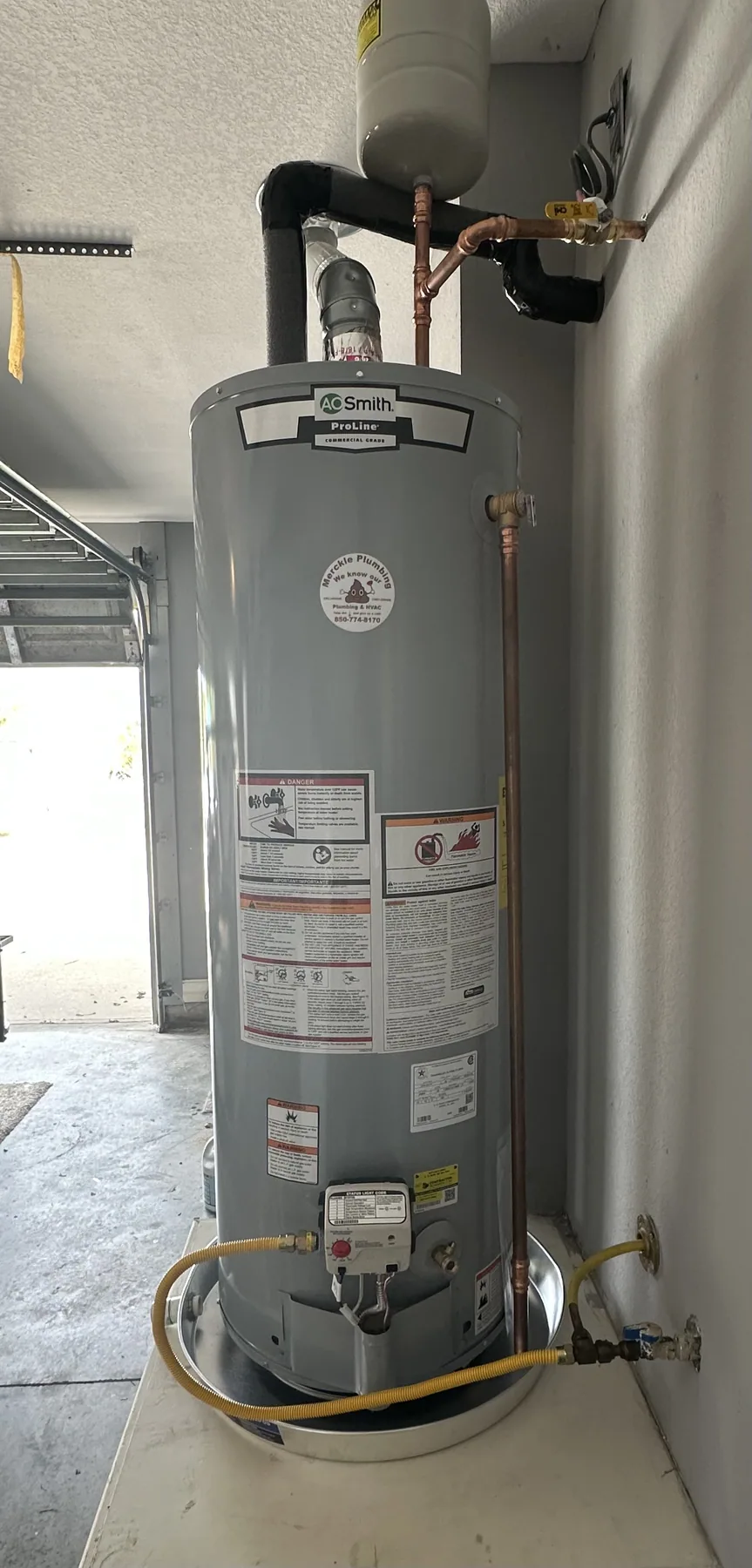
Descaling a wall-mounted tankless unit through its isolation valves on a Point Washington service call.
Get it looked at
Read us the error code off the display when you call. That one number narrows it down before we ever load the truck.
- Answered 24 hours, 7 days
- Licensed CFC1429646 and CMC1250426
- Repair first, always
Seniors and military members get 5% off our maintenance plans.
How we work through a fault
- Pull the code history
The controller stores what it has been complaining about. That history tells us whether this is a one off or a pattern building for months.
- Verify gas, water and venting
Supply pressure, inlet filter screen, isolation valves and vent condition. Restrictions upstream cause faults that look like unit failure.
- Check the exchanger for scale
Flow rate, temperature rise and burner behavior tell us how fouled it is. A descale with a circulation pump and solution is a routine service, not a repair of last resort.
- Test the components
Flow sensor, igniter, flame rod, gas valve and thermistors get checked individually rather than replaced as a set.
- You get the finding and the number
What failed, why, what it takes and what it costs. If a unit is genuinely past economic repair we say so and explain the reasoning.
Tankless service around the wellfield towns
We service tankless units through Freeport, Santa Rosa Beach, Point Washington and the 30A corridor including Seaside, WaterColor, Seagrove Beach and Inlet Beach. Tankless is popular in coastal and rental homes here because it saves closet space and never runs out mid changeover, but those same houses often go months without a flush, and scale does not take a holiday when the house is empty.
Inland we cover DeFuniak Springs, Paxton, Ponce de Leon, Vernon and Ebro, plus Niceville, Valparaiso, Destin and Eglin Air Force Base to the west. Homes on private wells outside the utility franchise tend to see scale build faster still, and those units benefit from flushing on a shorter interval than the manual suggests. We will tell you what interval your unit and your water actually need rather than repeating the factory default.
Not sure we reach you? Regular stops include Valparaiso, Ebro, Santa Rosa Beach, Destin, Vernon, Point Washington, Niceville, Caryville, Miramar Beach, Eglin Air Force Base and our hometown of Freeport. If your town isn’t named, the full service area list will settle it.
Questions we get about this
What does my error code mean?
Codes differ by manufacturer, but the families are consistent: ignition failure, flame loss, overheat, flow fault, venting restriction. Call and read it to us and we can usually tell you which family you are in before we arrive.
That matters because some codes are a five minute reset of an upstream issue and some mean the exchanger needs attention.
What is a descale and does my unit need one?
It is a circulation flush that dissolves mineral off the inside of the heat exchanger. Every tankless unit needs it periodically, and units on our well drawn supply generally need it more often than the manual implies. If your unit has never had one, it is due.
Why do I get cold water in the middle of a shower?
Usually the flow sensor or the unit’s minimum activation flow. If the tap is barely open, or the sensor is fouled, the burner drops out and you get a slug of unheated water before it catches again. It is a common complaint and it is usually fixable without touching the exchanger.
Is it worth repairing or should I just replace it?
Most of the time repair wins. Flow sensors, igniters, flame rods and descaling are routine service items on a unit that is otherwise fine. Replacement makes sense when the heat exchanger itself has failed, and we will show you why we think so rather than just asserting it.
Do you work on any brand?
We service the common brands installed around here. Tell us the make and model when you call so we can bring the right parts rather than making a second trip.
My unit is fine but I want it maintained. Do you do that?
Yes, and honestly that is the better call. A flush before it faults is a scheduled visit. A flush after it faults is an emergency in the middle of a rental changeover. Our maintenance plans cover this kind of thing.
Related plumbing work
- Tankless Water Heater Replacement
- Tankless Water Heater Installation
- Water Filtration
- Gas Line Installation
- Gas Line Repair
- Repiping
- Bathroom Plumbing
- Kitchen Plumbing
- New Construction Plumbing
If it leaks, drips, backs up or runs cold, chances are it is on our plumbing page. Still unsure? 850-318-5777 gets you a real person, the contact page takes a written description, and the gallery shows finished work.