
Cooling Quit? Here Is What Usually Causes It Here
Air conditioning on the Gulf Coast fails in patterns. Four causes account for most of the no cooling calls we run between April and October.
Your air conditioner does not make cold. It moves heat out of the house and dumps it outside, using refrigerant that changes state as it circulates. Warm indoor air passes across a cold evaporator coil, the refrigerant absorbs that heat and boils into a gas, the compressor pressurizes it, and the outdoor condenser coil releases the heat to the air outside. Interrupt any part of that loop and cooling stops.
Northwest Florida puts specific stress on that loop. Summer dew points sit in the high 60s and low 70s, so the coil is pulling a tremendous amount of moisture out of the air on top of pulling heat. Systems run nearly continuously from April through October. And within a few miles of the Gulf, salt in the air is chewing at the outdoor coil the entire time.
That combination means our failures skew heavily toward four things: condensate drainage, capacitors, coil corrosion, and dirty coils. We start where the evidence points instead of assuming the expensive answer, and a great many of these calls end as a modest repair rather than the replacement quote people brace for.
What a Failing AC Does First
- Air from the vents is only slightly cool while the outdoor unit runs nonstop
- Water pooling near the air handler or a stain spreading on the ceiling below it
- The outdoor unit hums but the fan will not start turning on its own
- Ice forming on the copper suction line or on the indoor coil itself
- The system trips off on its own and will not restart until it has sat a while
- The outdoor coil fins look chalky, white crusted, or bent flat
- Bills jumped this summer with no change in how you use the thermostat
In this climate the drain line never dries out, so things grow inside it and plug it.
The Four Big Ones on the Gulf Coast
Condensate drain clogs lead the list, and the reason is specific to humid climates. Your evaporator coil condenses moisture out of the air constantly, and that water drains away through a small PVC line. In a dry climate the system cycles off long enough for that line to dry out between runs. Here, from April through October, it essentially never does. A line that stays permanently wet grows algae and biological slime, that growth plugs the pipe, and then the safety switch shuts the system down or the pan overflows into your ceiling.
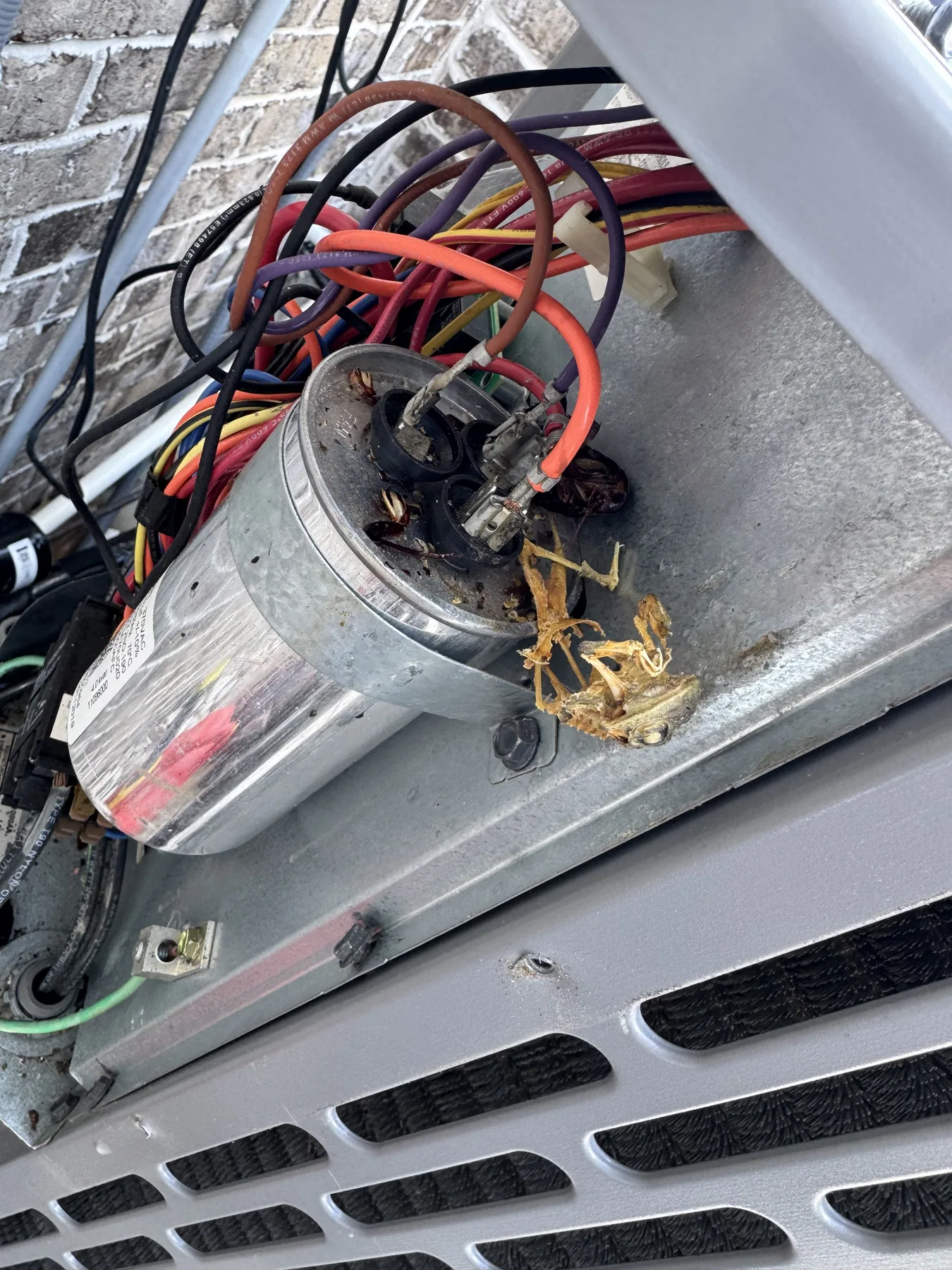
Capacitors are second. A capacitor stores the electrical jolt needed to start the compressor and the fan motor, and heat is what kills them. They live in an outdoor cabinet in full Florida sun, which is why they fail here at rates that surprise people from cooler states. The classic symptom is an outdoor unit that hums without the fan spinning, and it very often happens on the hottest afternoon of the week rather than at a convenient moment.
Salt air corrosion is the coastal one. Close to the Gulf, salt settles on the aluminum fins and copper tubing of the outdoor condenser coil. Over time it corrodes the metal, and where the copper thins enough you get pinhole leaks that let refrigerant escape slowly. A slow leak is sneaky, because the system keeps working, just gradually worse, and the first thing anyone notices is that it cannot keep up on hot days. Rinsing the coil with fresh water regularly genuinely slows this down. Dirty coils are the fourth, and they are simple physics: a coil packed with dust, pollen, or grass clippings cannot transfer heat, so the system runs longer and harder to accomplish less.

Clearing a plugged condensate line at an air handler after a float switch shut the system down.
Get it looked at
Not cooling right? Call 850-318-5777 and get it looked at before a plugged drain becomes a ceiling repair.
- Answered 24 hours, 7 days
- Licensed CFC1429646 and CMC1250426
- Repair first, always
Maintenance plan visits come with a written condition report and photos.
How We Chase a No Cooling Call
- Check the drain and the safety first
Float switches shut systems off deliberately. Confirming whether a safety tripped takes a minute and saves you from paying to diagnose a system that is working exactly as designed.
- Test the electrical components
Capacitor values, contactor condition, and motor amp draw get measured against spec. Weak capacitors read weak long before they read dead.
- Read the refrigerant side
Suction and liquid pressures against ambient conditions tell us whether the charge is right, whether there is a restriction, or whether airflow is the real problem.
- Inspect both coils
Indoor coil for dirt and ice, outdoor coil for corrosion and blockage. On coastal homes this is often where the answer has been sitting.
- Fix it and prove it
Repair made, system run through a full cooling cycle, and temperature split re-measured at the register so you can see it is genuinely working again.
Chasing Cooling Failures From the Beach to Inland Walton
Proximity to the Gulf changes what we find. On calls in Inlet Beach, Grayton Beach, Seagrove Beach, Seaside, WaterColor, Miramar Beach and Santa Rosa Beach, we check the outdoor coil early, because salt corrosion and pinhole leaks are simply more common the closer a condenser sits to the water. Units on the seaward side of a house take the worst of it.
Inland around Freeport, Point Washington, DeFuniak Springs, Paxton, Ebro and Vernon, corrosion drops down the list and drain clogs, dirty coils, and heat stressed electrical parts move up. We cover Niceville, Valparaiso, Destin, Eglin Air Force Base, Choctaw Beach, Westville, Ponce de Leon, Caryville and Panama City Beach as well. Vacation rentals get their own attention, since a system running flat out for a full house all summer accumulates wear a good deal faster than one in a home with two people in it.
Towns we get to most: Freeport, Santa Rosa Beach, Point Washington, Miramar Beach, Niceville, Destin, Eglin Air Force Base, Valparaiso, Ebro, Vernon, Caryville. See the full service area.
Questions we get about this
Why does my drain line keep clogging every summer?
Because it never dries out. Between April and October your system runs so much that the line stays wet continuously, and constant moisture lets algae and biological slime grow inside the pipe until it blocks. It is far more common in humid coastal climates than in dry ones.
Having the line cleared and treated as part of regular maintenance is what keeps it from becoming a ceiling stain in August.
My outdoor unit is humming but the fan is not spinning. What is that?
That is the textbook symptom of a failed run capacitor. The motor is getting power but does not have the starting torque it needs. It is a common, inexpensive part, and it is one of the most frequent repairs we make in summer.
There is ice on my refrigerant line. Should I keep running it?
No, shut it off and let it thaw. Ice means either airflow is restricted or the refrigerant charge is low, and running a frozen system risks liquid refrigerant reaching the compressor, which turns a moderate repair into an expensive one. Turn the fan to on to help it thaw and call us.
Does living near the beach really wear out my AC faster?
Salt air does corrode outdoor condenser coils, and pinhole refrigerant leaks from that corrosion are something we find regularly on coastal units. Rinsing the outdoor coil with fresh water on a regular basis helps meaningfully. We will not quote you a lifespan number, because it depends heavily on the individual site.
Can you add refrigerant to fix low cooling?
We can, but refrigerant does not get used up. If a system is low, it leaked, and simply adding more means you pay again next season while the leak keeps going. We look for the leak first and tell you what it takes to actually repair it.
Will you try to sell me a new system?
No. Most no cooling calls turn out to be a capacitor, a contactor, a plugged drain, or a dirty coil, and those get repaired. If the equipment is genuinely at the end, we will explain exactly why and let you decide without pressure.
Related HVAC work
- Furnace Repair
- Furnace Installation
- Furnace Tune-Up
- Heat Pump Service
- Air Balancing
- Evaporative Coolers
- Smart Thermostat Installation
- Air Duct Cleaning
- Air Balancing Analysis
You don’t need to know what the problem is called. Tell us what the system is doing at 850-318-5777 or through the contact page, and we’ll sort out which service it is. The HVAC page and the gallery are there if you want to look around first.