
Find Out How Much Cool Air Your Ducts Lose
Every joint in a duct system leaks a little. A test tells you whether yours leaks a little or leaks enough to be the reason your house never gets comfortable.
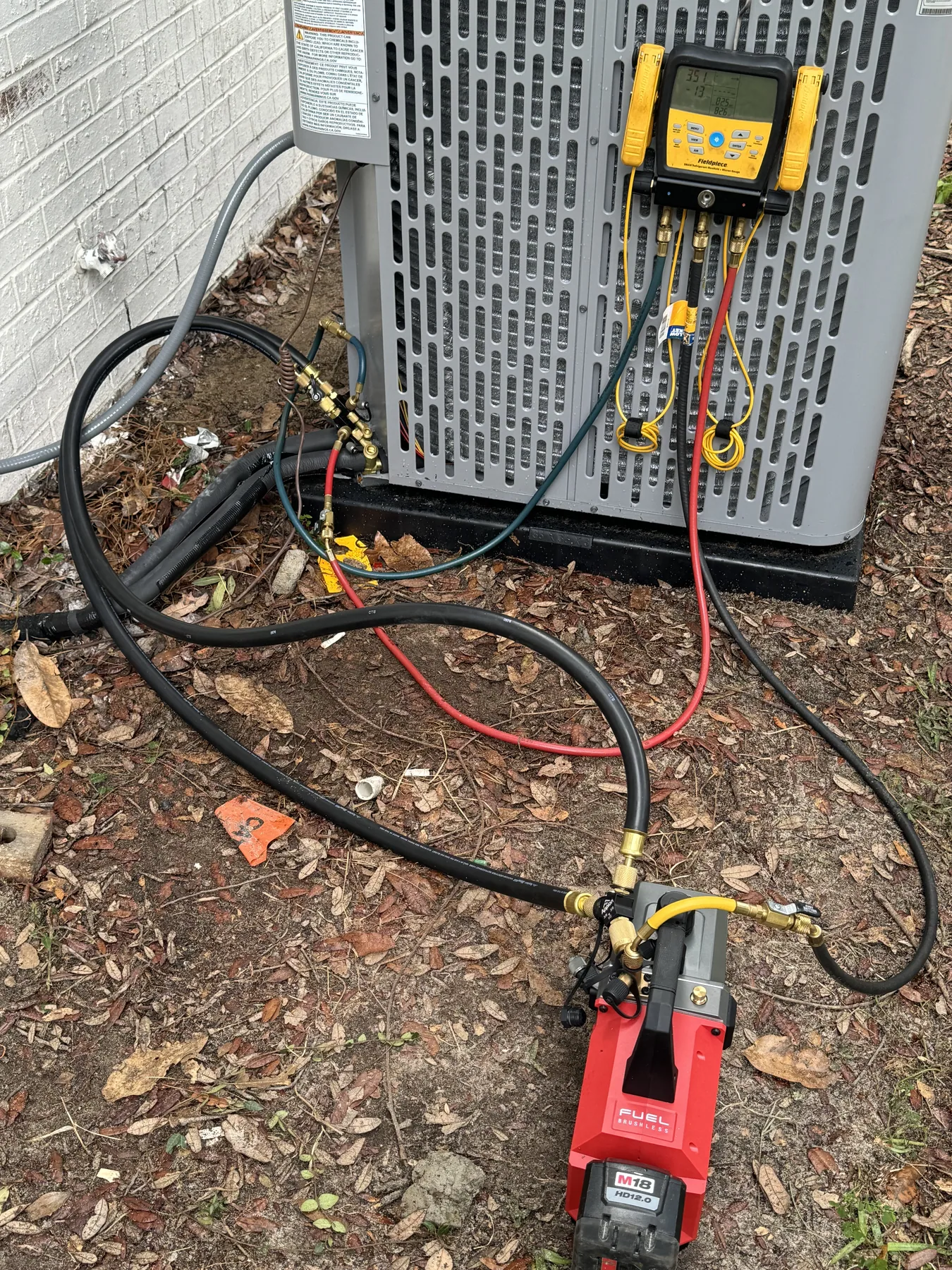
Duct leakage testing puts the duct system under pressure and measures how much air escapes. We seal the registers, connect a calibrated fan to the system, bring it to a set pressure, and read how much air the fan has to push to hold that pressure. Whatever the fan has to supply is exactly what the ductwork is losing through seams, boots, connections and tears.
Here is why anybody should care. In a Florida house the ducts usually run through the attic, and a Freeport attic in July is punishingly hot and full of humid outdoor air. Air lost from a supply duct up there is air you already paid to cool, dumped into a space nobody occupies. Worse, a leaky return pulls that hot attic air straight into the system, so the equipment spends its day cooling the attic instead of your bedrooms.
The test turns a hunch into a number. Instead of arguing about whether the ductwork is bad enough to justify repairs, you get a measured leakage figure against the system’s design airflow. That number tells you plainly whether sealing is worth doing and gives you something to compare against after the work is finished.
Reasons to Test
- Cooling bills that keep climbing while the equipment is the same age and the habits have not changed
- The air handler runs almost constantly through the summer and the house still feels damp
- Dust settles back onto surfaces within a day or two of cleaning
- The attic access hatch or attic space feels noticeably cool when the AC is running
- Rooms furthest from the air handler get weak airflow no matter how the dampers are set
- The ductwork is original flex duct on a house that is a couple of decades old or more
- You are about to pay for duct sealing and want to know the before number
Air leaking out of an attic duct is air you already paid to cool, spent on nobody.
Why Duct Systems Leak Here
Flex duct is joined with mastic, tape and straps at boots, takeoffs and plenum connections. Those joints are the failure points. Tape dries out and lets go, straps loosen, a boot works free of a ceiling register, and an insulated flex run gets torn by somebody moving through the attic to service something else. None of it is visible from inside the house.
Heat and humidity accelerate all of it. An attic here swings through wide temperature ranges every single day for months, and materials expand, contract and get brittle. Meanwhile our high dew points mean that when air leaks around a cold supply boot, the surrounding surfaces sit below dew point and condensation forms. That wets insulation, stains ceilings, and gives mold something to live on.
Return side leaks deserve special mention because they do the most damage for the least visibility. A return that pulls unconditioned attic air is importing hot, humid, dusty air directly into your filter and coil. You feel it as a house that never dehumidifies properly and a filter that loads up far faster than it should.
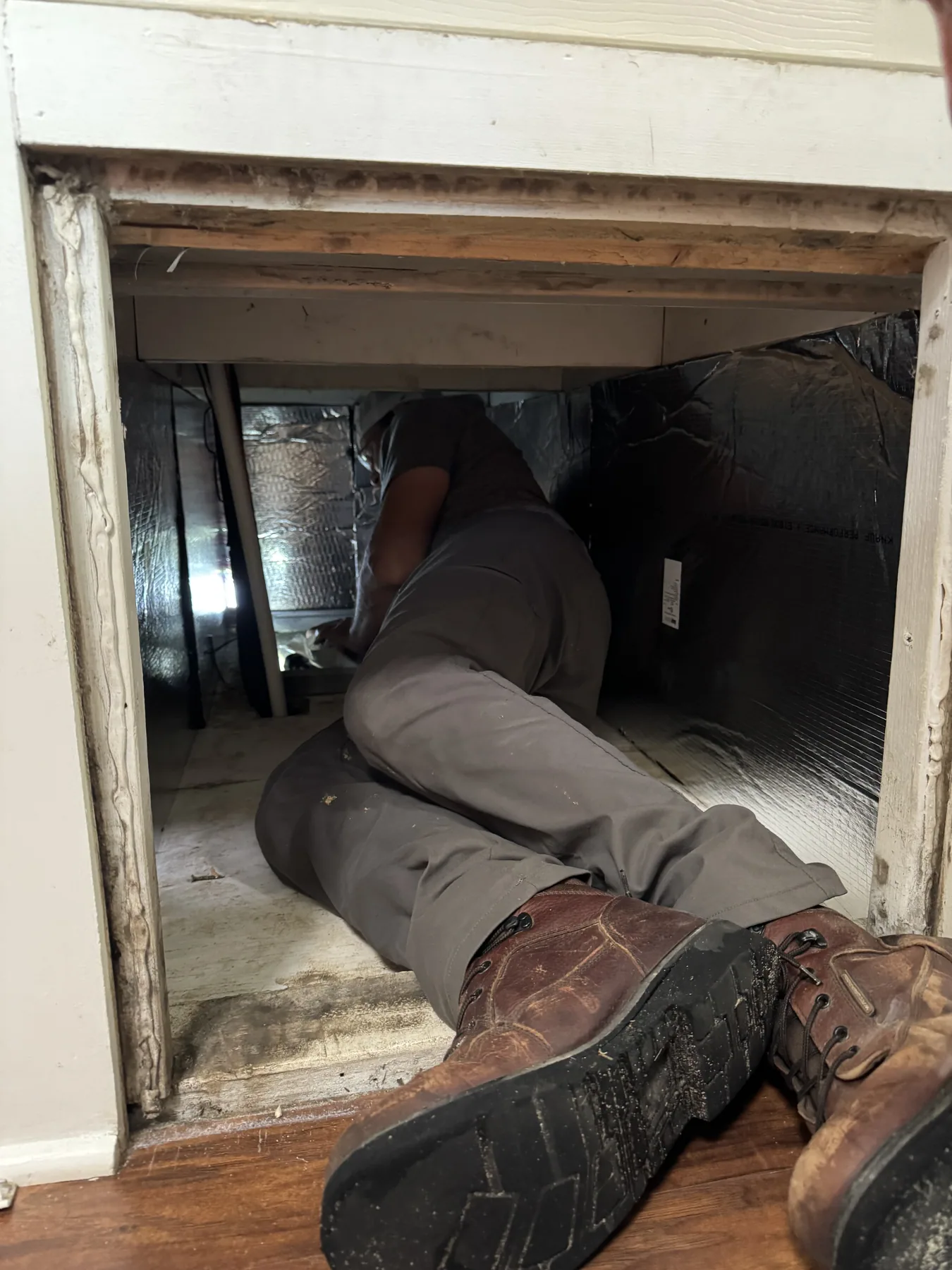
Blocking a ceiling register before pressurizing the duct system for a leakage measurement.
Get it looked at
A test gives you a measured leakage number instead of a guess. Call 850-318-5777 and we will tell you what the test costs before we schedule it.
- Answered 24 hours, 7 days
- Licensed CFC1429646 and CMC1250426
- Repair first, always
Prices for every maintenance plan are posted, so you know the cost before booking.
How the Test Runs
- Inspect what we can reach
Attic and crawl accessible duct gets a visual look first, since obvious disconnections should be found before you pay to measure them.
- Seal the openings
Every supply and return register gets temporarily blocked so the duct system becomes a closed loop.
- Pressurize with a calibrated fan
The duct system is brought to a standard test pressure and held there while the equipment records airflow.
- Read the leakage
The airflow the fan must supply to maintain that pressure is the leakage rate, expressed against the system’s design airflow.
- Locate the losses
With the system pressurized we walk the accessible runs to find where the air is actually escaping, and we photograph it.
- Explain the number
You get the measurement, the photos, and a plain explanation of whether sealing is worth doing on your system.
Testing Homes and Buildings Across the Panhandle
We test in Freeport, Santa Rosa Beach, Point Washington, Miramar Beach, and the 30A towns including Seaside, WaterColor, Grayton Beach, Seagrove Beach and Inlet Beach. Coastal houses often have long attic duct runs, and the ones built during busy stretches tend to show the sloppiest joints.
Inland and east we cover DeFuniak Springs, Paxton, Choctaw Beach, Ebro, Vernon, Caryville, Westville and Ponce de Leon, along with Niceville, Destin, Valparaiso, Eglin Air Force Base and Panama City Beach. Commercial duct testing is available across the same area. Call 850-318-5777.
Home base is Freeport, and from there we’re regularly in Miramar Beach, Destin, Santa Rosa Beach, Niceville, Point Washington, Valparaiso, Eglin Air Force Base, Caryville, Vernon and Ebro. The rest of our range is listed on the service area page.
Questions we get about this
What does the test actually measure?
The volume of air escaping the duct system at a standard test pressure, reported against how much air the system is designed to move. It gives you a percentage rather than an opinion.
Do I have to leave the house during the test?
No. We block registers and run a calibrated fan for a while, which is noisy but harmless. You can carry on around us.
Will testing tell you where the leaks are?
The measurement tells you how much. Locating the leaks is a separate part of the visit, where we walk the accessible ductwork with the system pressurized and find the escaping air. Some of it hides in places nobody can reach without opening things up, and we will be honest about that.
Is this the same as duct sealing?
No. Testing measures, sealing repairs. Plenty of people do both in sequence, and testing again afterward is how you prove the sealing worked.
Does duct leakage really affect humidity?
Considerably, in our climate. A leaky return pulls humid attic air into the system, and the equipment spends its capacity wringing water out of outdoor air instead of cooling your rooms. Fixing that often does more for how the house feels than any thermostat change.
Should I test before replacing my AC?
We would recommend it. Putting new equipment on a duct system that leaks badly gives you a new machine with the same old problem, and it is a lot cheaper to find that out first.
Related HVAC work
- Duct Sealing
- Mini-Split Installation
- Ductless Mini Splits
- HVAC Maintenance
- HVAC System Diagnostics
- Indoor Air Quality
- Emergency HVAC
- HVAC Repair
- HVAC Installation
If the job you need isn’t on this page, the HVAC services list probably has it. You can also see the gallery, or call 850-318-5777 and tell us what’s going on. A short note works too if you’d rather not call.