
Replace the Pipe Before It Picks the Date
When a building starts leaking in a new place every few months, you’re no longer fixing leaks. You’re paying for a repipe one emergency at a time.
Repiping means replacing the supply piping in a building rather than patching individual failures. It’s a big decision and nobody should make it casually, but there’s a point where the arithmetic flips. Once a system is failing from age or material rather than from a single bad joint, every repair is buying a few months, and the ceiling and drywall damage from each event costs more than the plumbing did.
The tell is the pattern. One leak is an event. Leaks in different locations, on different lines, in the same building over a year, are a system telling you something. In commercial and multi-unit buildings that pattern is expensive, because each event affects tenants, common areas and whatever sits below the failure.
The good news is that a repipe in an occupied building is a scheduling problem more than a plumbing problem. Buildings can be done in phases, riser by riser or floor by floor, with water restored at the end of each work window. That’s how a hotel or an apartment complex gets repiped without going dark, and planning that sequence is most of the work.
When patching stops making sense
- Leaks appearing in new locations rather than recurring at one fixed spot
- Pinhole leaks in copper showing up on more than one line
- Discolored water at multiple fixtures across different units
- Pressure that’s dropped building-wide over years, not overnight
- Repairs where the pipe crumbles or won’t hold a new fitting
- Galvanized supply piping still in service in an older building
- Insurance premiums or coverage questions tied to your plumbing’s age
One leak is an event. Leaks in three different places in a year is a system telling you something.
What ages out a building’s supply piping
Galvanized steel is the classic case. The interior zinc coating wears away, the steel underneath corrodes, and rust builds up inside until the usable diameter shrinks and the wall thins. You get lower pressure, discolored water, and eventually failures at the thinnest points. It doesn’t fail all at once, it fails progressively everywhere, which is exactly why patching stops working.
Copper fails differently, with pinhole leaks. Water chemistry, velocity from undersized lines, or poor electrical grounding through the plumbing all attack copper from the inside. When pinholes start appearing on multiple runs rather than at one elbow, the cause is systemic and the rest of the pipe is on the same trajectory.
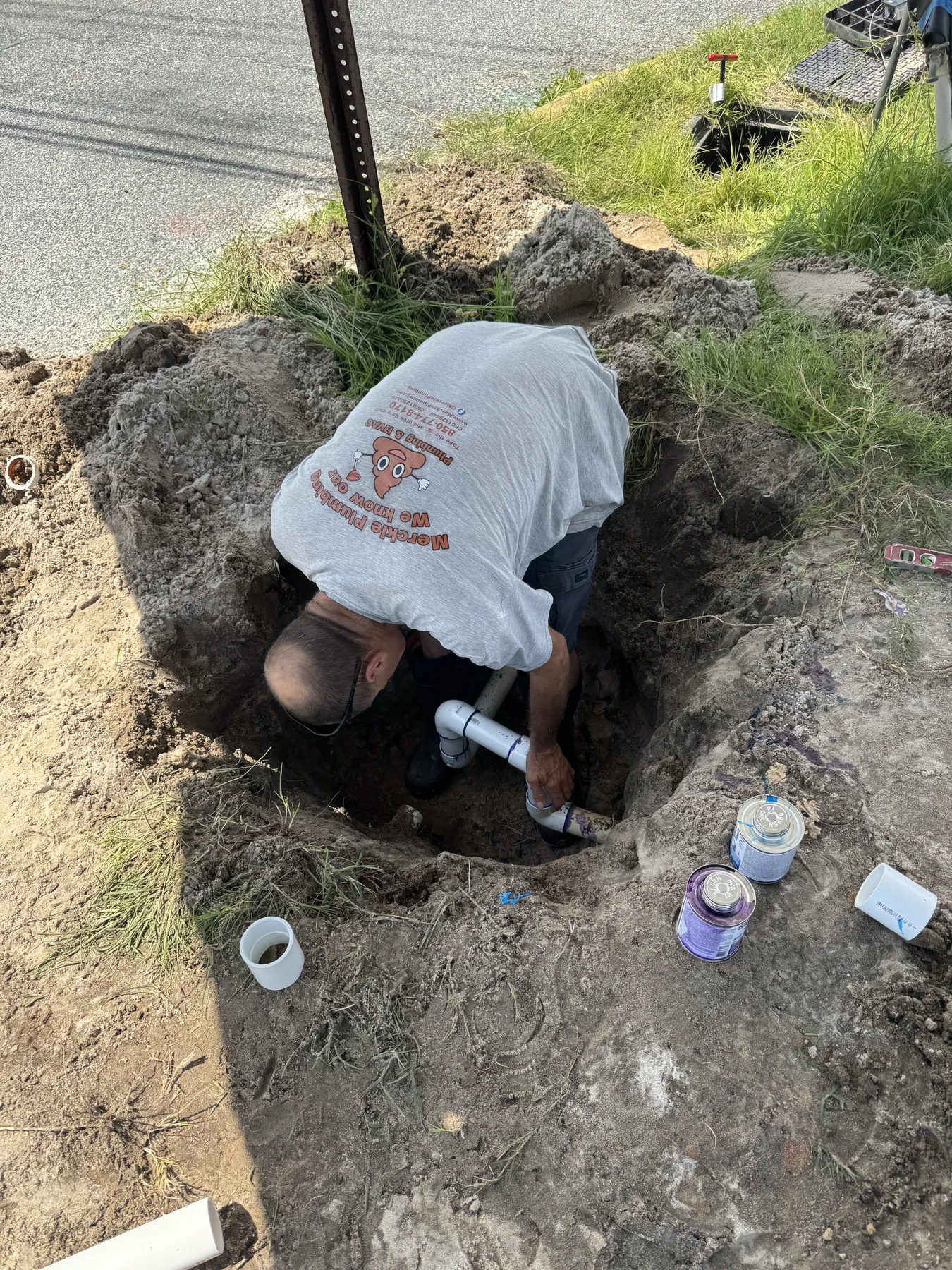
Florida’s slab-on-grade construction complicates all of it. Supply lines running under the slab can’t be inspected visually and can’t be spot-repaired without breaking concrete. That’s why a lot of commercial repipes here go overhead instead, running new lines through walls and ceilings and abandoning the under-slab pipe in place. It’s less invasive, it’s serviceable in the future, and it removes the slab from the equation permanently.
New overhead supply lines run through a ceiling during a phased repipe of an occupied commercial building.
Commercial work
Third leak this year in a different spot? Call 850-318-5777 and we’ll walk the building and give you a straight number.
- Answered 24 hours, 7 days
- Licensed CFC1429646 and CMC1250426
- Repair first, always
Maintenance plans from $16 a month keep this kind of thing from becoming an emergency.
Repiping a building that stays open
- Survey what’s there
Material, age, routing, and where the actual failures have been. We also identify what can stay, because not every building needs everything replaced.
- Design the route
Overhead reroute, in-wall replacement, or a mix. The route decides how invasive the job is and how serviceable the building is afterward.
- Phase the work
Riser by riser, floor by floor, or wing by wing, so occupancy continues and water outages stay short and predictable.
- Give tenants a schedule
Written notice of which units are affected on which days and for how long. This is the part property managers actually need from us.
- Install, pressure test, inspect
New pipe in to code, tested before anything gets closed up, and permitted and inspected where required.
- Restore and document
Drywall and finishes put back, and a written record of what was replaced and what routing was used for your building file.
Repiping occupied buildings on the coast
We repipe commercial and multi-unit properties in Freeport, Santa Rosa Beach, Point Washington, Miramar Beach and along 30A through Grayton Beach, Seaside, WaterColor, Seagrove Beach and Inlet Beach. Rental buildings there have narrow windows for this kind of work, so we plan around shoulder season and turnover calendars instead of fighting them.
The same work runs into Destin, Niceville, Valparaiso, DeFuniak Springs and Panama City Beach. Older inland commercial stock in DeFuniak Springs and Ponce de Leon is where we see the most galvanized supply piping still in service, while coastal condo and rental buildings tend to bring us copper pinhole problems on stacked risers.
Towns we get to most: Freeport, Santa Rosa Beach, Point Washington, Miramar Beach, Niceville, Destin, Eglin Air Force Base, Valparaiso, Ebro, Vernon, Caryville. See the full service area.
Questions we get about this
Do our tenants have to move out?
Almost never. Phased repiping keeps the building occupied by working one riser, floor or wing at a time and restoring water at the end of each window.
What tenants do need is notice. We give you a written schedule showing which units lose water on which day and for how long, so you can send it out ahead of time rather than field complaints during.
How long does a commercial repipe take?
It depends entirely on the size of the building and how the phasing is structured. A small commercial space is a matter of days. A multi-story building done a floor at a time around occupancy runs considerably longer by design, because the point is that the building keeps operating.
We give you a phase-by-phase schedule up front, and the number you hear before we start is the number we work to.
Can you just keep repairing instead?
For a while, and sometimes that’s genuinely the right answer. If the leaks are all at one location or one bad run, repair that and leave the rest alone. We’re not going to sell a repipe to a building that doesn’t need one.
When the failures are spread out and the material is aged, repairs stop being repairs and become installments on a repipe you’ll do anyway, with water damage added on top.
What about pipes under the slab?
Under-slab supply lines can’t be inspected visually and can’t be reached without breaking concrete, so on most commercial repipes here we route new lines overhead and abandon the old pipe in place.
That keeps the concrete intact, causes far less disruption in an occupied building, and leaves you with piping that’s actually serviceable next time something needs attention.
Will you handle permits and inspection?
Yes. The work is permitted and inspected where the jurisdiction requires it, and pressure testing happens before anything gets closed up. You get documentation of all of it for the building file, which owners and boards will want.
What material will you use?
It depends on the building, the routing and the water conditions, and we’ll explain the tradeoffs rather than just naming a product. What we won’t do is choose based on what’s fastest for us to install.
Related plumbing work
- Apartment Complex Plumbing
- Hotel Plumbing
- Commercial Emergency Plumbing
- Commercial Drain Cleaning
- Commercial Sewer Repair
- Commercial Hydro Jetting
- Backflow Installation
- Commercial Water Heaters
- Commercial Leak Detection
Not seeing it? The full list is on the plumbing page, or just call 850-318-5777 and describe it. You can also see the work or send a note.