
Mini-Split Installs Done Right the First Time
The equipment in the box is the easy part. Where the head goes, how the line set runs, and how the condensate drains decide whether you like this system in five years.

A mini-split install is four jobs that have to agree with each other. There is the indoor head, which needs a wall with the right throw across the room and no furniture blocking it. There is the outdoor condenser, which needs airflow, a level pad or bracket, and a location that will not be underwater or blasted with salt spray. There is the line set and condensate path between them. And there is the electrical circuit feeding the whole thing.
The line set is where corners get cut most often. Refrigerant lines have to be routed with the right bend radius, properly supported, insulated the whole length including at the flare connections, and pressure tested and evacuated before refrigerant is released into them. Skipping the vacuum step leaves moisture and air in the lines, which is the reason plenty of systems limp along at reduced capacity and eventually fail early.
Condensate is the other one we see done casually. The indoor head produces water any time it is cooling, and in a climate where the AC runs for most of the year that is a continuous stream. It needs a gravity drain with real fall or a condensate pump with a float safety. A drain that dribbles down the wall behind the head is a mold problem waiting to be discovered.
Common Reasons for an Install Call
- A garage, workshop or shed that the central system was never meant to reach
- A converted porch, sunroom, bonus room or attic space with no duct available
- A guest suite, casita or apartment over a garage that needs its own control
- One room that has never been comfortable no matter what the central system does
- An older house where adding duct would mean tearing into ceilings
- Wanting to cool part of the house without running the whole system for it
Skipping the vacuum on a line set is why some mini-splits never work right from day one.
What Makes or Breaks an Install Here
Outdoor unit placement matters more on the coast than almost anywhere. Salt air corrodes aluminum fins and copper lines, so a condenser sitting in the direct salt spray path in Seagrove Beach or Inlet Beach degrades faster than the same unit a few miles inland. We site the unit where it gets airflow but the least direct exposure, raise it clear of standing water, and talk to you about freshwater rinsing as regular upkeep.
Wall penetration and sealing is the second detail. The line set passes through the exterior wall, and that hole has to be sloped, sleeved and sealed properly. A sloppy penetration lets wind driven rain, humid air and insects into the wall cavity. Given our dew points, humid air reaching a cool cavity is exactly how you grow something inside a wall you cannot see.
Sizing gets rushed too. A head that is too large for the room cools it in minutes, shuts down, and never runs long enough to dehumidify, so the space ends up cold and clammy. That is a common and disappointing outcome in a converted garage. We look at the room’s actual load, its insulation, its glass and its exposure before picking a capacity, rather than defaulting to the biggest unit that fits the budget.
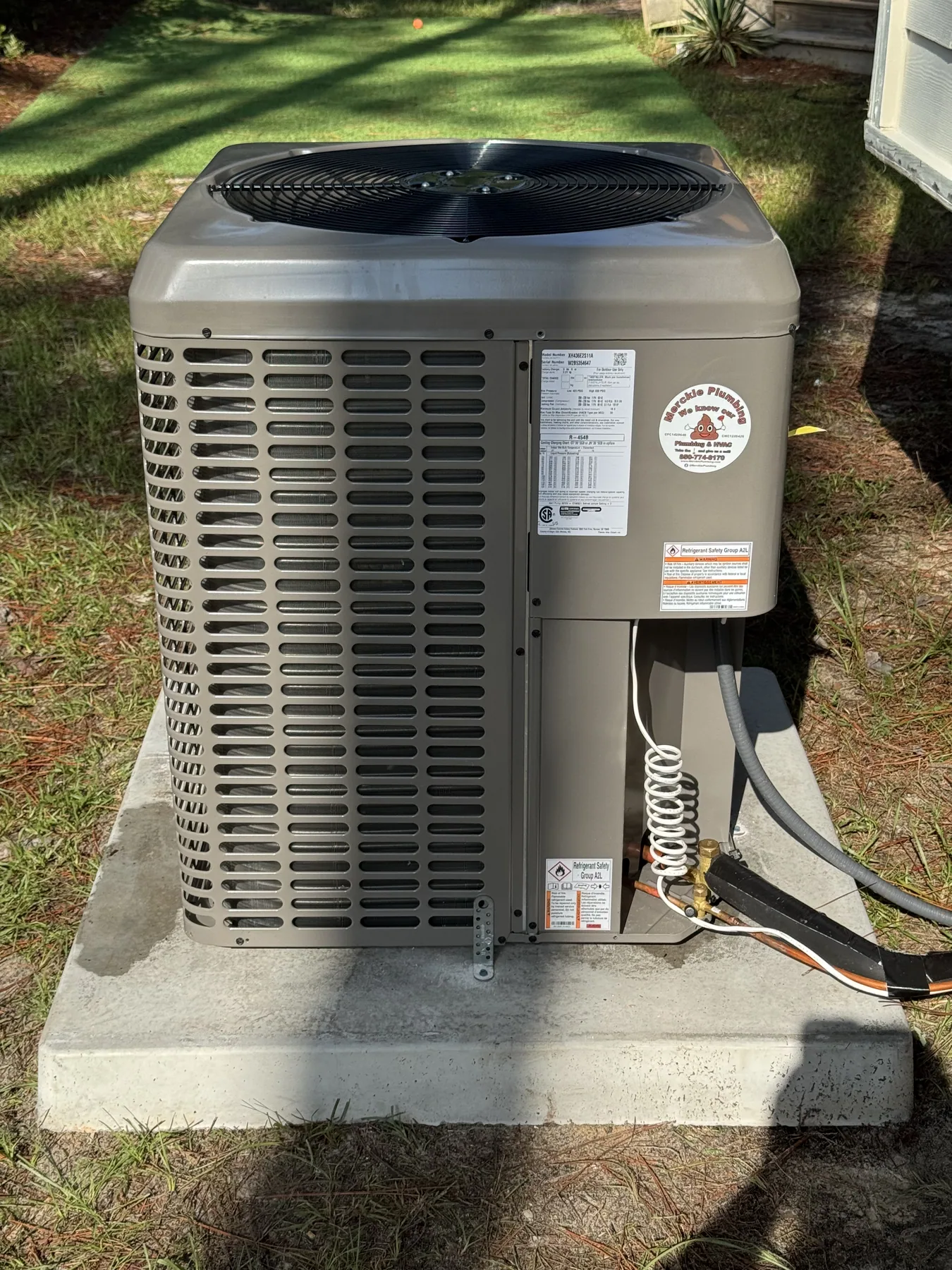
Insulated line set routed and supported between the indoor head and the outdoor condenser on a coastal install.
Get it looked at
Tell us the room and how you use it. We will size the head to it and give you a straight number for the whole install.
- Answered 24 hours, 7 days
- Licensed CFC1429646 and CMC1250426
- Repair first, always
Prices for every maintenance plan are posted, so you know the cost before booking.
The Installation Sequence
- Walk the space and pick locations
Indoor head placement for throw and access, outdoor unit placement for airflow, drainage, salt exposure and service clearance.
- Size the equipment to the room
Load, insulation, glazing and orientation decide capacity. Oversizing a mini-split leaves a room cold and damp.
- Mount and penetrate
The wall bracket goes in solid, the penetration is drilled with fall to the outside, sleeved and sealed.
- Run the line set and condensate
Refrigerant lines routed with proper bends and support, fully insulated, with a gravity drain or a pump and float switch for the condensate.
- Wire it in
A dedicated circuit and disconnect sized to the equipment, with the interconnecting control wiring landed correctly at both ends.
- Pressure test and evacuate
The system is held under pressure to prove it is leak free, then vacuumed to remove moisture and air before refrigerant is released.
- Commission and hand over
Startup readings, airflow and temperature split checked, then we walk you through the controls and the maintenance it will want.
Mini-Split Installs Around Walton and Okaloosa Counties
Garage conversions, guest suites and enclosed porches keep us busy in Freeport, Santa Rosa Beach, Point Washington, Miramar Beach and along 30A in Seaside, WaterColor, Grayton Beach, Seagrove Beach and Inlet Beach. Coastal placement gets extra thought, because a condenser in the salt spray path pays for it later in corroded fins and pinhole refrigerant leaks.
Further inland at DeFuniak Springs, Paxton, Ponce de Leon, Westville, Vernon, Ebro and Caryville, we install more often in older houses and outbuildings where there is no duct to extend. Destin, Niceville, Valparaiso, Eglin Air Force Base, Choctaw Beach and Panama City Beach are all in our area. Call 850-318-5777.
Beach-side calls take us to Santa Rosa Beach, Miramar Beach and Destin. Away from the beaches we’re in Freeport, Point Washington, Niceville, Valparaiso and Eglin Air Force Base, and farther up in Ebro, Vernon and Caryville. See the whole service area for more.
Questions we get about this
How long does a single head installation take?
Most single zone installs are a day, sometimes less if the wall penetration is straightforward and the electrical circuit is easy to reach. Multi zone systems take longer because there is more line set to route and more commissioning to do.
Does it need its own electrical circuit?
Yes. Mini-splits need a dedicated circuit and a disconnect near the outdoor unit, sized to the manufacturer’s specification. If your panel does not have room, that is a real cost we will identify up front instead of discovering it mid job.
Where should the outdoor unit go?
Somewhere with clear airflow, elevated above standing water, reasonably accessible for service, and as sheltered from direct salt spray as the property allows. We also think about noise near bedrooms and windows.
Can you install a unit I already bought?
Often, yes. Tell us the make and model when you call. What we will not do is skip the pressure test and evacuation to save time on somebody else’s equipment, because that is the step that determines whether it lasts.
What happens to the condensate?
It drains, either by gravity with proper fall to a suitable termination or through a condensate pump with a float safety switch that cuts the unit off if the pump fails. In our humidity that head produces water constantly, so this is not a detail to improvise.
Do you install multi zone systems?
Yes. One outdoor unit can serve several indoor heads, which suits a house with a few problem rooms. It takes more planning around line set routing and capacity sharing between the heads, and we will walk you through the tradeoffs before you commit.
Related HVAC work
- Ductless Mini Splits
- HVAC Maintenance
- HVAC System Diagnostics
- Indoor Air Quality
- Emergency HVAC
- HVAC Repair
- HVAC Installation
- AC Repair
- Furnace Repair
If the job you need isn’t on this page, the HVAC services list probably has it. You can also see the gallery, or call 850-318-5777 and tell us what’s going on. A short note works too if you’d rather not call.