
Sized right, vented right, permitted properly
Putting in a tank heater is more than swapping a box. Capacity, recovery rate, venting and code all have to line up, or you feel it every morning.
Most people judge a water heater by the number of gallons on the label. That number only tells you half the story. The other half is recovery rate, meaning how fast the unit can reheat once you have drained it. A fifty gallon tank with slow recovery and a fifty gallon tank with fast recovery behave like completely different appliances in a house where three people shower before work.
So we size from how you actually use water. Number of bathrooms, whether the tub is a big soaker, whether the washing machine runs at the same hour as the showers, whether the house is a full time residence or a rental that fills up on weekends. Then we match capacity and recovery to that, rather than replacing whatever was there because it was there.
The rest of it is the part nobody sees. Gas units need proper combustion air and a vent that draws correctly. Every install needs the right relief valve, a discharge line routed to a safe place, correct connections and a permit pulled where one is required. Skipping that is how a cheap install becomes an expensive problem two years later.
When replacing beats repairing
- Water is pooling from the body of the tank rather than a fitting
- The tank has been repaired more than once in a short stretch
- Rusty hot water continues after the anode rod has already been replaced
- The household grew and the heater has never kept up since
- The unit is undersized for a remodel that added a bathroom or a soaker tub
- The existing venting or connections are not to current code
Gallons tell you how much you have. Recovery tells you how fast you get it back.
What we account for on a Northwest Florida install
Location changes everything about an install. A garage heater in DeFuniak Springs is straightforward. A unit in a conditioned interior closet, common in newer coastal homes, needs a properly plumbed drain pan and discharge routing, because there is finished floor underneath it and a slow drip becomes a flooring claim. Attic platform installs need the same attention plus safe access for the next service call.
Gas units get particular attention. Combustion air, vent sizing and vent slope are not paperwork details, they are the difference between exhaust going outside and exhaust coming back into the house. If the existing vent was undersized or run badly by whoever installed the last one, we correct it rather than reconnecting to it.
Our supply comes from wells and carries dissolved mineral, so we talk about the anode rod on every install. It is a sacrificial rod that corrodes so the tank does not. Knowing it exists and having it checked periodically is the single cheapest thing a homeowner can do to make a tank last, and almost nobody is told about it when the heater goes in.
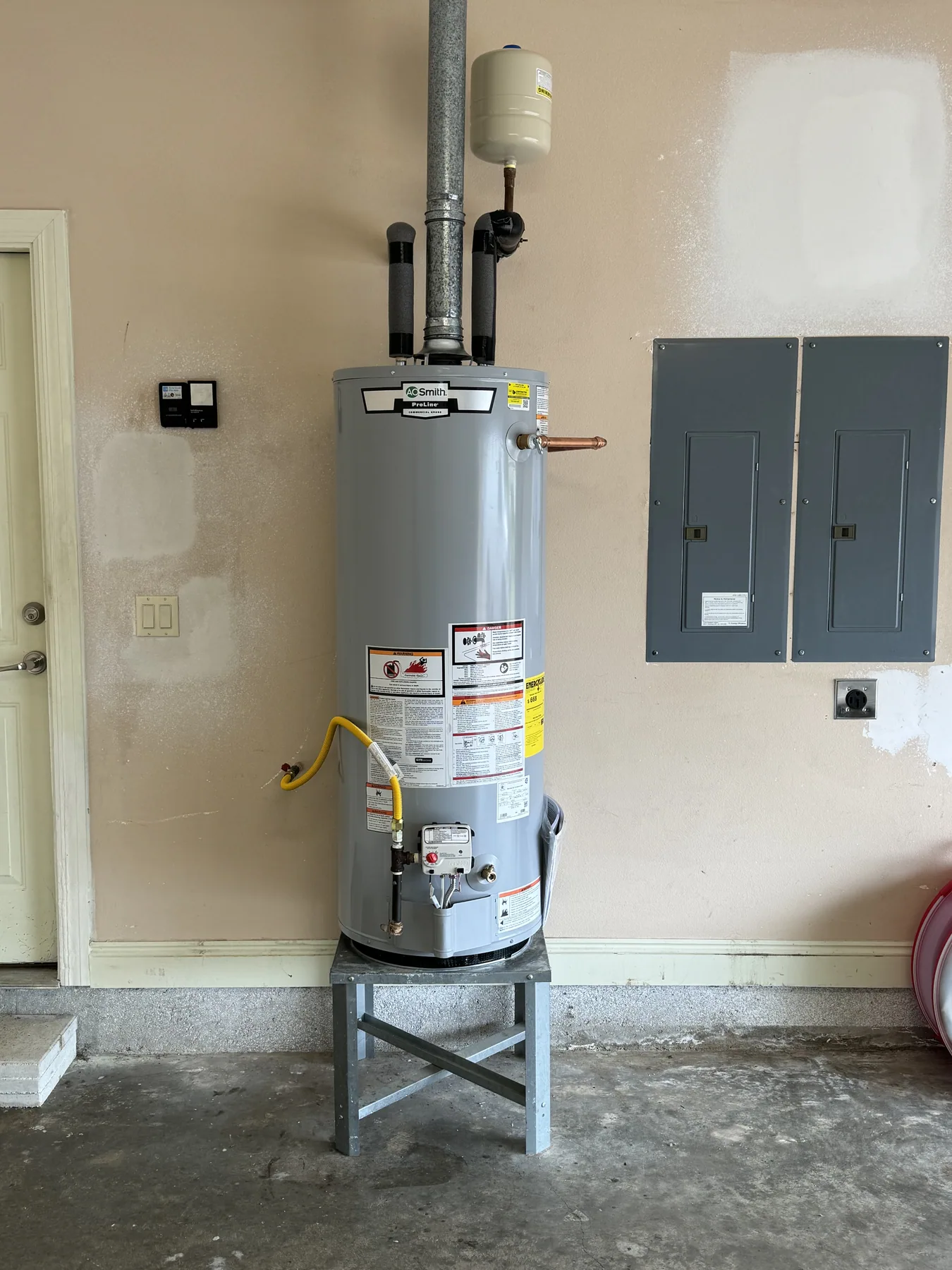
New fifty gallon tank set with a fresh drain pan and correct discharge routing in a Freeport garage.
Get it looked at
Call and tell us how many bathrooms, how many people and what is there now. We will tell you what size makes sense and what the install runs.
- Answered 24 hours, 7 days
- Licensed CFC1429646 and CMC1250426
- Repair first, always
Maintenance plans from $16 a month keep this kind of thing from becoming an emergency.
From the first call to hot water
- Usage walkthrough
We ask how the house actually runs. Bathrooms, tub size, laundry timing, full time or rental. That determines capacity and recovery, not the label on the old unit.
- We look at the space
Venting, combustion air, clearances, drain pan, shutoffs and how the unit will come out and go in. Attic and closet installs have their own requirements.
- A straight number, in writing
Unit, labor, any code corrections needed, and permit if one applies. No surprises added on the day.
- Removal and install
Old unit drained and hauled out. New unit set, connected, vented, pan and discharge line correct, expansion handled where required.
- Fire up and hand off
We bring it to temperature, check for leaks and proper draw, set the thermostat sensibly, and show you the shutoff, the T and P valve and the drain.
Installs from Freeport out to the beach towns
We install tank heaters across Walton County and out to Miramar Beach, WaterColor, Grayton Beach and Point Washington. Vacation rental owners along 30A tend to need more capacity than the square footage suggests, because a rental house sees peak demand in a single two hour window rather than spread across a day. We size for the peak, not the average, because a rental with a cold shower generates a review that costs more than the bigger unit did.
Inland toward DeFuniak Springs, Paxton and Ponce de Leon, and west into Niceville, Valparaiso and Destin, the job is often an older garage unit where the venting and connections were done to a standard that has since changed. We bring those up to current code as part of the install. Noah holds Florida plumbing certification CFC1429646, so the permit and the inspection are handled the way they should be rather than skipped and hoped over.
Towns we get to most: Freeport, Santa Rosa Beach, Point Washington, Miramar Beach, Niceville, Destin, Eglin Air Force Base, Valparaiso, Ebro, Vernon, Caryville. See the full service area.
Questions we get about this
What size heater do I need?
It depends on peak demand more than house size. A three bathroom home where everyone showers at seven in the morning needs different capacity and recovery than the same house with staggered schedules.
Tell us how the mornings go and we will tell you what fits. Oversizing costs you money to run and undersizing costs you a cold shower.
Do I need a permit?
Water heater replacement generally requires one, and it is on us to pull it. It exists so somebody independent confirms the venting, the relief valve and the connections are right. We do not treat it as optional.
Should I switch to tankless while I am at it?
Sometimes. Converting from tank to tankless usually means gas line and venting changes, which is real work and real cost. It suits some houses very well and others not at all. We have a page on tankless conversion that walks through what is actually involved, and we will tell you plainly if your house is not a good candidate.
Can you install a unit I already bought?
Usually yes. We will look at it first to be sure it is the right capacity and fuel type for the space and that the venting can be done correctly. If it is the wrong unit for the location, better to know before it is uncrated than after.
Will you take the old one away?
Yes. Draining, disconnecting, hauling and disposal are part of the job, not an add on.
How long does it take?
A straight swap in an accessible spot is usually a few hours. Attic installs, venting corrections or moving the unit to a different location take longer, and we tell you which one yours is before the day rather than on it.
Related plumbing work
- Tankless Water Heater Repair
- Tankless Water Heater Replacement
- Tankless Water Heater Installation
- Water Filtration
- Gas Line Installation
- Gas Line Repair
- Repiping
- Bathroom Plumbing
- Kitchen Plumbing
Not seeing it? The full list is on the plumbing page, or just call 850-318-5777 and describe it. You can also see the work or send a note.