Straight Talk: Swamp Coolers and Florida Humidity
Evaporative coolers work by evaporating water into the air. In a place this humid, the air is already close to full, which limits what they can do.
The mechanism explains everything about where these work and where they do not. An evaporative cooler, often called a swamp cooler, pulls outside air through a wet pad. Water evaporates off that pad, evaporation absorbs heat, and the air coming out the other side is cooler and considerably more humid. There is no refrigerant and no compressor. It is just water changing state, which is why they cost so little to run.
That process depends entirely on the air’s capacity to absorb more moisture. In Phoenix, where the air is bone dry, an evaporative cooler can drop the temperature substantially and the added humidity is welcome. In Northwest Florida, summer dew points sit in the high 60s and low 70s. The air is already carrying close to all the moisture it can hold, so evaporation slows dramatically, the temperature drop is small, and the humidity you add makes the space feel worse rather than better.
We are telling you this before you spend money on one, because that is the whole point of how this company operates. There are genuine applications for evaporative cooling here, and they are real, but a closed up humid living room is not one of them. If somebody has offered to install one in your house, this page is the second opinion.
Where These Actually Make Sense Here
- An open workshop or pole barn where doors stay open and air moves through freely
- A detached garage used for projects that is not sealed or conditioned
- A covered patio or outdoor kitchen area where spot cooling is the goal
- Agricultural buildings, greenhouses and livestock spaces built for ventilation
- Industrial areas near heat sources where cooling a specific work zone is all you need
- Any space where continuous outdoor air exchange is already happening by design
Our air is already close to full of moisture, so there is little room left to evaporate into.
Why Humidity Limits the Effect
Evaporative cooling trades heat for moisture. Every bit of temperature drop you gain comes from water evaporating into the air stream, and air can only hold so much water at a given temperature. Dew point is the honest measure of how much is already in there. When our summer dew points sit in the high 60s and low 70s, the air arrives at the pad nearly saturated, evaporation slows to a crawl, and the cooling effect largely disappears on exactly the days you wanted it most.
There is a second problem specific to enclosed spaces. These units are designed to run with air continuously exhausting out of the space, because you have to keep pushing the humidified air out and drawing fresh air in. Run one in a sealed room and the humidity climbs steadily until the pad can no longer evaporate anything at all. Then you have a fan, a water bill, and a damp room. In a climate where mildew is already an ongoing battle, adding indoor moisture is not a neutral outcome.
None of this makes the technology useless here, it makes it situational. In an open shop bay, a barn, or a covered outdoor space with real air movement, you are cooling a zone rather than conditioning a sealed envelope, humidity vents away instead of building up, and the running cost is a fraction of refrigerated cooling. That is a legitimate use and we will service equipment doing that job. What we will not do is sell you one for a space where the physics says it will disappoint you.
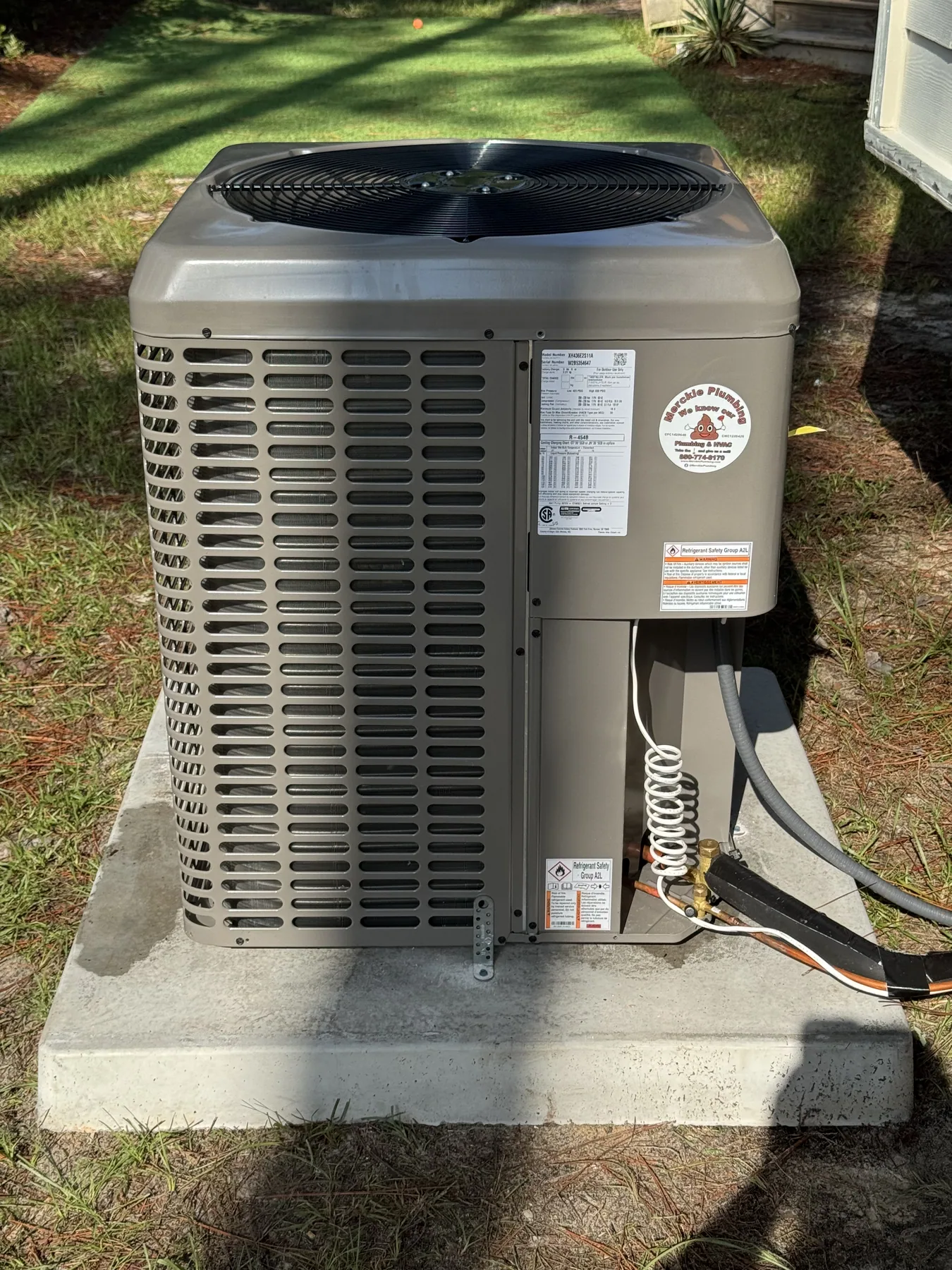
Comparing cooling options for an open shop bay where ventilation runs through the space continuously.
Get it looked at
Wondering whether an evaporative cooler suits your space? Call 850-318-5777 and we will tell you straight, even if the answer is no.
- Answered 24 hours, 7 days
- Licensed CFC1429646 and CMC1250426
- Repair first, always
Seniors and military members get 5% off our maintenance plans.
How We Handle These Calls
- Ask what space you are cooling
Open, ventilated, or sealed matters more than square footage. That single answer usually determines whether evaporative cooling is the right technology at all.
- Explain the tradeoff honestly
You get the mechanism and the humidity limits in plain language, including what performance actually looks like here on a humid August afternoon.
- Service what is already installed
If you have a unit doing appropriate work, we handle pads, the water distribution system, pump, float, blower and the plumbing supply feeding it.
- Point to a better fit when there is one
For sealed conditioned space, that usually means a mini split, which cools and dehumidifies and can be added to a garage or shop without touching the main system.
- Give you a straight number either way
Whatever direction makes sense, you get a clear price and no pressure. Talking somebody out of the wrong purchase is a normal outcome here.
Cooling Shops and Open Spaces Across Walton County
Most of these calls come from working buildings rather than houses. Shops, barns and detached garages around Freeport, Point Washington, DeFuniak Springs, Paxton, Ebro, Vernon and Caryville are where evaporative cooling genuinely has a place, because those spaces are ventilated by design and the goal is making a work zone bearable rather than conditioning a sealed envelope.
Closer to the water in Santa Rosa Beach, Miramar Beach, Seagrove Beach, Grayton Beach, Inlet Beach, Seaside and WaterColor, humidity runs higher still and the case gets weaker. We also cover Niceville, Valparaiso, Destin, Eglin Air Force Base, Choctaw Beach, Westville, Ponce de Leon and Panama City Beach. When somebody in one of these communities asks us about a swamp cooler for a covered outdoor kitchen or a garage gym, the conversation usually ends up comparing it honestly against a small ductless unit, and we will lay out both.
Closest to home: Freeport, Point Washington, Santa Rosa Beach and Miramar Beach. A little farther west: Destin, Niceville, Valparaiso and Eglin Air Force Base. Inland to the north: Ebro, Vernon and Caryville. The service area page covers everything else.
Questions we get about this
Do evaporative coolers work in Florida?
Poorly in sealed humid living space, and reasonably well in open ventilated areas. The cooling comes from evaporating water into the air, and our air is already carrying a great deal of moisture, so there is limited capacity left for evaporation.
In an open shop, barn or covered patio where air exchanges continuously, they can still make a real difference on a work zone.
What is the difference between a swamp cooler and an air conditioner?
An air conditioner uses refrigerant to remove both heat and moisture from the air, which is why your house feels dry as well as cool. An evaporative cooler adds moisture as a byproduct of how it cools. In a humid climate that difference is the whole story.
Someone offered to install one in my house. Should I?
We would want to hear a lot more about the space first, and in most sealed residential situations we would steer you elsewhere. Adding humidity to a Florida home tends to make it feel muggier and gives mildew more to work with. Call us for a second opinion before you spend the money.
What should I use for a garage or workshop instead?
If the space is sealed or you want it genuinely conditioned, a ductless mini split is usually the right answer. It cools, it removes humidity, and it can be added without disturbing your main system. If the space is open with doors up most of the time, evaporative cooling can be a reasonable low cost choice.
Can you service an evaporative cooler I already have?
Yes. Pads, pump, float valve, water distribution, blower and the plumbing supply line all get serviced. Holding a plumbing license alongside the mechanical one helps here, since these units are as much a water appliance as an air one.
Why are you talking me out of a sale?
Because selling somebody equipment that will not perform in their space is how you get one job and no reputation. The owner started this company to do higher quality work at a fair price for his own community, and part of that is saying so when a product is wrong for the application.
Related HVAC work
- Smart Thermostat Installation
- Air Duct Cleaning
- Air Balancing Analysis
- Duct Leakage Testing
- Duct Sealing
- Mini-Split Installation
- Ductless Mini Splits
- HVAC Maintenance
- HVAC System Diagnostics
From mini-splits to rooftop units, the HVAC page lists all of it. Photos from real installs and repairs are in the gallery. Questions go to 850-318-5777 at any hour, or to the contact form if you’d rather write.