
Most storm damage to plumbing and HVAC comes down to a handful of things people did not know beforehand. None of it takes long to sort out.
Everyone on this coast has a hurricane routine by now. Water, batteries, gas in the truck, plywood if it looks serious. What tends to be missing from the routine is the two systems that cause the most expensive cleanup afterward, which are the plumbing and the HVAC.
None of this takes long. Most of it is knowing something rather than doing something, and knowing it in June is much better than looking it up in the dark with the wind up.
Find your main water shut-off now
This is the highest-value item on the entire list and it costs nothing. If a supply line lets go during or after a storm, whether from a fallen tree, debris, or a failed connection, the difference between a wet floor and a flooded house is how fast the water stops.
Most houses here have the main valve at the meter box near the street, and many have a second one where the supply enters the house. Go find yours today. Open the meter box lid, look at it, and confirm the valve actually turns, because a valve that has not moved in fifteen years sometimes will not. If it will not budge, that is worth fixing while it is calm.
The right time to find your main shut-off valve is a sunny afternoon in June, not a dark night in September.
Show everyone in the house. Put the meter key somewhere obvious. If you have a rental on 30A, tell your management company and make sure the information is written down where a guest could find it.
The condenser: secure it, do not cover it
Your outdoor unit is heavy, but sustained hurricane wind moves things that seem too heavy to move, and a condenser that shifts on its pad tears its refrigerant lines and its electrical whip in the process. That turns a windstorm into a system replacement.
What actually helps:
- Check that the unit is properly strapped or bolted to its pad. Florida code has required hurricane tie-downs on outdoor equipment for years, but older installations sometimes predate that or have corroded straps.
- Clear anything nearby that can become a projectile. Patio furniture, potted plants, yard tools, loose fence sections, and above all trim back overhanging limbs.
- Kill power at the disconnect box before the storm arrives. That protects the compressor and control board from the surges that come with grid instability and with power restoration.
- Do not wrap or tarp the unit while it is running. Blocking airflow on an operating condenser damages it faster than a storm does.
- Photograph the unit, the model and serial plate, and the surrounding area before the storm. If you end up filing a claim, having a dated before picture is worth a great deal.
That last one applies to the whole property. Five minutes of photos before a storm is the cheapest insurance documentation available.
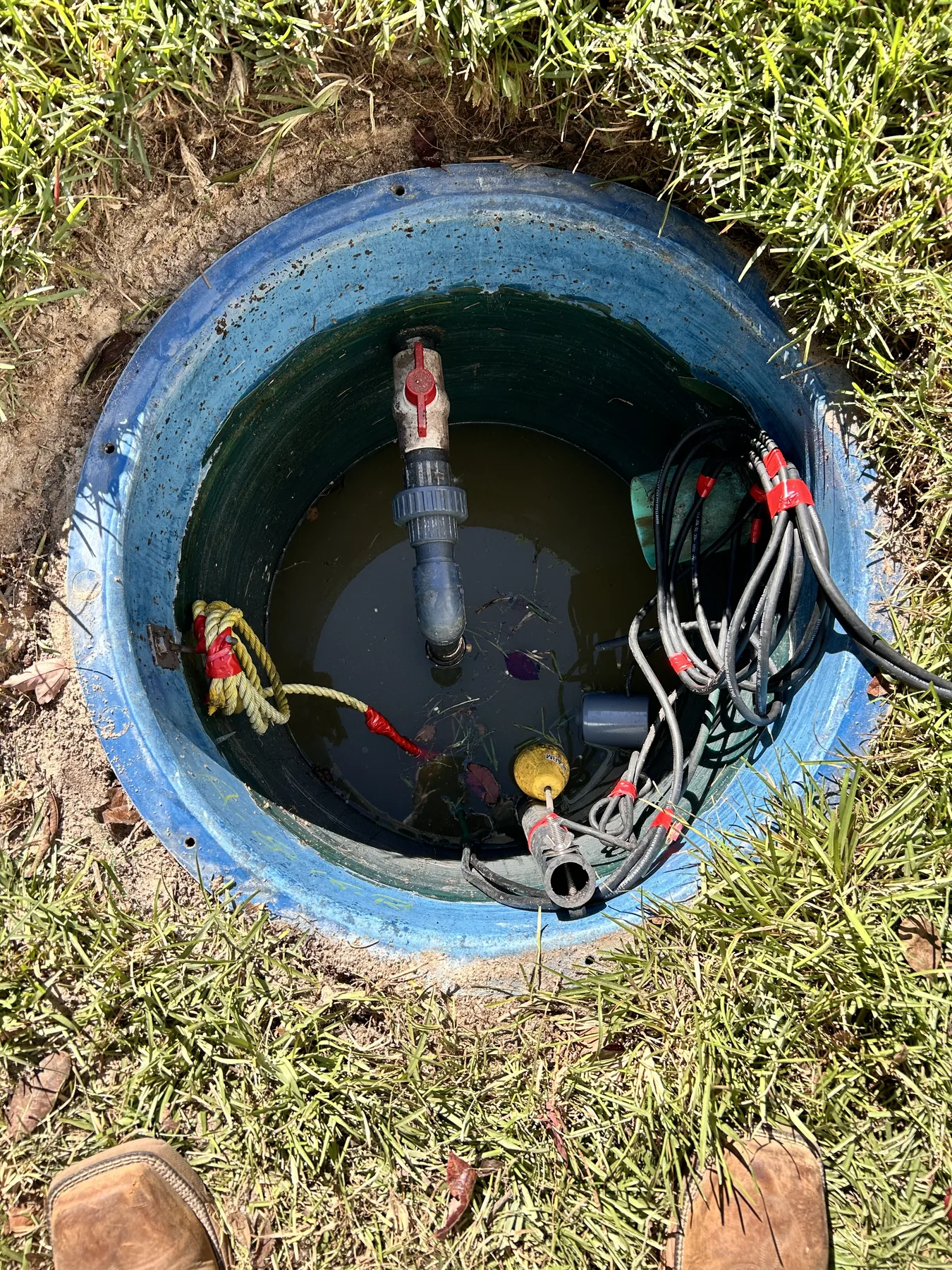
If you are on a grinder pump, plan for the outage
This is the item that catches Freeport and 30A residents hardest, and it is worth being blunt about.
A grinder pump runs on your household electricity. When the power goes out, the pump stops, and wastewater cannot be disposed of through a grinder pump during an outage. There is no workaround at the house. Every flush, every shower, and every load of laundry after the power drops is going into a tank with no way to empty.
During a power outage, the tank in your yard has a fixed amount of room and no way to make more.
So the plan is water conservation from the moment the power goes, not from the moment the alarm sounds. Fill containers ahead of time for washing and for flushing decisions. Hold off on laundry and dishwashing entirely. If the outage runs long, this is the single most likely reason for sewage to come back up into your house, and it is completely preventable if you know about it beforehand.
Generators and gas lines
If you have a standby generator on natural gas or propane, storm season is when you find out whether it was maintained. Exercise it under load before the season, not during it. Check that the gas line to it is sound and that connections are tight, and if you smell gas anywhere near it at any point, leave and call from somewhere else.
Portable generators are where people get hurt. Never run one in a garage, a screened porch, or anywhere attached to the house. Carbon monoxide is the leading cause of post-storm deaths in these events and it happens to people who thought they had enough ventilation. Outside, well away from windows and doors, always.
If you are having a generator connected to your gas supply, that is licensed work. Sizing the line matters, because a line that feeds a generator plus a water heater plus a range has a real load calculation behind it, and an undersized line starves everything on it.
After the storm, in order
When it has passed, the sequence matters more than the speed.
- Do not switch the condenser back on if it took floodwater. Water inside the electrical components means energizing it can destroy the unit and start a fire. It needs to be inspected first, and that is not a judgment call to make from the porch.
- Look at whether the unit shifted on its pad. Even a small shift can have strained the refrigerant lines or the electrical whip.
- Rinse salt and debris off the condenser with fresh water once power is confirmed off at the disconnect. Storm surge and wind-driven spray push far more salt onto equipment than normal coastal exposure does, and letting it sit is what does the damage.
- Check for sewage backup indoors before running much water, particularly if you are on a grinder pump and the power was out a while.
- Run water at fixtures and watch for discoloration or a pressure drop that was not there before, which can indicate a break in a supply line.
- If your grinder pump alarm is lit after power restoration, cut water use again and get it looked at.
That first item is the one people get wrong most. The instinct after days without power is to turn everything back on immediately. A flooded condenser is the one thing that genuinely should wait for someone to look at it, because energizing wet electrical components is how a recoverable situation becomes an unrecoverable one.
We answer through it
We work through storm season across Freeport, Santa Rosa Beach, Point Washington, Miramar Beach, Destin, Niceville, and the 30A towns, and somebody picks up the phone at any hour. A lot of our post-storm calls are second homes and rentals with owners several states away, and we are used to coordinating that way.
If you want the storm-season items handled before the season rather than during it, that is what a maintenance visit in the spring is for. The tie-down check, the coil condition, the condensate line, and a look at the shut-off valve all fit in one appointment. Call 850-318-5777.
Questions
Should I cover my outdoor AC unit before a storm?
Not while it is running, and generally not at all. Covering a condenser blocks the airflow it needs and can trap moisture against the coil. If the unit is properly tied down to its pad and you have cleared projectiles from the area, it is better off uncovered. Kill power at the disconnect before the storm to protect the electronics from surges.
Can I use my toilet during a power outage if I am on a grinder pump?
Very sparingly, and with the understanding that the tank has a fixed amount of room and no way to empty until power returns. The pump does not run without electricity, so everything going down the drain is accumulating. Plan water conservation from the moment the power drops rather than waiting for an alarm.
My AC took floodwater. Can I just turn it back on and see?
Please do not. Water inside electrical components means energizing the unit can destroy it outright and can start a fire. A flooded condenser needs to be inspected and dried out or condemned by somebody who can actually assess the electrical side. This is the one post-storm item genuinely worth waiting on.
Is rinsing the condenser after a storm actually necessary?
It helps more than people expect. Storm surge and wind-driven spray deposit far more salt on equipment than ordinary coastal exposure, and salt holds moisture against aluminum and copper. A fresh water rinse with the power off at the disconnect carries it away before it starts working on the metal.
Something not right at your place?
Call 850-318-5777 any hour and describe what it is doing, or send it in writing. We diagnose before we quote, every time.