
A heat pump does not create heat, it relocates it. That distinction is why the economics work here and why running Em Heat all winter is costing you money.
People who move here from further north often ask us where the furnace is. The answer is usually that there is not one, and that the thing outside doing the cooling in August is the same thing doing the heating in January.
That surprises people, and it is worth explaining properly, because understanding how a heat pump works is what makes sense of everything else about it: the defrost cycle that makes it steam on a cold morning, the auxiliary heat strips, the reason it blows air that feels cooler than a furnace does, and why an Em Heat setting left on is quietly expensive.
It moves heat, it does not make it
A furnace makes heat. It burns gas or runs current through a resistance element, converting fuel or electricity directly into warmth. Simple, and limited by physics: you get out roughly what you put in, and no more.
A heat pump does something different. It moves heat that already exists from one place to another. In summer it pulls heat out of your house and dumps it outside, which is what an air conditioner does. In winter it runs the same process backward, pulling heat out of the outdoor air and bringing it inside.
That sounds impossible if the outdoor air feels cold. It is not, because cold is relative. Air at 45 degrees still contains a great deal of thermal energy compared to absolute zero. Refrigerant boiling at a much lower temperature than that will absorb heat from it readily. The system is not creating warmth, it is collecting warmth that is already out there and concentrating it.
Moving heat takes far less energy than making it, and that difference is the entire argument for a heat pump.
That is why a heat pump can deliver several times more heat energy into your house than the electrical energy it consumed. It is not beating physics. It is not converting electricity to heat at all, it is spending electricity to relocate heat, and moving something is cheaper than manufacturing it.
The reversing valve is the whole trick
One component makes this possible. The reversing valve is a switch in the refrigerant circuit that changes the direction refrigerant flows through the system.
In cooling mode, the indoor coil is cold and absorbs heat from your house while the outdoor coil is hot and releases it outside. Flip the reversing valve and those roles swap. The outdoor coil becomes the cold one absorbing heat from outdoor air, and the indoor coil becomes the hot one releasing heat into your house. Same compressor, same refrigerant, same coils, opposite direction.
Worth knowing, because when a heat pump cools fine but will not heat, or heats fine but will not cool, the reversing valve or the solenoid that operates it is one of the first things we check. That is a component-level repair, not a system replacement, and it is exactly the kind of thing that gets skipped when somebody arrives ready to quote equipment.
Why it steams on a cold morning
In heating mode the outdoor coil is colder than the outdoor air, because that is how it absorbs heat. When outdoor air is humid and the coil drops below freezing, moisture condenses on the coil and freezes there. Frost builds up, and frost blocks airflow through the coil, which cuts the system’s ability to collect heat.
So the system periodically runs a defrost cycle. It briefly flips into cooling mode, sending hot refrigerant out to the outdoor coil to melt the frost off, while the outdoor fan stops. What you see from the yard is a unit that appears to be steaming, sometimes dramatically, and if you are indoors you may notice the air from the vents go briefly cool while it happens.
That is the system working correctly. People call us about it every winter, convinced something is on fire. Nothing is wrong. A defrost cycle should last a few minutes and end on its own. A system that is stuck in defrost, or one that ices over solid and never clears, is a real problem worth calling about.
Auxiliary heat, emergency heat, and the money question
Every heat pump here has electric resistance heat strips in the air handler as backup. Understanding when they are supposed to run is worth real money.
- Auxiliary heat comes on automatically when the heat pump alone cannot keep up, usually on our coldest mornings or when the thermostat is asking for a big temperature jump at once. That is correct behavior.
- Emergency heat, the Em Heat setting on your thermostat, shuts the heat pump off entirely and heats using only the resistance strips.
- Those strips are pure electric resistance heating. They make heat rather than moving it, which means they cost substantially more per unit of warmth than the heat pump does.
- Em Heat exists for one situation: the heat pump is broken and you need warmth until it is fixed.
- An Em Heat light that is on for hours during normal operation, or aux heat running when it is 55 degrees outside, means something is wrong with the heat pump side.
Em Heat is a backup, not a setting. If it is running constantly, you are paying resistance heat prices for a job the heat pump should be doing.
Every winter somebody calls us about an electric bill that doubled. A meaningful share of those turn out to be a system running on strips because the heat pump is not engaging: a bad reversing valve, a defrost control that failed, a low refrigerant charge, or a thermostat that got switched to Em Heat months ago and never switched back.
Why the math works here specifically
A heat pump gets less efficient as outdoor temperatures fall, because there is less heat available outside to collect. In a climate with sustained sub-freezing weather, that is a real limitation and it is why heating strategies differ up north.
Our winters are mild. Walton and Okaloosa counties see cold snaps, and we get freezing nights, but sustained deep cold is not what our season looks like. A heat pump operates in its efficient range for the large majority of our heating hours, and the strips only pick up the slack on the handful of genuinely cold mornings.
Add the fact that the same equipment does your cooling, which here is the much larger job, and one system for both is the sensible answer. There is no separate furnace to buy, maintain, or eventually replace.
On efficiency ratings, one thing worth knowing since Florida sits in the federal Southeast region: the current minimum for heat pumps is 14.3 SEER2 and 7.5 HSPF2. You will hear 15.2 SEER2 quoted as if it were required. It is not.
What we check before we call anything finished
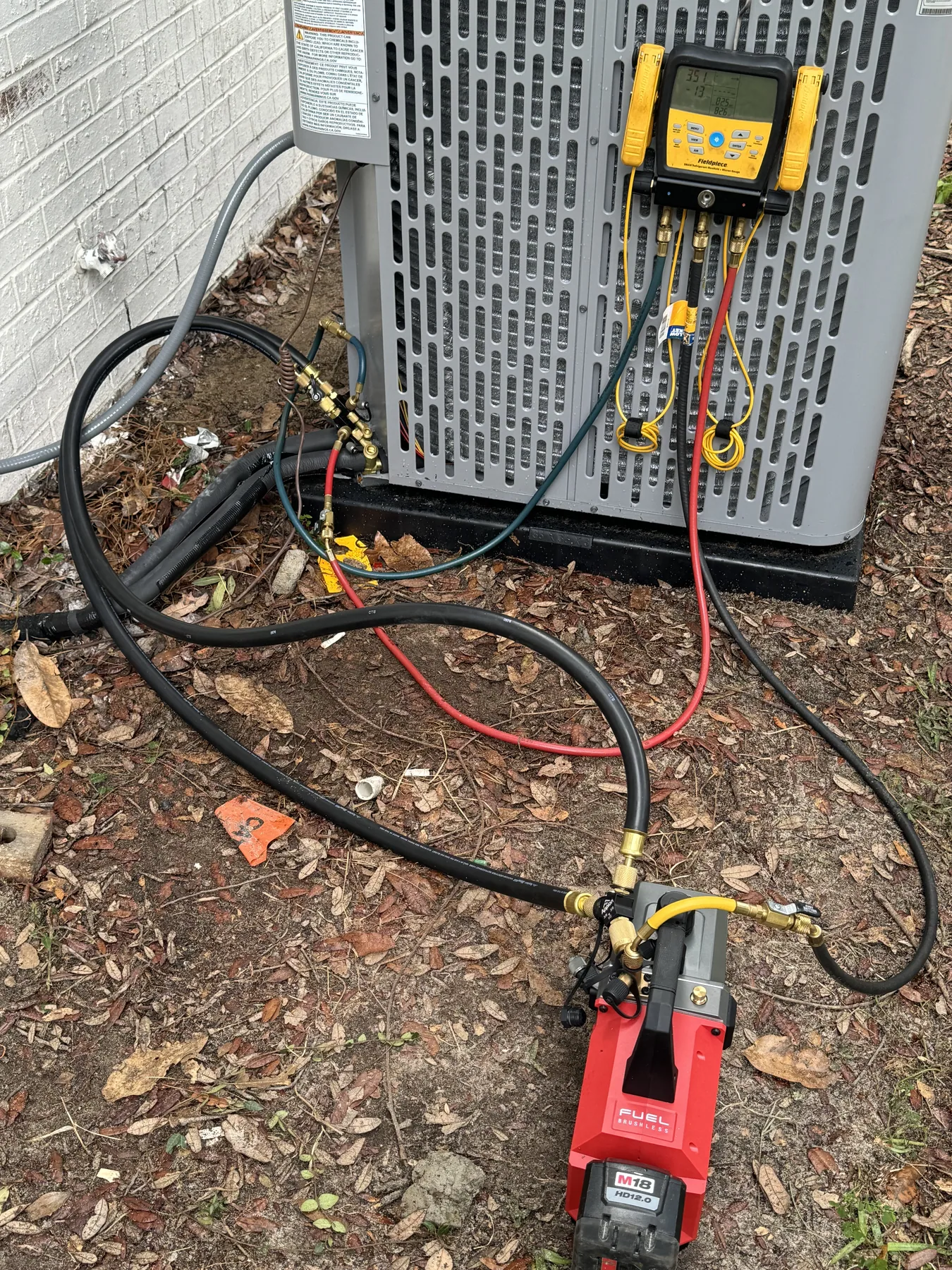
On a heat pump that is not heating well we take readings first. Refrigerant pressures on both sides, temperature split across the coil, whether the reversing valve is actually shifting, whether the defrost board is cycling on schedule, amp draw at the compressor, and whether the aux strips are engaging when they should rather than constantly.
Those numbers tell you what is happening. A heat pump that will not heat is frequently a reversing valve, a defrost control, a capacitor, or a charge issue, and each of those is a repair. Replacement is sometimes the honest answer, and when it is, we will show you the readings that led us there.
We service heat pumps across Freeport, Santa Rosa Beach, Niceville, Destin, DeFuniak Springs, and the 30A towns. If your bill jumped this winter or your aux heat light will not go off, call 850-318-5777.
Questions
Why does my heat pump blow air that feels cool compared to a furnace?
Because it genuinely is cooler, and it is still heating your house. A gas furnace puts out air well above body temperature, so it feels hot on your skin. A heat pump delivers air that is warmer than the room but often below body temperature, so it can feel cool against your hand while still raising the room temperature steadily. Longer, gentler cycles are how a heat pump is supposed to run.
Should I use the Em Heat setting when it gets cold?
No. Em Heat shuts the heat pump off and heats with electric resistance strips only, which costs substantially more per unit of heat. It exists for when the heat pump is broken. On a cold morning the system brings auxiliary heat in automatically when it needs it, without you switching anything.
My outdoor unit is steaming on a cold morning. Is something wrong?
That is almost certainly a normal defrost cycle. In heating mode the outdoor coil runs colder than the outside air and picks up frost, so the system periodically reverses briefly to melt it off. The steam is that frost turning to vapor. It should last a few minutes and end by itself. A unit iced over solid that never clears is a real problem.
Is 15.2 SEER2 the legal minimum here?
No, and this comes up a lot. Florida is in the federal Southeast region, where the minimum for heat pumps is 14.3 SEER2 with 7.5 HSPF2. 15.2 SEER2 is an ENERGY STAR threshold, which is a voluntary efficiency program, not a requirement. Higher efficiency can be a good buy, but nobody should tell you it is mandatory.
Something not right at your place?
Call 850-318-5777 any hour and describe what it is doing, or send it in writing. We diagnose before we quote, every time.