
A slow bathroom sink is a slow bathroom sink. When the kitchen, the tub and the toilets all start dragging in the same week, the trouble is usually downstream of every one of them.
Try this before you call anyone. Run the kitchen sink for a minute, flush the toilet in the hall bath, and watch the tub. If the tub gurgles, or water rises in the shower drain, everything in the unit is sharing one struggling line. That is a very different call from a single clogged sink, and it changes what we bring and where we look first.
Around Miramar Beach, where condo buildings and rental homes sit close together and get heavy use, it also raises a question a single family house never has to answer: whose pipe is it?
One drain slow, or all of them
Every fixture drains into a branch line, the branches join into a main, and the main leaves the building toward the sewer. A clog in a branch slows the fixtures on that branch and nothing else. A clog or a break in the main slows everything above it.
The lowest fixtures show it first. A tub or a shower drain usually sits closest to the main, so when the main backs up, that is where the water comes up. Gurgling in one fixture while another drains is air being shoved through water that cannot get past the blockage.
Some of this means pick up the phone now. Sewage rising into a tub or a floor drain is one. In a rental, so is a backup on the morning of a check-in, because the next group will be using every fixture at once and the line will not get a rest. If it is only one sink, a local clog is likely, and that can wait for a booked time.
The camera goes in first
Nobody should be digging on a guess. Before anything is cut or excavated, we run a camera down the line from a cleanout, the capped opening that exists for exactly this. The screen shows what is actually in the pipe: a soft blockage, roots, a section that has sagged and holds water, a joint that has pulled apart, or pipe that has rotted through.
The camera also tells us where. A locator picks up the camera head from above ground, so we can mark the spot and how deep it sits. A vague problem somewhere under the yard becomes a known point, and the opening stays small.
Sometimes the camera shows nothing broken at all, only a buildup that a proper cleaning clears. That is a good day, and we will tell you so instead of selling a repair the pipe does not need. Repairing before replacing is the reason the company was started in 2022, and it still decides most of these calls.
What a rotating cast of guests flushes
A rental gets used by people who have never seen its plumbing and will never see its repair bill. Wipes are the big one. Even the ones labeled flushable hold together far longer than toilet paper, and they snag on anything rough inside a pipe. Paper towels and cotton follow close behind.
They tend to gather where the line changes direction or where a cleanout tee sits, and they build up until the water backs up behind them.
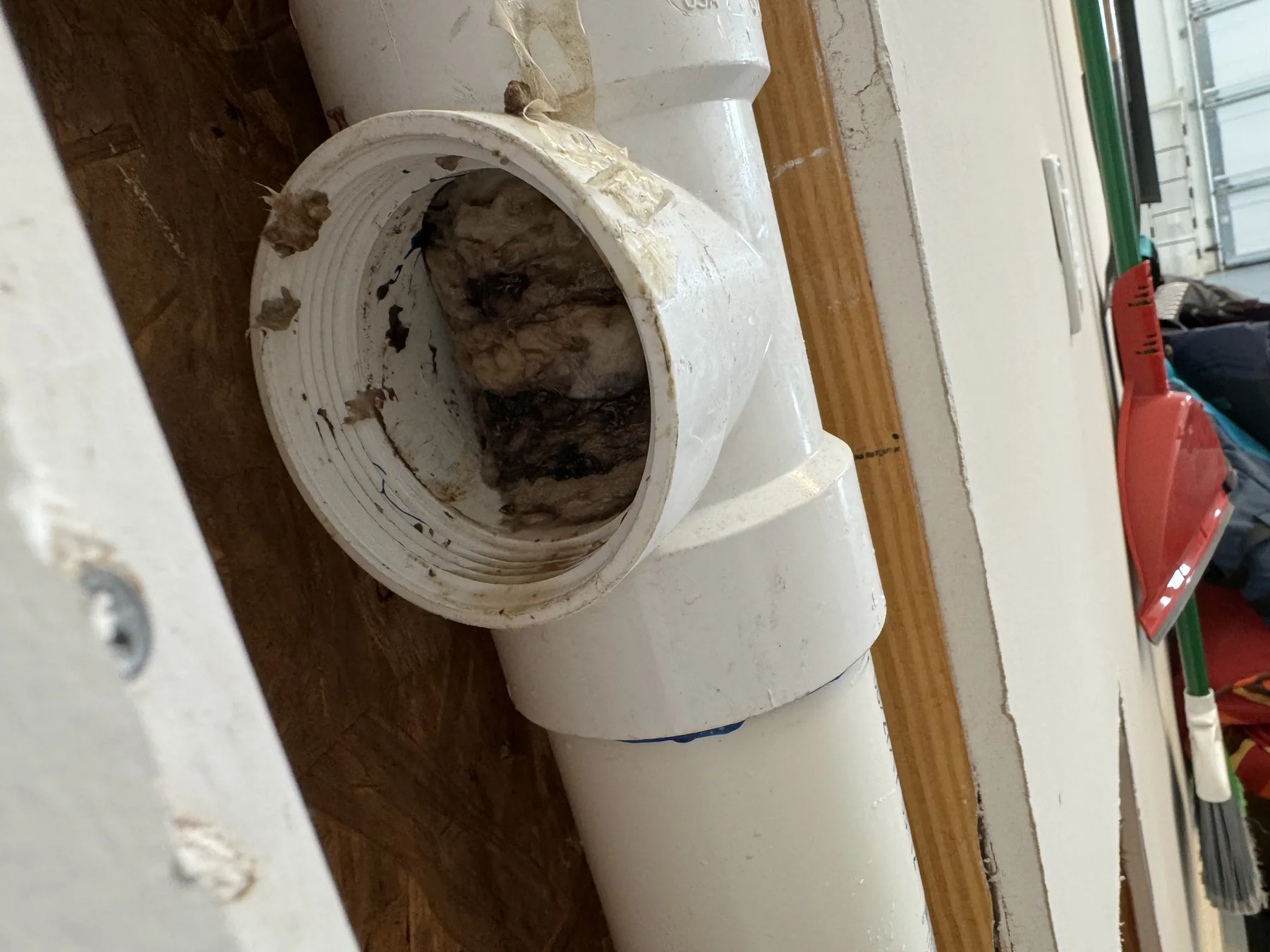
A short, plain sign in each bathroom helps more than owners expect. So does a lidded wastebasket right beside every toilet, so guests have somewhere else to put things. If the camera shows a line packed like this one and no damage behind it, clearing it and changing the habit is the whole job.
Fixing one section or replacing the run
When the camera does find damage, the real question is how much of the line is involved. A single failed joint, one cracked length, or roots getting in at one spot can often be repaired on its own, with the opening sized to that section and the good pipe left alone.
Old cast iron changes the math. It tends to rot along the bottom, where the water runs, so the top of the pipe looks sound while the floor of it is thin or gone, and roots work their way into the gaps. One bad spot in a run like that usually means more along the same length. Our post on cast iron rotting from the bottom shows what that looks like on camera and in the ground.
So we watch the whole run before deciding. If one section has failed and the rest is solid, we fix the section. If the same wear repeats down the line, replacing the run costs you less than paying for one spot repair after another.
Your line, the building’s line, and the booking calendar
In a multi-unit building, the pipe carrying your unit’s waste may join a shared line within a few feet, or it may run on its own for a long way. Which part is yours to repair and which belongs to the building is set by the association documents, and they are worth reading before anybody opens a wall or a floor. We will show you on camera where your line meets the shared one, and you can take that to the association.
Timing matters as much as the repair. A sewer repair on a rental has to fit between checkout and the next arrival, cleanup and restoration included. Mention the next changeover when you call. We plan the work to that window where we can, and if a job genuinely will not fit, we say so straight away so you can move a booking. Our sewer line repair in Miramar Beach is built around that kind of planning, and the sewer line repair page covers the methods. If the supply side is leaking too, see our repiping page.
Sewer line questions we get
Can drain cleaning fix a slow main line for good?
If the camera shows a soft blockage in a sound pipe, cleaning it out can be the whole fix, and it lasts if whatever caused it stops too. If the camera shows roots, a sag or a broken section, cleaning only buys time. The blockage comes back because the damage that catches debris is still sitting there in the line.
Why does the tub gurgle when the toilet flushes?
The water from the toilet is trying to get down a main line that is partly blocked, and it pushes air back up through the nearest open drain, which is often the tub. One gurgle now and then can be a venting issue. Gurgling every time a toilet flushes, along with slow drains elsewhere, points at the main line.
Should guests keep using the unit while the sewer line is slow?
If water or sewage is coming up into a tub or a floor drain, no. Every flush and shower adds to the backup, and it can end up on the floor. If everything is only draining slowly, light use until a booked visit is usually fine, but call before the next full group arrives, since a full house is when a weak line gives out.
Slow everywhere means look at the main. Get it on camera, find out whose pipe it is, fix what is broken and leave what is sound, and plan the work around the next check-in. Most of these calls end in a smaller job than the owner feared.
Every drain backing up at once?
Call 850-318-5777 and tell us which fixtures are slow and when the next guests arrive, or send a note and we will get a camera down the line.