
Cast iron drain pipe rots from the bottom up, so the part you can see looks fine long after the part you cannot see has gone. A camera settles it.
If your house in Niceville, Valparaiso, DeFuniak Springs, or one of the older streets around Grayton Beach was built somewhere between the 1950s and the early 1980s, your drain, waste, and vent lines are very likely cast iron. It was the standard for decades and there were good reasons for it. It is strong, it is quiet, and it does not care about heat.
It also has a design life, generally reckoned at somewhere around fifty to seventy five years. Do that arithmetic against a house built in 1968 and you land in the present, which is precisely why we are having more of these conversations than we used to.
The way cast iron fails is specific, and understanding it explains why so many homeowners are blindsided by it.
Rot starts at the bottom, where nobody looks
A horizontal drain line is not full of water. Waste flows along the bottom of the pipe and air moves above it. That means the bottom of the pipe is wet essentially all the time, and the top is not.
Wastewater is not neutral. Bacteria in a sewer line produce hydrogen sulfide gas, and where that gas meets moisture and oxygen on the pipe wall, it converts into sulfuric acid. That acid attacks the iron. The process concentrates exactly where the moisture is constant, which is the bottom third of the pipe.
The top of a cast iron pipe can look completely sound while the bottom of the same pipe has corroded away entirely.
That is bottom rot, and it is why an inspection based on looking at exposed pipe is worthless. Somebody crawls under a house or looks at a stub in a wall, sees intact cast iron, and pronounces it fine. They looked at the top. The channel underneath may have been gone for years.
Once the bottom is open, waste water does not stay in the pipe. It goes into the soil under the slab, and it carries fine material away with it as it goes. Over enough time that erodes the support the slab was built on. This is how a drain problem quietly becomes a structural one, and it is the reason we take an old cast iron system seriously even when the homeowner has not noticed anything dramatic yet.
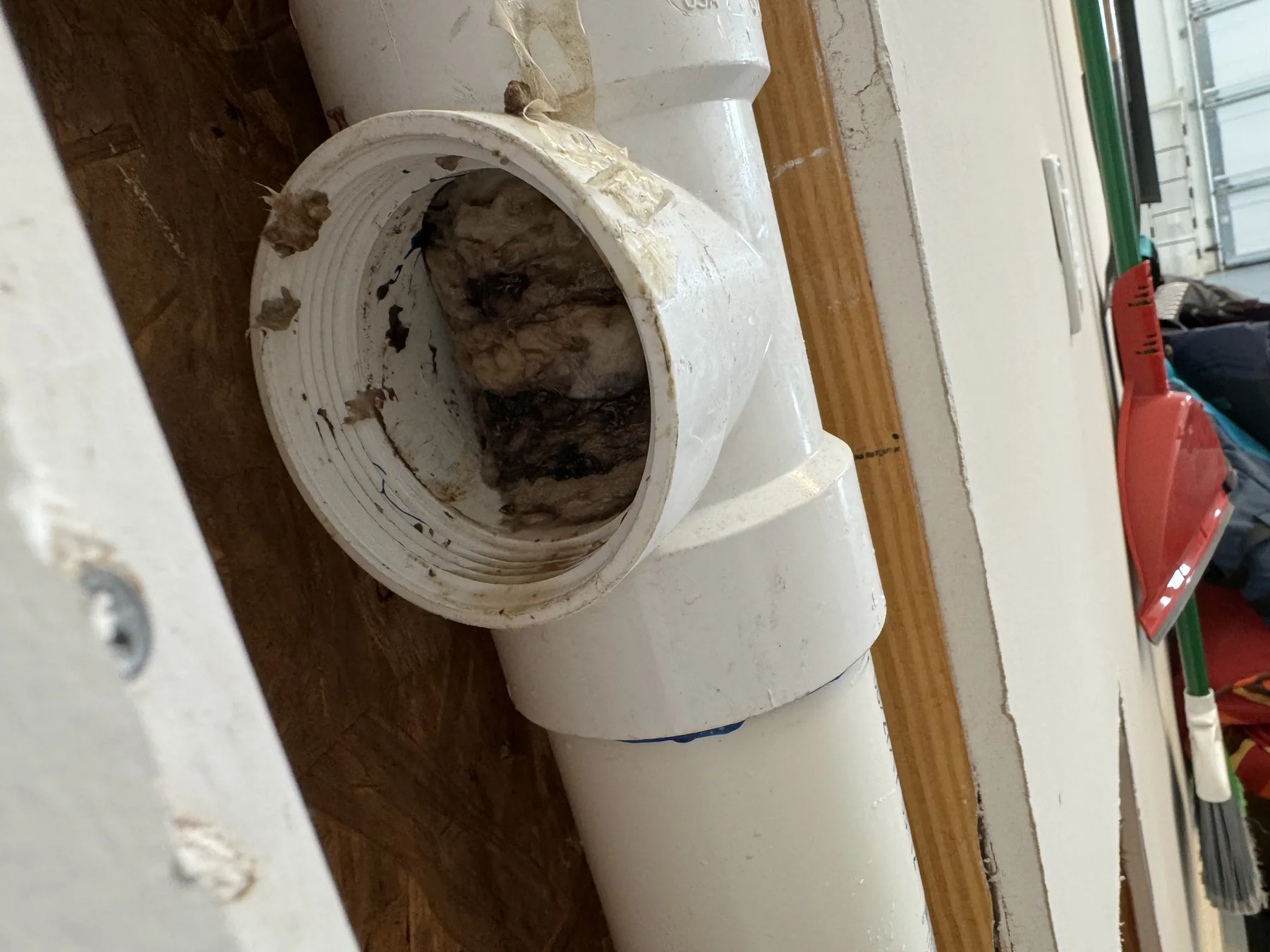
What you notice, in roughly the order you notice it
- Drains that run slower and slower over years, gradually enough that the household adjusts without registering it.
- Recurring backups in the same fixture, usually the lowest drain in the house, that come back within months of every clearing.
- A sewer smell in the yard or inside, particularly after rain, which can mean waste is escaping the pipe rather than moving through it.
- Rust-colored or dark flakes appearing in a tub or floor drain, which is pipe wall material coming loose.
- Cracked tile or an uneven, dipping section of floor over a drain line run, which can mean the soil underneath has washed out.
- Roots coming through at a joint outside, because roots find any opening in a compromised line.
The recurring backup is the one that ought to get your attention. A clog that comes back to the same place repeatedly is not bad luck. Cast iron corrodes inward with a rough, scaled interior that catches everything passing through it. Once that surface is established, clearing the line removes the current blockage but leaves the surface that created it. Six months later you are calling again.
A camera is the only honest diagnosis
There is no substitute here. A sewer camera on a flexible push rod goes into the line through a cleanout and travels the run, sending back video of the actual interior. It shows you what condition the pipe is in, where the bad sections are, how far along the run they are, and whether there is a full break or a partial loss.
That last part is the difference between a real conversation and a sales pitch. A camera inspection produces a location and a condition. It might tell you that fifteen feet of the run under the kitchen is gone and the rest is serviceable, which is a targeted repair. It might tell you the whole system is scaled down to half its diameter, which is a different conversation. Either way you are looking at footage instead of taking somebody’s word for it.
Nobody should be quoting you a whole-house repipe on a cast iron system without putting a camera in it first.
We say that plainly because it happens. Cast iron replacement is a large job, and a large job quoted from an educated guess is how people end up paying to replace pipe that had years left in it. Noah started this company specifically because of that pattern.
What the options actually are
When the camera says something has to be done, the paths look like this.
Spot replacement addresses the failed section and leaves the rest. When the camera shows a clearly localized failure and the rest of the run is in reasonable shape, this is the sensible move. It usually means opening the slab in one area or excavating one section of yard.
Full replacement of the under-slab drain system means removing what is there and running new pipe, typically PVC, which does not corrode. It is the biggest version of this job and it is the right answer when the camera shows a system that is uniformly at the end. Whether it makes sense depends on how long you plan to be in the house and what the footage actually shows.
Trenchless lining is worth asking about in some situations. It creates a new pipe inside the old one without excavating the whole run. It suits some geometries better than others and it is not a fit for every failure, particularly where the bottom of the pipe is fully gone and there is nothing left to line against. It is a genuine option in the right conditions and we will tell you honestly when your conditions are not right for it.
What to do if your house is the right age
If your house was built in that window and nobody has ever put a camera in the lines, that is worth doing before something forces the issue. An inspection with no problems found is genuinely good news and it establishes a baseline. An inspection that finds early deterioration gives you time to plan rather than deciding under pressure with sewage in the tub.
It is also worth doing before you buy. A general home inspection typically does not include a sewer camera, so a buyer can close on an older house with no idea what is under the slab. That is a real gap and it is a cheap one to close.
We camera and repair drain lines across Niceville, Valparaiso, DeFuniak Springs, Freeport, Point Washington, Ponce de Leon, and the older stock along 30A. If your drains keep backing up in the same place, call 850-318-5777 and let us look inside the pipe before anybody talks about replacing it.
Questions
How do I know if my house has cast iron drains?
Age is the strongest indicator. Houses built roughly between the 1950s and the early 1980s were overwhelmingly plumbed with cast iron DWV. If you can see exposed drain pipe in a garage or utility area, cast iron is dark grey, heavy, and rings dully when tapped rather than sounding hollow like plastic. A camera inspection confirms it and tells you the condition at the same time.
Can bottom rot be seen without a camera?
Not reliably, and this is the whole trap. The corrosion concentrates on the underside of the pipe where waste sits constantly, so the top of a pipe can look completely sound while the bottom has already opened up. Any inspection based on looking at the outside of exposed pipe is examining the part that fails last.
Do I have to replace the whole system if part of it is bad?
Not necessarily, and that depends entirely on what the camera shows. A localized failure with the rest of the run in decent shape is a targeted repair. A system that is uniformly scaled and deteriorated across its length is a different conversation. Anybody quoting a full replacement without footage is guessing.
Is a slow drain always a cast iron problem in an older house?
No, and it is worth checking the simple causes first. A single slow fixture is usually local. What points at the pipe itself is a pattern: multiple fixtures slowing over years, or the same drain backing up repeatedly within months of each clearing. That pattern says the interior surface of the pipe is catching everything that passes.
Something not right at your place?
Call 850-318-5777 any hour and describe what it is doing, or send it in writing. We diagnose before we quote, every time.