
Your AC pulls gallons of water out of the air every day and sends it down a drain line that never gets a chance to dry out. That is exactly the environment algae likes.
Here is something most homeowners never picture: your air conditioner is a dehumidifier that happens to also cool the house. On a humid August afternoon in Walton County, an average residential system can pull several gallons of water out of the air in a day. That water condenses on the cold evaporator coil, drips into a pan under it, and leaves through a small PVC drain line.
That line is where a large share of our summer service calls come from. Not the compressor, not the refrigerant, not the thermostat. A piece of white plastic pipe about the width of your thumb.
The reason it clogs here so much more than it does in a dry climate is worth understanding, because once you understand it, the fix and the prevention both make obvious sense.
The line never gets to dry out
In a place with a real spring and fall, an air conditioner runs in bursts. It cools, it shuts off, it sits idle for hours, and the drain line dries between cycles. Dry plastic does not grow anything.
From April to October our dew points run in the high 60s and low 70s, which means the air is loaded with moisture nearly around the clock. Systems here run close to continuously through those months. The drain line is permanently damp, permanently dark, and sitting at a comfortable temperature. That is a growing environment. Algae, mold, and mildew colonize the inside of the pipe and build up into a slimy plug that eventually stops water from moving.
A condensate line clog is a biology problem before it is a plumbing problem, and it happens here because the pipe never dries.
Add the dust and the fine debris that gets past a filter and settles in the pan, and the growth has something to bind to. That is the mechanism. It is not neglect and it is not a defective system. It is what our climate does to a wet pipe.
What you notice when it happens
The symptoms depend entirely on whether your system has a safety float switch, and most modern ones do.
- The AC shuts itself off and will not restart, with no obvious reason and the thermostat still calling for cooling. That is a float switch doing its job.
- Water on the floor or in the emergency pan around the air handler, usually in a closet, attic, or garage.
- A brown or tan stain spreading on a ceiling below an attic unit, sometimes with the drywall starting to sag.
- Water dripping steadily from the secondary drain outlet outside, often above a window. That outlet exists specifically to tell you the primary line is blocked.
- A musty smell near the return or in the room with the air handler.
- Higher indoor humidity even though the system is running and the house feels cool but clammy.
That fourth one deserves a note. If you have ever seen water dripping from a small pipe stub high on an exterior wall and assumed it was normal, it is not. That is the overflow. The house is telling you the primary drain has stopped working, and it is doing it in the least destructive way available.
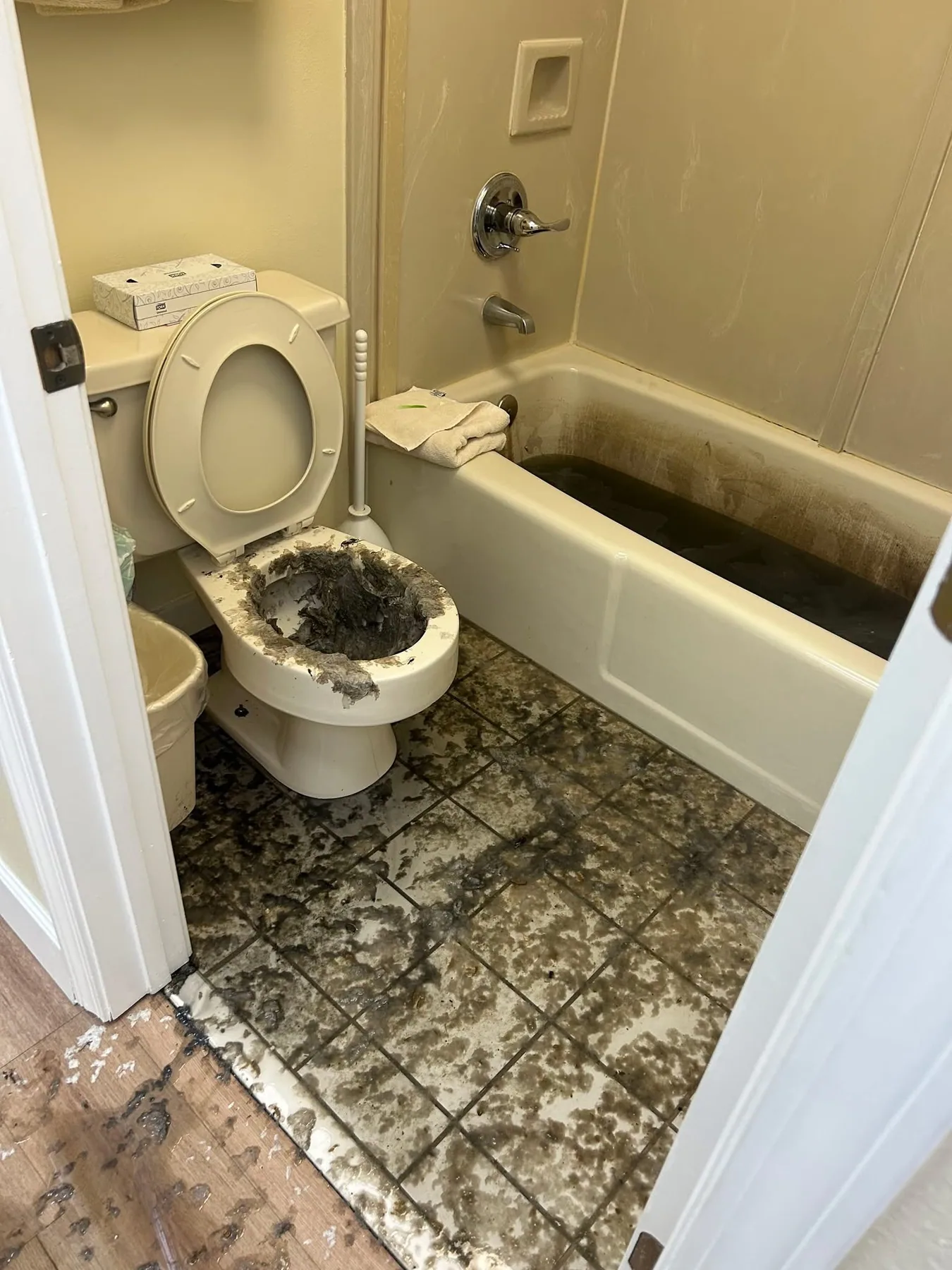
The float switch is a feature, not a failure
When a homeowner calls and says the AC quit for no reason during the hottest week of the year, a tripped condensate float is one of the first things we check. People are often frustrated that the system shut itself down. It is genuinely the best outcome available.
Without that switch, a blocked line means the pan overflows and the water goes wherever gravity takes it. In an attic installation, that is straight through a ceiling. The float switch trades an uncomfortable afternoon for not replacing drywall, insulation, and whatever was underneath. It is doing you a favor.
The seasonal habit that prevents most of this
Before cooling season really gets going, and again partway through the summer, flushing the line keeps the growth from establishing. Most residential systems have an accessible cleanout, typically a capped tee near the air handler.
Distilled white vinegar poured slowly into that cleanout is the common approach, and it works because the acidity discourages biological growth without attacking the PVC or the metal in the pan. Give it time to sit before running water behind it. Bleach is sometimes recommended, and we would rather you did not, because it is hard on the pan and on anything metal it reaches, and in a system with a condensate pump it is hard on the pump too.
A wet/dry vacuum at the outdoor termination is the other half of the routine. Sealing it around the pipe and pulling for a minute or two will draw out a surprising amount of material. If the vacuum brings back a plug of dark slime, that was your clog and it was well on its way to shutting you down in July.
Two flushes a season is a ten minute habit that heads off most of the emergency calls we take in August.
When it has gone past a DIY flush
There is a point where clearing the line is not the problem anymore. Get it looked at when:
- You flush it and the water backs up in the cleanout instead of going down, which means the blockage is solid and further along the line.
- You clear it and it clogs again within weeks, which usually means a slope problem, a sagging section of line, or a trap that is holding standing water.
- There is already a ceiling stain, because water has been in the assembly for a while and you need to know how far it went.
- The system is short cycling or the float keeps tripping after the line is confirmed clear.
- The drain pan itself is rusted or cracked, which no amount of line clearing fixes.
That second one is the most useful diagnostic on the list. A line that clogs repeatedly is telling you something about how it was installed. Condensate lines drain by gravity, so they need consistent fall the whole way. A section that sags, or a run that was pitched wrong when the unit was put in, creates a low spot where water sits permanently and growth restarts immediately after every cleaning. Repeatedly clearing that line is a subscription. Correcting the pitch ends it.
Both trades, one visit
Condensate problems sit right on the line between plumbing and HVAC, which is why they turn into two contractors and two waits for a lot of people. Noah holds both the plumbing and the mechanical certification, so a drain line dumping into a ceiling gets diagnosed and corrected by the same person on the same visit.
Condensate line clearing is part of what should happen on a real maintenance visit, along with the coil cleaning and the electrical checks. If you would rather it just get handled twice a year without you thinking about it, the plan rates are published on our pricing page so you can read them before anybody comes out.
We work these calls across Freeport, Santa Rosa Beach, Miramar Beach, Destin, Niceville, and the 30A towns. If your AC just shut itself off and there is water where it should not be, call 850-318-5777.
Questions
My AC shut off by itself and there is water near the air handler. Same problem?
Almost certainly. A safety float switch senses water rising in the drain pan and cuts the system so the pan cannot overflow into your ceiling. Clearing the blockage and draining the pan usually brings it right back. If it trips again after the line is confirmed clear, something else is going on.
Can I use bleach instead of vinegar?
We would rather you did not. Bleach is corrosive to the drain pan, to any metal it contacts, and to a condensate pump if you have one. Distilled white vinegar handles the biological growth without doing that damage, and it is what we use.
How often should the line be flushed?
Twice through the cooling season works for most homes here, once before the season really starts and once around the midpoint. Homes with pets or heavier dust loads sometimes want a third. Because our systems run nearly continuously April through October, this is a much bigger deal locally than it is in a dry climate.
Why does mine keep clogging even though I clean it?
That pattern usually points at the slope of the line rather than the cleaning. Condensate drains by gravity and needs consistent fall the whole run. A sagging section or a low spot holds standing water permanently, so growth restarts as soon as you finish. Correcting the pitch is what actually ends it.
Something not right at your place?
Call 850-318-5777 any hour and describe what it is doing, or send it in writing. We diagnose before we quote, every time.