
Nobody Thinks About the Roof Until It Stops Cooling
Service, repair and replacement for packaged rooftop units, including the corrosion problem that comes with putting equipment on a roof near the Gulf.

A packaged rooftop unit puts everything in one cabinet: compressor, condenser, evaporator, blower and often the heat, all sitting on a curb over a roof penetration with duct running down into the building. It is an efficient way to condition commercial space, and it has one significant drawback, which is that it lives outdoors in full weather for its entire life.
Out of sight is the real issue. An RTU on a flat roof gets no attention because nobody walks past it. The filters do not get changed on the schedule the office equipment does, the drain pan does not get looked at, and the corrosion happening on the coil is invisible from the parking lot. So the first symptom of most rooftop problems is the space getting hot, which by then means a component has already failed.
We service, repair and replace packaged units across the Emerald Coast, and a good share of that work is preventing the failure rather than responding to it. Getting on the roof twice a year to clean coils, check the drain, read the electrical and look at the cabinet is what keeps an RTU from becoming an emergency during your busiest month.
What a Failing Rooftop Unit Shows You
- The space getting warm in the afternoon and recovering overnight
- A breaker or disconnect that has to be reset to get the unit running
- Rust streaking down the cabinet or blistering on the base rail
- Water showing up on a ceiling tile directly under the roof curb
- The unit running but the air at the diffusers not feeling cold
- New noise from the roof: grinding, screeching, or a rattle that was not there
- Bent, packed or corroded condenser fins visible on the coil face
Equipment you never walk past is equipment that fails without warning you first.
The Coastal Rooftop Problem
Salt is the defining factor near the Gulf. Salt-laden air settles on the condenser coil and the cabinet, and it does two separate kinds of damage. It corrodes aluminum fins and copper tubing, which is how pinhole refrigerant leaks start, and it builds a fouling layer that blocks heat transfer so the unit runs longer and hotter to do the same work. Units in Miramar Beach, Seagrove Beach, Inlet Beach and Panama City Beach take this constantly, from every direction, with nothing shading them.
Water is the second. The curb, its flashing, and the condensate path are all opportunities for water to get into the building. Wind-driven rain here comes sideways, and a curb that was adapted poorly during a previous changeout will let water past. Meanwhile the condensate side runs almost continuously through our long humid season, so the pan and drain never dry out and biological growth blocks them. Water on a ceiling tile under an RTU is usually one of those two things.
Then there is heat and runtime. A dark flat roof in July is a brutal place for a condenser to reject heat, and the unit is asked to do it for twelve or more hours a day for most of the year. Contactors, capacitors, belts and bearings all wear on a runtime clock, and rooftop equipment runs that clock harder than anything at ground level.
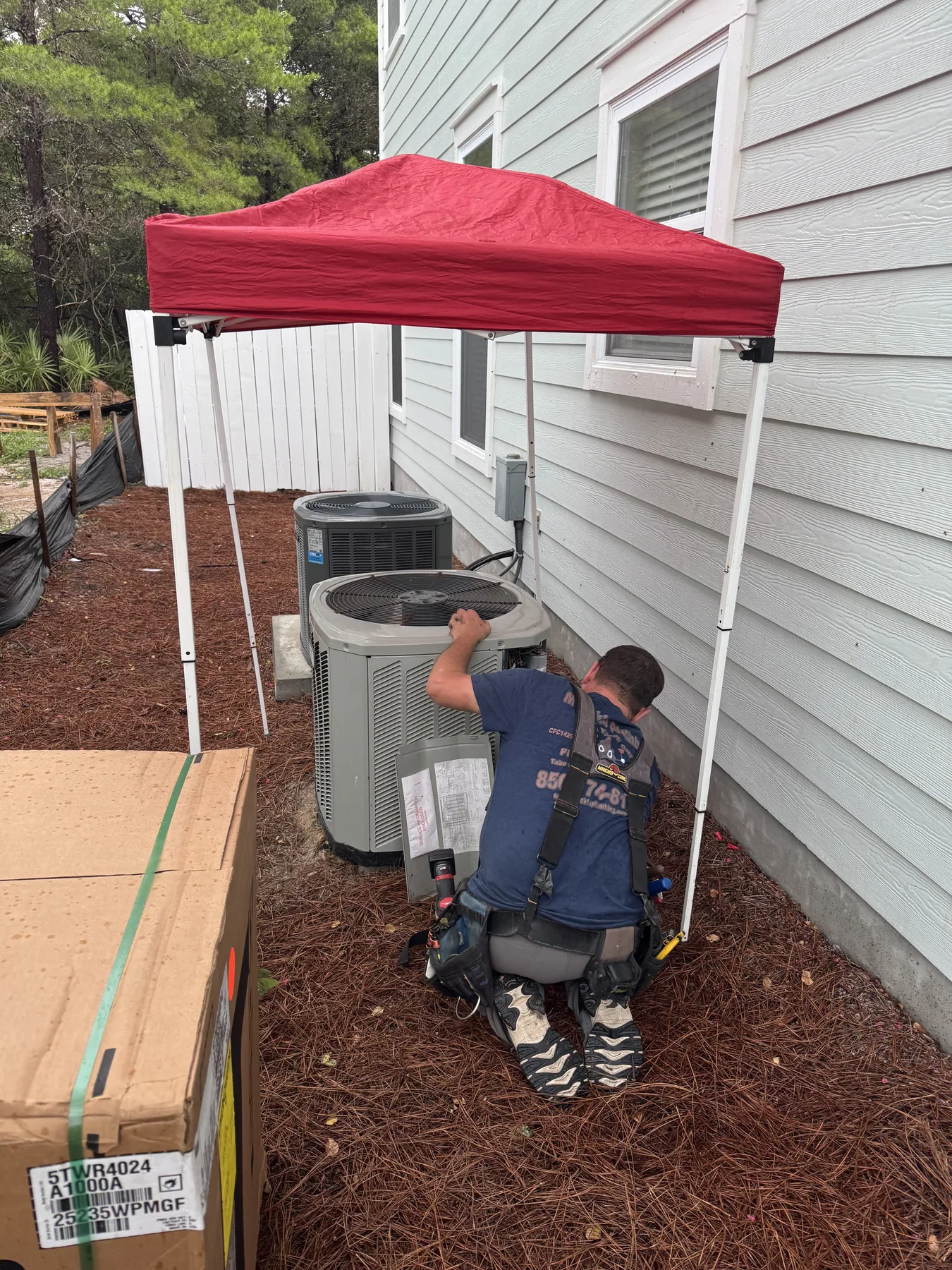
Salt-corroded condenser fins on a packaged rooftop unit a few blocks from the Gulf.
Commercial work
Rooftop unit struggling, leaking, or tripping its breaker? Call 850-318-5777 and we will get up there and tell you what it takes.
- Answered 24 hours, 7 days
- Licensed CFC1429646 and CMC1250426
- Repair first, always
Maintenance plan visits come with a written condition report and photos.
Working on Rooftop Equipment
- Get on the roof safely
Access is planned first: how we get up, where equipment stages, and what your roof warranty allows. We do not improvise this part.
- Read the unit before touching it
Electrical, refrigerant pressures, temperature split and airflow measured while it runs, so the diagnosis is based on what the unit is actually doing.
- Inspect what corrodes
Coil face and fin condition, cabinet and base rail, disconnect and contactor terminals, curb and flashing. This is where coastal units fail first.
- Clear the water path
Pan, primary and secondary drain, and trap. This is the failure that shows up as a ceiling stain and it is entirely preventable.
- Repair or lay out replacement
If it is a wear part we fix it. If the unit is genuinely done, we tell you what replacement takes, including the crane and the access window.
- Document the visit
Readings, photos and the condition of the cabinet and coil, so you can track how the equipment is trending year over year.
Rooftop Units From Freeport to the Beach
The closer to the water, the harder the equipment lives. Rooftop units on restaurants, retail and hospitality buildings in Seaside, Grayton Beach, Inlet Beach, Miramar Beach, Destin and Panama City Beach see salt exposure that inland equipment simply does not, and freshwater coil rinsing between services makes a real difference. We will show your maintenance staff how to do it correctly, since it costs you nothing but a hose.
Replacement in these towns is a logistics job as much as a mechanical one. Setting a packaged unit in a tight commercial district means a crane window, street coordination and often a pre-dawn start. We plan that before the equipment ships. Inland, in Freeport, DeFuniak Springs, Niceville and Vernon, access is easier but units still need the same drain and electrical attention, because the humidity that clogs a condensate line does not stop at the county line.
Beach-side calls take us to Santa Rosa Beach, Miramar Beach and Destin. Away from the beaches we’re in Freeport, Point Washington, Niceville, Valparaiso and Eglin Air Force Base, and farther up in Ebro, Vernon and Caryville. See the whole service area for more.
Questions we get about this
How often should a rooftop unit be serviced?
Twice a year is the sensible baseline, before cooling season and before heating season. Coastal units benefit from more frequent coil attention because of salt exposure, and we will tell you honestly what your specific equipment needs.
Can a corroded coil be repaired?
Sometimes a single leak can be repaired, but widespread fin corrosion is different because the damage is across the whole heat transfer surface. We show you the coil face and give you a straight assessment of whether repair buys you real time.
Does replacing an RTU need a crane?
Usually, yes. Packaged units are heavy and go on a roof, so a crane or a large lift is standard. On tight coastal streets that means a scheduled window and some coordination, which we arrange as part of the job.
Why is there water on the ceiling under the unit?
Almost always the condensate pan or drain, occasionally the curb flashing. In our humidity the drain never dries out and growth blocks it, so the pan overflows into the building. Both causes are worth finding quickly.
Will rinsing the coil actually help?
Yes, on coastal equipment it helps meaningfully. Freshwater rinsing carries salt off the fins before it corrodes them and before it builds an insulating layer. It is one of the few genuinely free things a building owner can do for their equipment.
Can you work on our unit if another company installed it?
Yes. Most rooftop equipment we service came with the building. What matters is whether parts are available and whether the unit is worth putting money into, and we will tell you both.
Related HVAC work
- Commercial HVAC System Diagnostics
- Commercial HVAC Service
- Commercial Air Balancing
- Commercial HVAC Cleaning
- Commercial Equipment Installation
- Commercial Duct Leakage Testing
- Commercial Duct Sealing
- Thermal Imaging
- Kitchen Ventilation
Every heating and cooling service we offer is on the HVAC page. If your system is doing something you can’t put a name to, call 850-318-5777 and describe the noise or the temperature. Past jobs are in the gallery, and the contact form works for anything that can wait.