
Measured Airflow, Documented Room by Room
Before anybody adjusts a damper, somebody should measure. This is the instrumented reading and the written report that tells you what the system is actually delivering.
An air balancing analysis is measurement, not repair. We put instruments on the system and record what it is genuinely doing: cubic feet per minute at each supply register, return airflow, external static pressure across the air handler, temperature split across the coil, and how those numbers compare to what the equipment and the ductwork were designed to move. The output is a document, not a guess.
That distinction matters more than it sounds. Plenty of comfort complaints get solved by adjusting dampers, and plenty get blamed on the wrong thing entirely. Static pressure that reads high tells you the system is fighting a restriction. A return that cannot pull enough air tells you the problem is upstream of every register in the house. Numbers separate those cases in an afternoon.
Owners, builders and property managers ask for this work for a few different reasons. Some want verification that a newly installed system performs the way the design says. Some are trying to settle an argument about whether a system is undersized. Some just want documentation in hand before they spend money. All three are legitimate, and all three get the same instrumented treatment.
When Numbers Are Worth Having
- A new system was installed and nobody ever verified the airflow against the design
- Two contractors have given you two different explanations for the same uncomfortable room
- You are about to spend real money and want data before you commit to it
- A commercial space has occupants complaining in some zones and not others
- Utility bills climbed with no change in habits or equipment
- You need documentation of system performance for a builder, an inspection or a warranty claim
Adjusting airflow without measuring it first is just moving the complaint to a different room.
What the Readings Reveal
External static pressure is the single most telling number we take. It is the resistance the blower is pushing against, and when it reads well above what the equipment was rated for, the system is straining. That points at a restricted return, an undersized filter grille, crushed flex, or a coil that needs attention. A blower fighting high static moves less air everywhere, so no amount of damper adjustment will rescue it.
Register by register CFM readings tell the other half of the story. When total delivered airflow is close to design but distributed wrong, balancing solves it. When total delivered airflow is far short of design, the ductwork or the return side is the problem, and a report that says so saves you from paying for corrective work that was never going to help.
In Northwest Florida we take one more reading seriously, and that is the temperature and moisture behavior across the coil. Our summer dew points run high, so a system moving too much air across the coil will hit the thermostat setpoint while leaving the house clammy, and a system moving too little will freeze up. Duct running through a hot Freeport attic changes the delivered temperature between the plenum and the register, and that difference shows up in the measurements where guesswork would miss it entirely.
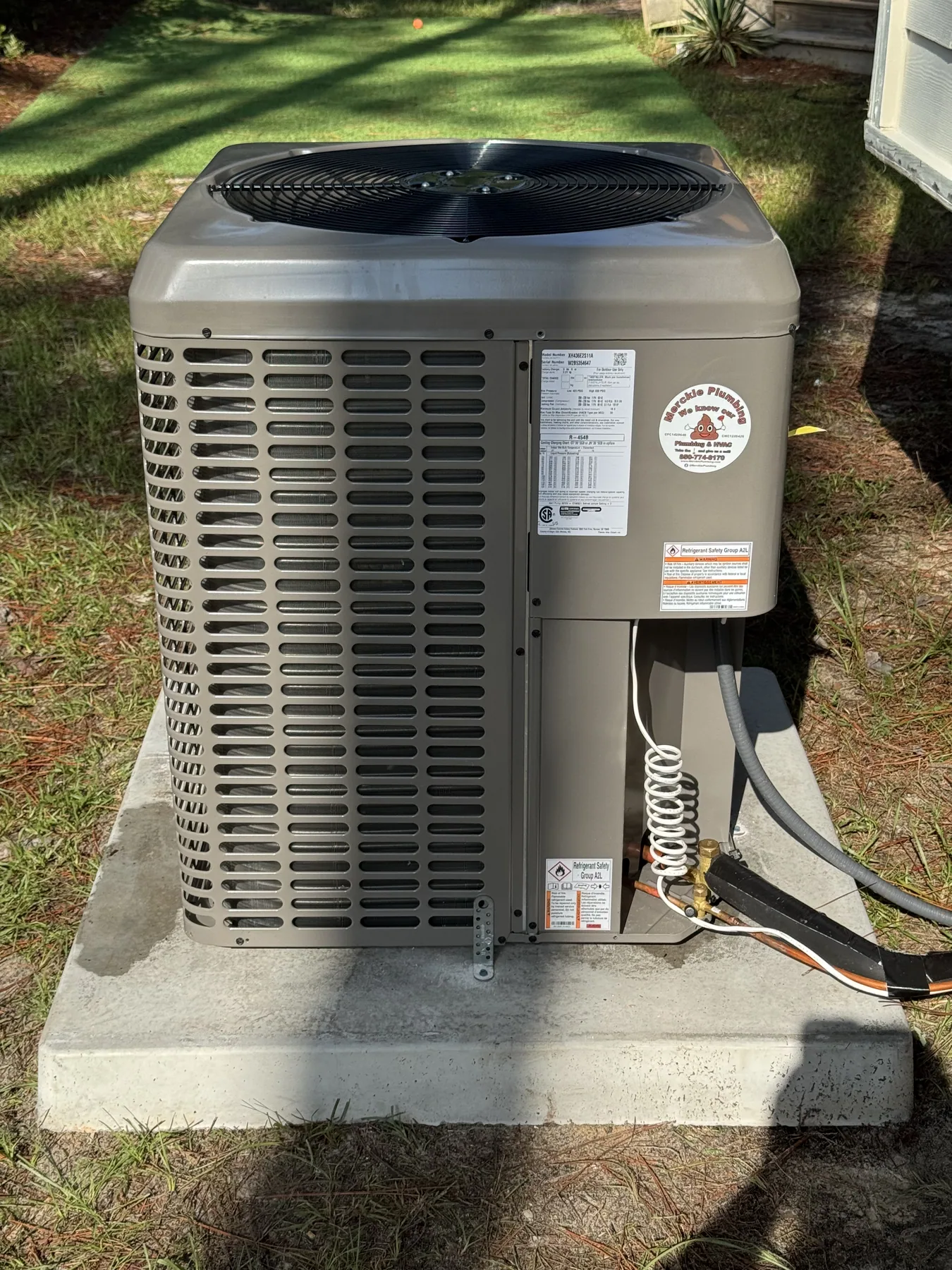
Taking a static pressure reading at the air handler before recording register airflow through the rest of the house.
Get it looked at
You get instrument readings, photographs and a written report you can hand to anybody. Call 850-318-5777 and we will schedule the measurement.
- Answered 24 hours, 7 days
- Licensed CFC1429646 and CMC1250426
- Repair first, always
Prices for every maintenance plan are posted, so you know the cost before booking.
What the Analysis Involves
- Document the system as found
Equipment model and rated capacity, filter type and condition, duct layout, damper positions. The report starts with the baseline so the numbers have context.
- Measure static pressure
Readings on the supply and return side of the air handler establish how hard the blower is working and whether a restriction exists.
- Take CFM at every register
A calibrated hood or anemometer reading at each supply and return, room by room, recorded rather than remembered.
- Check the coil performance
Temperature split and moisture removal across the evaporator, which tells us whether the airflow suits the equipment and our climate.
- Compare against design
Measured values go next to what the equipment and the room loads call for. The gaps are where the problem lives.
- Deliver the written report
You get the readings, photos, our reading of what they mean, and a plain description of what corrective work would involve.
Verification Work Around the Emerald Coast
New construction verification comes up regularly in Freeport, Santa Rosa Beach, Inlet Beach and the 30A communities, where a lot of houses are built and handed over quickly. A documented set of readings at handover is how an owner knows the system was commissioned rather than merely turned on.
Commercial and multi unit analysis takes us to Destin, Miramar Beach, Niceville, Valparaiso, Eglin Air Force Base and Panama City Beach, plus DeFuniak Springs and the Washington and Holmes county towns like Vernon, Ebro and Ponce de Leon. Merckle holds mechanical contractor license CMC1250426. Call 850-318-5777 to book a visit.
Towns we get to most: Freeport, Santa Rosa Beach, Point Washington, Miramar Beach, Niceville, Destin, Eglin Air Force Base, Valparaiso, Ebro, Vernon, Caryville. See the full service area.
Questions we get about this
How is this different from air balancing?
Analysis measures and documents. Balancing is the corrective work of adjusting dampers and registers afterward. Some jobs need only the analysis, because the report shows the real problem is somewhere else entirely.
When both are wanted, the analysis comes first, since adjusting airflow without a baseline gives you no way to prove the adjustment worked.
What do I actually receive?
A written report with the measured CFM at each register, supply and return static pressure, temperature and humidity readings across the coil, photographs of the equipment and duct conditions, and our plain language reading of what the numbers mean.
Can you do this on a commercial building?
Yes. Offices, retail spaces, restaurants and multi unit buildings all get the same instrumented treatment, zone by zone. Commercial work usually involves more measurement points and a longer report.
Is this useful on a brand new house?
Very. New systems get installed correctly far more often than they get commissioned correctly. Measuring at handover documents that the equipment performs to the design, and it gives you something concrete if it does not.
Will the report tell me to buy new equipment?
Only if the numbers say so, and we would rather they did not. The whole reason Noah started this company was to do honest diagnosis instead of selling replacements. Plenty of reports come back saying the equipment is fine and the ductwork needs attention.
How long does the measurement take?
A typical home takes a few hours on site, with the written report following. Larger commercial spaces take longer depending on the number of zones and diffusers. We will tell you what to expect when you book.
Related HVAC work
- Duct Leakage Testing
- Duct Sealing
- Mini-Split Installation
- Ductless Mini Splits
- HVAC Maintenance
- HVAC System Diagnostics
- Indoor Air Quality
- Emergency HVAC
- HVAC Repair
If the job you need isn’t on this page, the HVAC services list probably has it. You can also see the gallery, or call 850-318-5777 and tell us what’s going on. A short note works too if you’d rather not call.