
Noah started this company after too many years watching working equipment get quoted for replacement by people who never took a reading. Here is what we do instead.
I want to explain why this company exists, because it is not a complicated story and it shapes everything about how a call goes here.
I spent years in this trade watching technicians walk up to equipment, look at it, and tell a homeowner it needed to be replaced. No gauges. No meter. No reading of any kind. Just a look at the age on the label and a number on a page. Sometimes they were right by accident. Often they were not, and somebody who did not have it to spare spent thousands of dollars on equipment that had years left in it.
I wanted to have a higher quality service at an affordable price to my community. That is the whole reason, and Freeport is my community, so that is where I do it.
An opinion without a reading is a guess
Here is the thing about mechanical equipment: it tells you what is wrong with it if you have the instruments to listen. A compressor that is failing draws more current than it should, and that shows up on a meter well before it shows up as a hot house. A charge that is off shows up as a temperature split outside its range and as superheat and subcooling that do not match what they ought to. A capacitor that is weakening reads low against its rated microfarads. Duct problems show up as static pressure.
None of that is visible. All of it is measurable. So when somebody says a system needs replacing, the fair question is what they measured, and if the answer is nothing, then what you have is not a diagnosis. It is a guess with a price attached.
Age on a label is not a diagnosis. A twelve year old system that is running within spec is a twelve year old system that is running within spec.
That goes for plumbing too. A water heater does not stop working because it turned ten. It stops working because an element failed, a thermostat drifted, a gas valve stuck, a thermocouple corroded, or the tank itself rusted through. Four of those five are parts. The fifth is the end of the road, and pulling the anode rod and looking at the tank tells you which one you are dealing with.
What we actually measure before saying anything
On an HVAC call that is not obvious, here is what comes off the truck before we form an opinion:
- Refrigerant pressures on both sides, with superheat and subcooling worked out from them, because that is how you verify a charge rather than assume it.
- Temperature split across the evaporator coil, air in versus air out.
- Amp draw at the compressor and the fan motors, compared to what the nameplate says they should be.
- Capacitor microfarad readings against rated value.
- Static pressure across the duct system, because a system fighting the ductwork looks exactly like a system with an equipment problem until you measure it.
- Contactor and electrical connection condition, since loose connections make heat and heat is what starts fires.
- On a heat pump, whether the reversing valve is shifting and whether the defrost control is cycling correctly.
Plumbing gets the same treatment in its own form. We do not open a wall until we have located the leak acoustically or thermally. We do not quote a drain line replacement without putting a camera in the pipe and showing you the footage. We do not condemn a grinder pump before opening the station and checking whether the floats are reading and the check valve is holding.
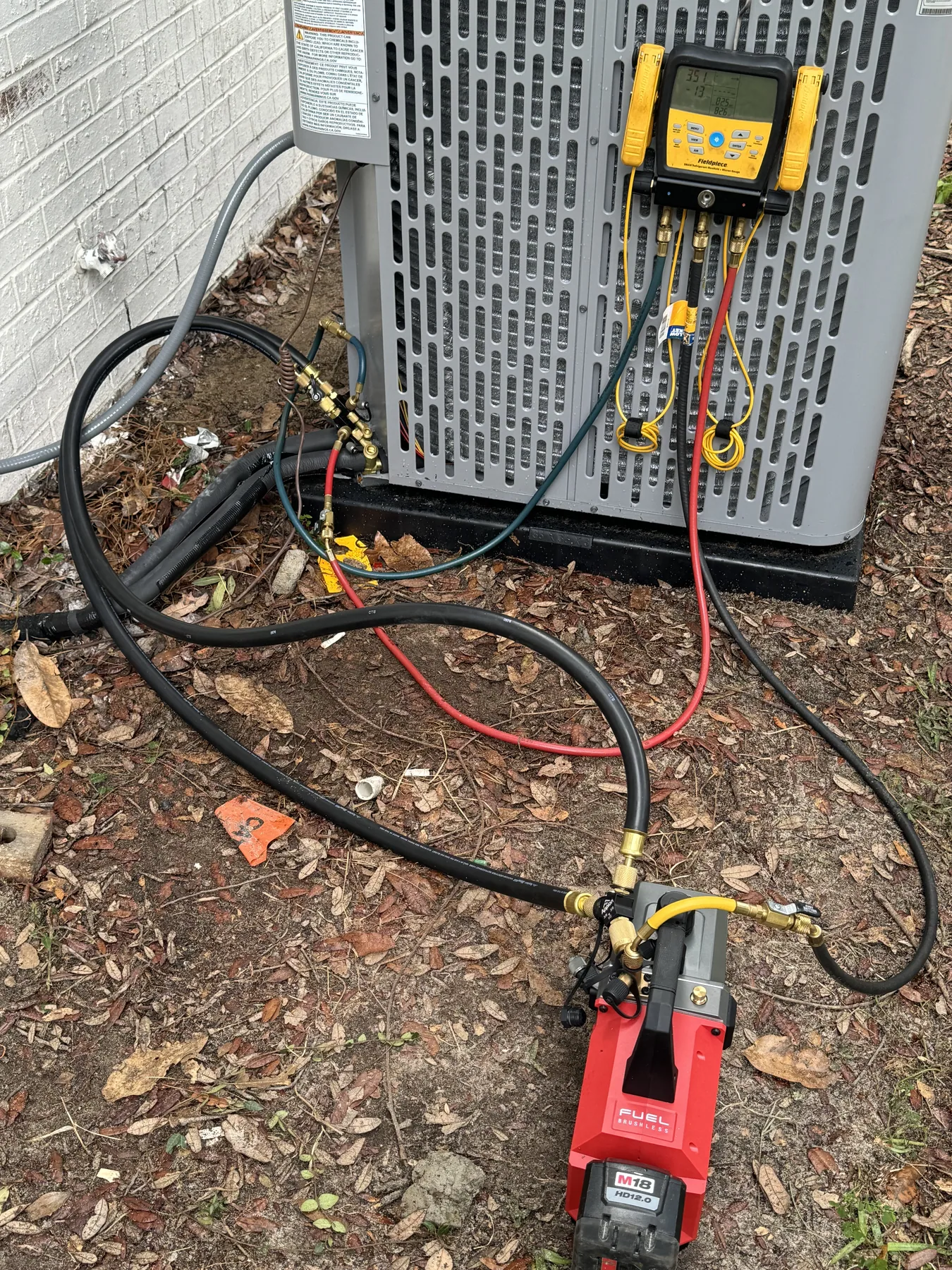
What an honest end-of-life conversation looks like
Sometimes equipment really is finished. That happens and pretending otherwise would be its own kind of dishonesty. A compressor with a grounded winding is done. A tank that has rusted through cannot be repaired. A cast iron line whose bottom is gone across its whole run is not getting patched. A heat exchanger with a crack is not something to negotiate with.
When that is where we land, you see how we got there. The meter reading, the camera footage, the pressures, the picture of what we found. Not because we are being defensive, but because you should be able to look at the same evidence we looked at and reach the same conclusion. If you cannot see why, we have not explained it well enough yet.
That is the part I care about most. Being knowledgeable and being the experts able to explain well and why that would need the service. If you walk away not understanding why the thing needed doing, then even if we were right, we did the job badly.
You should be able to see what we saw. If you cannot, we have not explained it well enough yet.
Why the maintenance prices are on the website
Our maintenance plan rates are published on the pricing page. Anyone can read them right now, without a phone call and without anybody coming to the house.
That is a deliberate choice and I will tell you exactly what it is about. In the version of this business I did not want to be part of, the number appears at the end. Somebody spends forty five minutes at your house building a case, walking you through what could go wrong, and then reveals the price when you are already worried. That works, which is why it is common. It is also a bad way to treat people.
Publishing the rates removes the whole dynamic. You decide with a clear head, at your kitchen table, without anybody standing there. If the number does not work for you, no visit happened and nobody wasted anybody’s time.
On repair work we tell you what it takes and what it costs before we start, at whatever hour you called. There is no after-hours premium game here. Nobody signs anything at three in the morning under pressure.
Why both licenses matter to you
I hold the state plumbing certification and the state mechanical certification, CFC1429646 and CMC1250426. That is unusual and it is genuinely useful to a homeowner, for a specific reason.
A lot of the problems in a Florida house sit exactly on the seam between the two trades. An AC condensate line dumping into a ceiling is an HVAC problem discharging through a plumbing drain. A gas line feeding both a water heater and a furnace is one line with two loads on it. Water heater venting overlaps both. When those are two contractors, each one can honestly point at the other, and the homeowner ends up in the middle paying for two visits and getting one answer.
Under one license holder it is one call, one truck, and one person who cannot pass the problem sideways.
What maintenance is supposed to be
A maintenance visit here is real preventative maintenance, not a sales call you paid for. The coil gets cleaned properly, which means somebody gets wet. The condensate line gets flushed and the float switch gets tested. The readings get taken and written down. You get a written condition report with photos of what was actually found.
That report is the point. One visit is a snapshot. Three visits is a trend, and a trend is how you see a failure coming with enough time to plan for it instead of deciding under pressure in August. Think of it like an oil change for your home. Nobody is thrilled about it, and it is much cheaper than the alternative.
We work Freeport, Santa Rosa Beach, Point Washington, Miramar Beach, the 30A towns, DeFuniak Springs, Niceville, Valparaiso, Destin, and out through Washington and Holmes counties. Somebody answers at any hour, and there is a 5% discount for seniors and military on the plans.
If something is not working right and you would rather understand it than be sold something, call 850-318-5777. Tell us what it is doing, and we will go find out why.
Questions
Does repair-first mean you will never recommend replacement?
No. Sometimes equipment is genuinely finished, and saying otherwise would be its own dishonesty. A grounded compressor winding, a rusted-through tank, a cracked heat exchanger. What repair-first means is that we take the readings before we form the opinion, and when replacement is the answer, you see the evidence that led there rather than being asked to take our word for it.
Why do you publish maintenance prices instead of quoting on site?
Because a price revealed at the end of a long visit is a sales technique, and it works on people who are already worried. Publishing the rates lets you decide at your own kitchen table with nobody standing there. Noah started this company partly to get away from the other version.
What does it matter that one person holds both licenses?
A lot of Florida house problems sit right on the line between the trades. A condensate line flooding a ceiling, a gas line serving both a water heater and heating equipment, water heater venting. With two contractors, each can honestly point at the other while the homeowner pays twice. With one license holder covering both, nobody can pass the problem sideways.
What do I get after a maintenance visit?
A written condition report with the actual readings on it and photos of what was found, not a verbal summary and a business card. The numbers matter because they let you compare year to year. Amp draw creeping up or a capacitor reading drifting down is how you see a failure coming while there is still time to plan for it.
Something not right at your place?
Call 850-318-5777 any hour and describe what it is doing, or send it in writing. We diagnose before we quote, every time.