
On a lot shaded by big trees, the sewer line is the one pipe the roots are actually looking for, and an older line rarely keeps them out forever.
Most lots around Point Washington carry heavy tree cover, with pines and hardwoods growing right up to the house. That shade is a big reason people choose to live here. Underground it is a different story. A sewer lateral carries warm water past roots all day long, and any joint or crack in an older line gives them a way in.
This is what we see on wooded lots around Point Washington, how it shows up inside the house, and what an owner can realistically do about the trees.
How roots get into a line that was tight when it went in
Roots do not force their way into a pipe, at least not at first. They grow toward moisture, and a sewer lateral gives a little of it off at every weak point: a joint that has shifted, a gasket that has aged, a hairline crack in an old section. Fine feeder roots slip through gaps you could barely see. Once inside, they find water and food moving past constantly, so they grow faster in the pipe than they ever would in the sand around it.
Over months those feeder roots thicken into a mat that spans the pipe. Paper and grease snag on it, and the mat catches more. The root also pushes the joint it came through a little wider as it grows, which makes the next root’s job easier.
Older laterals are the most exposed simply because they have more joints and more years of settling behind them. Sandy soil shifts, trees get bigger, and a line that was sealed when the house was built slowly opens up. A newer line in solid pipe with glued joints gives roots far fewer places to start.
The signs show up across the house
A clog under one sink is usually that sink. Roots in the lateral are different, because the lateral is the pipe every drain in the house empties into, so the clues tend to appear in more than one place.
- Several drains running slow in the same week, especially the lowest ones in the house.
- Gurgling from a tub or toilet when another fixture drains.
- A toilet that needs a second flush more often than it used to.
- A backup that clears with a plunger or a store cable and returns a few weeks later.
That last one is the sign owners talk themselves out of. It cleared, so it feels fixed. With roots, clearing it trims the mat and leaves the root sitting in the joint, and the mat grows back on its own schedule. A line that backs up on a pattern is telling you something about its condition.
The worst case is sewage coming up into a tub or shower. Stop running water and call that one in right away.
Why the camera goes in before anything else
We camera the line before deciding whether a call is a cleaning job or a repair, and on a wooded lot that order matters. A slow house can be roots. It can also be a belly where the line has sagged and holds water, a section that has broken apart, or an old buildup of grease and wipes that has nothing to do with trees. Each of those wants a different fix.
The camera goes in through a cleanout and shows the inside of the pipe on a screen. You see where the roots come in, how many joints are involved, and whether the pipe around them is still round and whole. We can also locate the trouble spot from above, so if digging is ever needed, it happens in one place instead of along the whole run.
It gives you something to look at yourself, too. You are not taking our word that the line is full of roots. You are watching it. A line that has separated can also leak into the soil, which is where our leak detection work in Point Washington picks up the thread.
When cleaning is enough and when it is not
Once roots are confirmed, there are two honest answers, and they do different things.
Cleaning cuts the roots back to the pipe wall with a cable machine, or scours them out with a water jetter. The line flows again, often very well. But the root that came through the joint is still alive, and the gap it used is still there. Depending on the tree and the pipe, the line may run fine for a long stretch or start slowing again within a season. Cleaning on a schedule is a reasonable plan for a line that is otherwise sound.
A repair takes away the way in, usually by replacing the damaged section with new pipe like the white PVC line in the trench below.
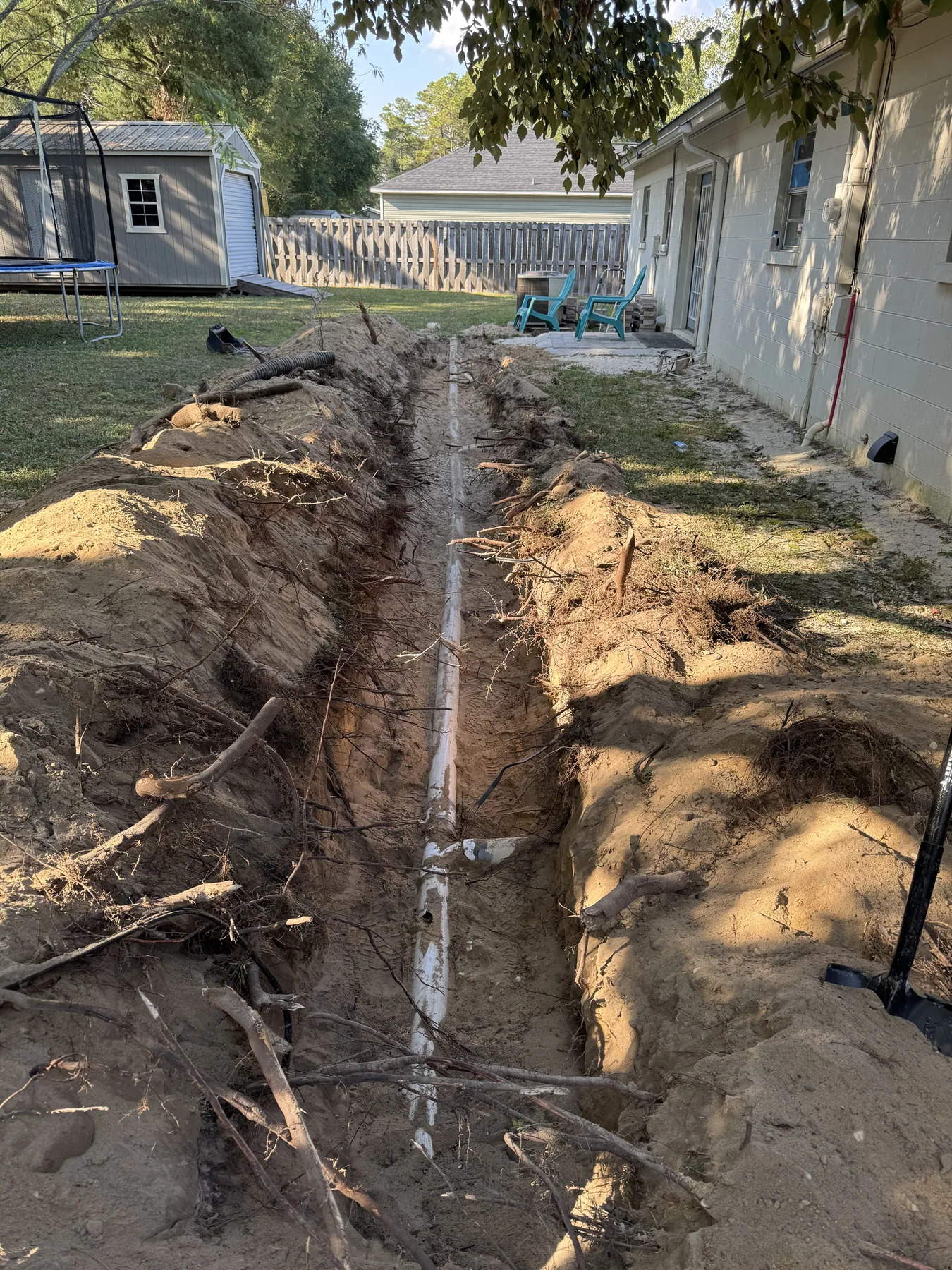
The camera decides which one fits. Round pipe with roots at a joint or two may only need cleaning for now. Cracked, sagging or separated pipe means another cleaning is paying to put off the same problem. Our drain cleaning in Point Washington covers both sides of that call.
What you can do about the trees near the line
Nobody here wants to cut down the shade to save a sewer line, and most of the time you do not have to.
Start by knowing where the line runs. It leaves the house near the main cleanout and heads toward the street, a septic tank, or on low bayside ground a grinder pump basin. If we have had a camera in it, we can mark the path. When you plant, keep new trees and large shrubs well off that route, and think about how wide the tree will be when it is grown, not how it looks in the pot.
For trees already in place, the pipe is where the effort pays. Keep wipes and grease out of the drains so a small root has less to catch. Some root treatments sold for sewer lines can slow regrowth after a cleaning, but nothing you pour closes a cracked joint. On a home with a grinder pump, ask us before sending chemicals toward the basin, and read our note on what not to flush on a grinder pump.
If a tree is already lifting the ground above the pipe, get a camera look before the roots settle the question for you.
Questions about roots in the line
Can roots get into PVC pipe?
They can, though far less often than into older clay or cast iron. PVC joints are glued, so roots usually get in where a joint has pulled apart, a fitting has cracked, or the line was disturbed when something was dug nearby. A camera shows which of those you are dealing with.
Can I pour a root killer down the drain instead?
Some products made for sewer lines can slow roots down for a while, used exactly as the label says. They are not a fix. A thick root mat will not dissolve fast enough to clear a backup, and nothing poured down a drain closes a broken joint. On a home with a grinder pump, check with us first.
Do I need to take the tree down?
Usually not. Most root problems get solved at the pipe, either by cleaning on a schedule or by repairing the section the roots use to get in. Taking down a mature tree does not repair a cracked line, and the roots already inside still have to be cleared. If you are planting new trees, keep them well away from the sewer line.
A shaded lot and an older sewer lateral can get along for a long time. Know where the line runs, pay attention when the whole house starts draining slow, and get a camera in the pipe before anybody starts digging or cutting trees.
Drains slowing down again?
Call 850-318-5777 and tell us which drains are slow and how often it keeps happening, or send a note and we will set up a camera visit.